Twelve-part bugaku and a rich tradition of sacred dances at three shrines
The Bugaku of Tōtōmi Mori

Festival information
EVENT INFORMATION- Season / frequency
- Typically, April and July
- Location
- Amamiya Shrine, Oguni Shrine, and Yamana Shrine
- Area
- Shizuoka Prefecture・Mori Town(From Tokyo: approx. 1 h–1 h 30 min · bullet train)Prefecture-level estimate to a main station or airport, not the venue. Airport access, check-in and onward travel are extra; remote areas and islands can take much longer.
- Features
- Highlights and activities
- Wishes behind the festival
- Participation / viewing
- Spectators welcome
- Participation fee
- Oguni Shrine’s Twelve-Stage is free
- Last updated
- 2026/10/19
This traditional performing art lets visitors watch bugaku passed down at three shrines in Mori Town, performed on festival stages. The 12 dances, children’s dances, , and distinctive performances using props create a different atmosphere at each shrine.
About The Bugaku of Tōtōmi Mori
The Bugaku of Tōtōmi Mori is bugaku performed at shrine festivals in Mori Town, passed down at Oguni Shrine, Amamiya Shrine, and Yamana Shrine.
It developed as bugaku spread to regional areas and became part of local folk traditions. The forms at Oguni Shrine and Amamiya Shrine are associated with the Nara Kasuga Shrine tradition, while Yamana Shrine is considered a typical example of bugaku adapted into the furyū style.
The three forms of bugaku continue to be preserved and passed down as performing arts that support local festivals.
Source: 国指定文化財等データベース
Festival highlights
A highlight is experiencing the different programs and performance styles at each shrine.
Twelve dances have been passed down at Oguni Shrine and Amamiya Shrine. They include children’s dances, demon-exorcism dances, and lion dances praying for a bountiful harvest—expressions that differ from court bugaku.
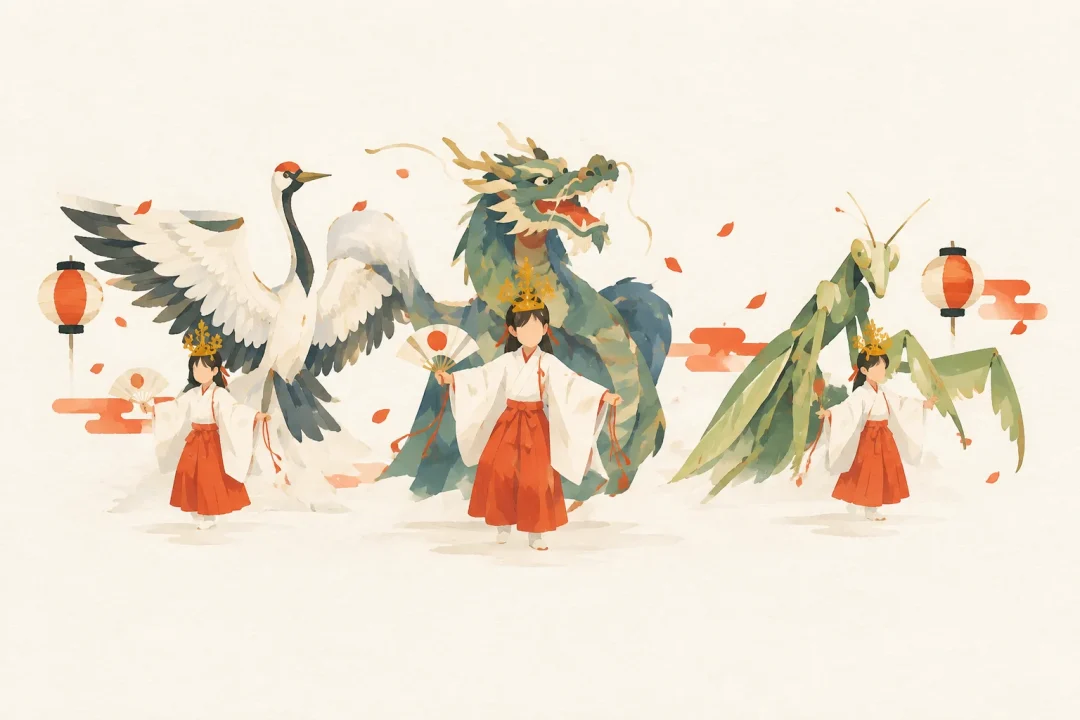
At Yamana Shrine, distinctive features include dances performed with props depicting cranes, dragons, praying mantises, and other figures on the dancers’ heads, as well as sangaku-style movements performed while climbing a pillar.
Twelve-part bugaku and a rich tradition of sacred dances at three shrines
What to expect
At Amamiya Shrine’s 12-part bugaku, the program begins with Enbu, a dance that announces the start of the performance and purifies the stage.
In the 2026 guide, performances such as Teikocho and Taiheiraku were featured, and 12 types of dance were presented in sequence at the shrine precincts’ dance pavilion.
At Oguni Shrine and Yamana Shrine, too, the respective traditional pieces are performed as part of shrine festivals.
How to take part
Bugaku is a performing art presented as part of shrine festivals and is open to the public.
No performer recruitment or way for visitors to join the dances is announced, so visitors can watch the dances being presented.
Source: しずおか文化財ナビ 遠江森町の舞楽|静岡県公式ホームページ
Location and access
- Venue and address
Performances take place at Amamiya Shrine (576 Amamiya, Mori Town, Shuchi District, Shizuoka Prefecture), Oguni Shrine (3956-1 Ichimiya, Mori Town, Shuchi District, Shizuoka Prefecture), and Yamana Shrine (Iida, Mori Town).
- Train and bus
To reach Oguni Shrine, take the direct bus on the Oguni Shrine Kaiun Line from JR Fukuroi Station (about 40 minutes), or from Enshu-Mori Station on the Tenryu Hamanako Railway (about 15 minutes). The shrine is a short walk from the bus stop.
- By car
To reach Oguni Shrine by car, take the Shin-Tomei Expressway to Mori-Kakegawa IC, then travel about 8 km via Prefectural Route 280 (about 15 minutes), or take the Shin-Tomei Expressway to Enshu-Morimachi Smart IC and travel about 4 km (about 7 minutes).
- Parking
Oguni Shrine has parking for 700 vehicles, free of charge. Parking is listed as available at Amamiya Shrine.
Source: 小國神社十二段舞楽(静岡県/森町(静岡県))|開催期間・アクセス|るるぶ&more.
Event venue 静岡県森町 天宮神社
This map uses the venue name. Check the official guide for the event area and entrances.
Dates and season
In 2026, the 12-part bugaku at the Amamiya Shrine Grand Festival is scheduled for April 4 (Saturday) and the 5th (Sunday). The guide lists performances from 2 p.m. on the 4th and 10 a.m. on the 5th, with the 12-part bugaku starting at 3:30 p.m. on both days.
The 12-part bugaku at Oguni Shrine was held on April 18 (Saturday) and the 19th (Sunday).
山名神社の舞楽は例年7月15日に近い土曜・日曜と案内されています。
Accommodation and hotels PR
Showing nearby accommodation.
Prices and availability are current at the time of retrieval. For multi-night stays, only the first night’s price is shown. Confirm the final price and directions to the venue with the booking provider. Select your dates again when using the area search link. Search area: within 3 km of Central Shizuoka Prefecture / Mori Town (the search is not centered on the festival venue)
Nearby attractions
Acty Mori, the Mori Town Experience Village, and Osadaen Honten are introduced as places to visit near Oguni Shrine’s Twelve-Stage Bugaku.
Acty Mori is presented as a place for pottery and handicraft experiences, while Osadaen Honten is described as a facility with food products, local sake, a teahouse, and a sweets shop.
All are potential places to visit in Mori Town, and you can consider visiting them alongside the bugaku.

小国神社
静岡県周智郡森町一宮にある神社
Origins and History of The Bugaku of Tōtōmi Mori
The Bugaku of Tōtōmi Mori developed as bugaku performed at the imperial court and at shrines and temples spread to regional areas and took root as a local festival performing art.
At Oguni Shrine and Amamiya Shrine, a regionalized form of bugaku associated with the Nara Kasuga Shrine tradition has been passed down; at Yamana Shrine, a form adapted into the furyū style is passed down.
On January 14, 1982, the Bugaku of Tōtōmi Mori, which includes the bugaku traditions of all three shrines, was designated a National Important Intangible Folk Cultural Property.
Official information
You can check designation details, locations, and visitor information in the Agency for Cultural Affairs’ National Cultural Properties Database and Shizuoka Prefecture’s official Shizuoka Cultural Properties Navi.
Information about the 2026 Amamiya Shrine Grand Festival is also available from the Mori Town Tourism Association in Shizuoka Prefecture.
The Bugaku of Tōtōmi Mori at a Glance
The Bugaku of Tōtōmi Mori is a nationally designated Important Intangible Folk Cultural Property passed down at Oguni Shrine, Amamiya Shrine, and Yamana Shrine in Mori Town.
You can see different expressions at each shrine, including 12 dances, children’s dances, lion dances, and distinctive performances using props.
In 2026, performances are scheduled at Amamiya Shrine and Oguni Shrine in April; Yamana Shrine’s performance is held as part of its festival in July in a typical year.
Japanese Festivals.jp Editorial Team
Celebrating local culture and helping you discover a side of Japan you never knew.
Article updated: 2026/10/19
Submit information or a correction Submit photos of this festival