A 12-section ritual performing art that uses a taiko drum to represent a rice paddy and pray for a good harvest
Ta-asobi at Oguni Shrine
Festival information
EVENT INFORMATION- Season / frequency
- Every year on January 3 / Every year
- Area
- Shizuoka Prefecture・Mori Town(From Tokyo: approx. 1 h–1 h 30 min · bullet train)Prefecture-level estimate to a main station or airport, not the venue. Airport access, check-in and onward travel are extra; remote areas and islands can take much longer.
- Highlights and activities
- Wishes behind the festival
- Last updated
- 2026/10/19
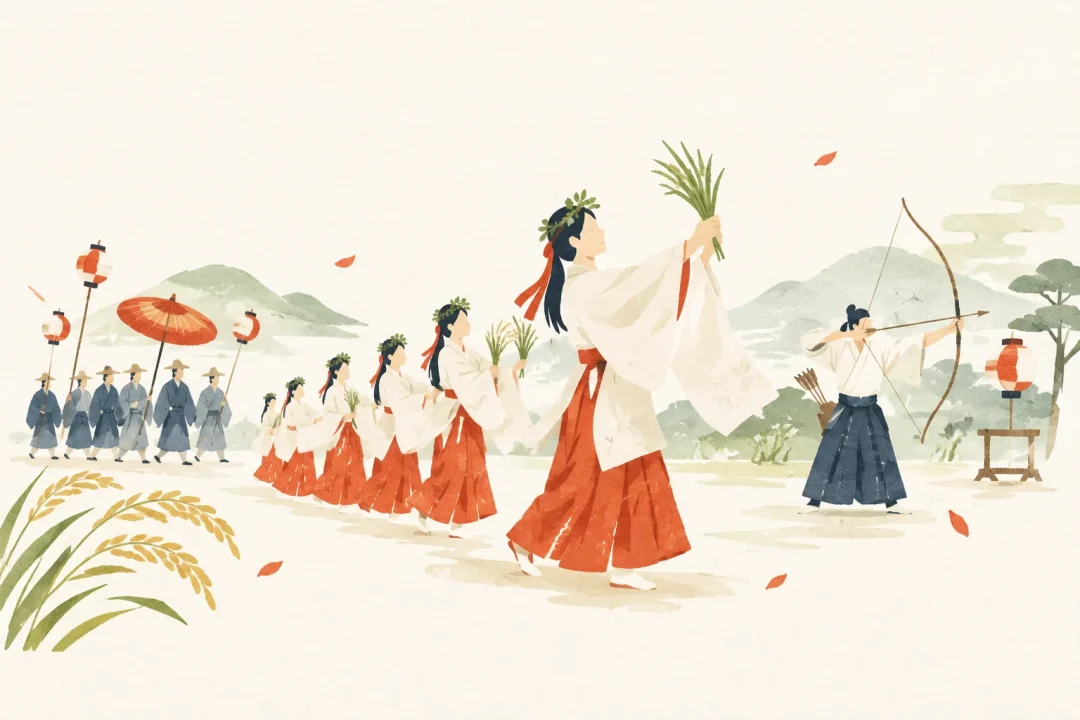
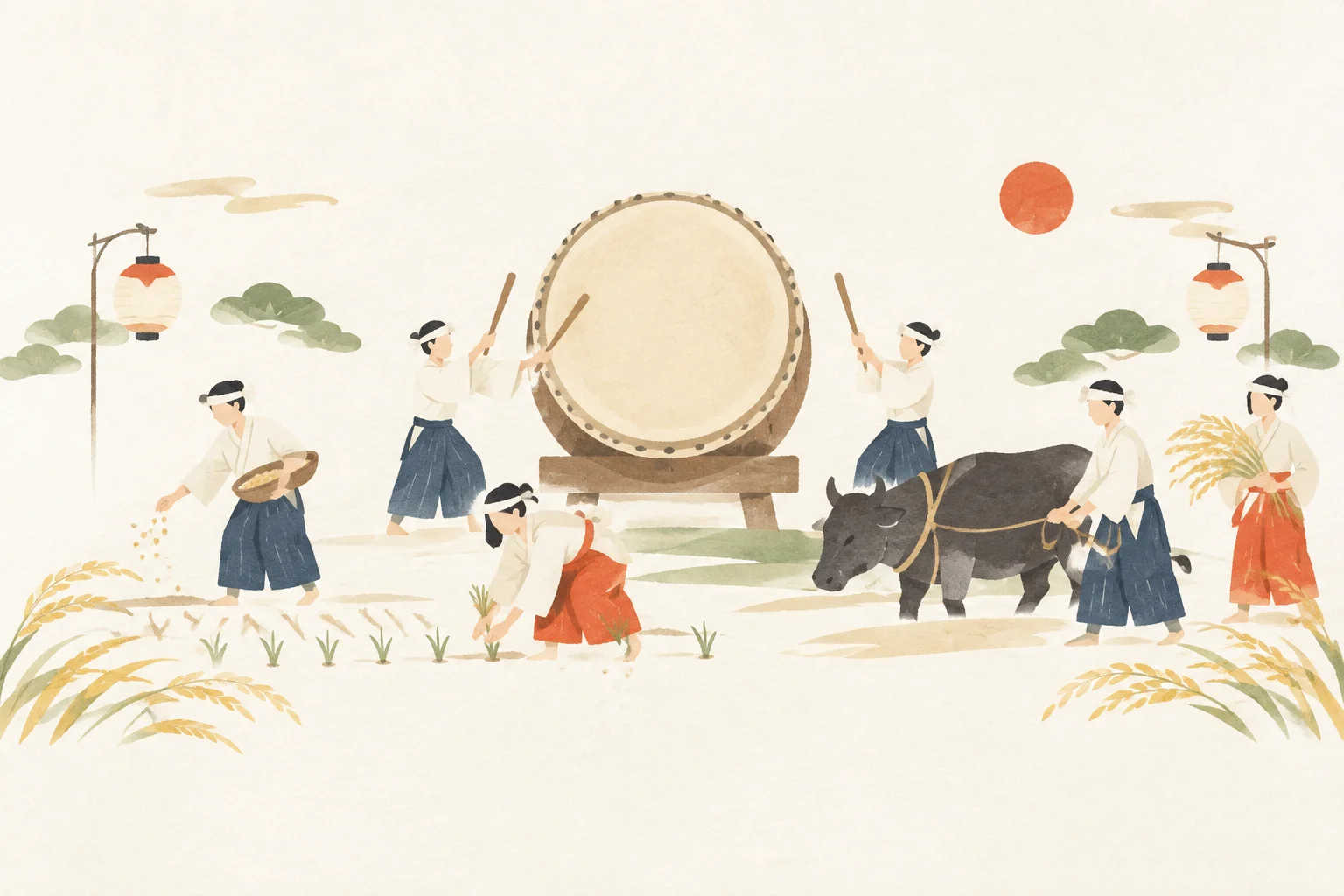
The Ta-asobi at Oguni Shrine portrays rice cultivation, from preparing the fields to harvesting, in 12 performance sections. This ritual performing art is held at the beginning of the year to pray for a good harvest. A large drum represents a rice paddy, and gestures portraying an ox, rice seedlings, and sowing seeds carry on an age-old agricultural prayer tradition.
About Ta-asobi at Oguni Shrine
The Ta-asobi at Oguni Shrine is a ritual performing art held at the beginning of the year to pray for bountiful harvests and the well-being of the local community.
The process of rice cultivation, from preparing the fields to harvesting, is reenacted, with a taiko drum representing a rice paddy.
It consists of 12 performance sections and has been passed down by people from the shrine’s former priestly families.
Source: 田遊び | 遠江国一宮 小國神社
Festival highlights
The highlight is the sequence of 12 performances, with a large taiko drum representing a rice paddy.
A performer playing the ox acts out plowing a field, represented by a taiko drum. Another gesture depicts chasing birds while beating a tub with a willow branch.
In the final Uta-oroshi, verses of prayer are chanted to the beat of the taiko drum. After the ritual, talismans bearing the ox-king deity’s image are distributed, and rice cakes are thrown to the crowd.
Source: しずおか文化財ナビ 小国神社の田遊び|静岡県公式ホームページ
A 12-section ritual performing art that uses a taiko drum to represent a rice paddy and pray for a good harvest
What to expect
The performances proceed in this order: Su-Kuwa, Aze-nuri, Shirokaki-ushi, Naegusa-yose, Naegusa-maki, Naegusa-fumi, Tane-maki, , Nae-home, Yo-nado-yō, Tori-oi, and Uta-oroshi.
A fan is used to represent a hoe, leaves are scattered as rice seedlings, and the work of an ox is portrayed. Each scene in rice cultivation is expressed through gestures and chant-like words.
Toward the end, prayers and songs for a good harvest are offered.
Location and access
- Address
Mori Town
Host municipality 静岡県森町
This map shows the surrounding area, not the exact venue location.
Dates and season
- Season
Every year on January 3
- Frequency
Every year
Accommodation and hotels PR
Showing nearby accommodation.
Prices and availability are current at the time of retrieval. For multi-night stays, only the first night’s price is shown. Confirm the final price and directions to the venue with the booking provider. Select your dates again when using the area search link. Search area: within 3 km of Central Shizuoka Prefecture / Mori Town (the search is not centered on the festival venue)
Nearby attractions
Oguni Shrine stands at the foot of Mount Hongu, beside the clear waters of the Miyagawa River, and has extensive sacred grounds.
Within the grounds are the 800-year-old sacred “Hyō-no-ki” tree, believed to bring good matches, and “Kotomachi Pond,” a sacred pond where people pray for their wishes to come true.
Maple trees line the Ichinomiya River, offering a chance to enjoy the seasonal scenery.

小国神社
静岡県周智郡森町一宮にある神社
Origins and History of Ta-asobi at Oguni Shrine
The Ta-asobi is said to have originated in the mid-Kamakura period.
A record from Enpō 8 (1689) preserved at Oguni Shrine notes that it was performed at night on the third day of the first month of the old lunar calendar, on the white-sand grounds in front of the shrine.
It was designated an Intangible Cultural Property of Shizuoka Prefecture in Showa 35 and selected in Heisei 19 as a national “Intangible Folk Cultural Property for which measures such as the creation of records should be taken.”
Official information
For official information, see the “Ta-asobi” page of Tōtōmi Province’s Ichinomiya, Oguni Shrine.
The overview introduces the performances, the content of each section, the implements used, and the event’s status as a cultural property.
For information about the 2026 event, please check the official information along with the shrine’s latest announcements.
Source: 田遊祭<小國神社>[周智郡森町]|静岡新聞アットエス
Ta-asobi at Oguni Shrine at a Glance
The Ta-asobi at Oguni Shrine portrays the year in rice cultivation through 12 sections of gestures and chant-like words, and is a traditional event to pray for a good harvest and the well-being of the local community.
Highlights include performances in which a large taiko drum represents a rice paddy, gestures associated with the ox king, and the Uta-oroshi.
In 2026, it was held on January 3 at Oguni Shrine in Ichinomiya, Mori Town.
Japanese Festivals.jp Editorial Team
Celebrating local culture and helping you discover a side of Japan you never knew.
Article updated: 2026/10/19
Submit information or a correction Submit photos of this festival