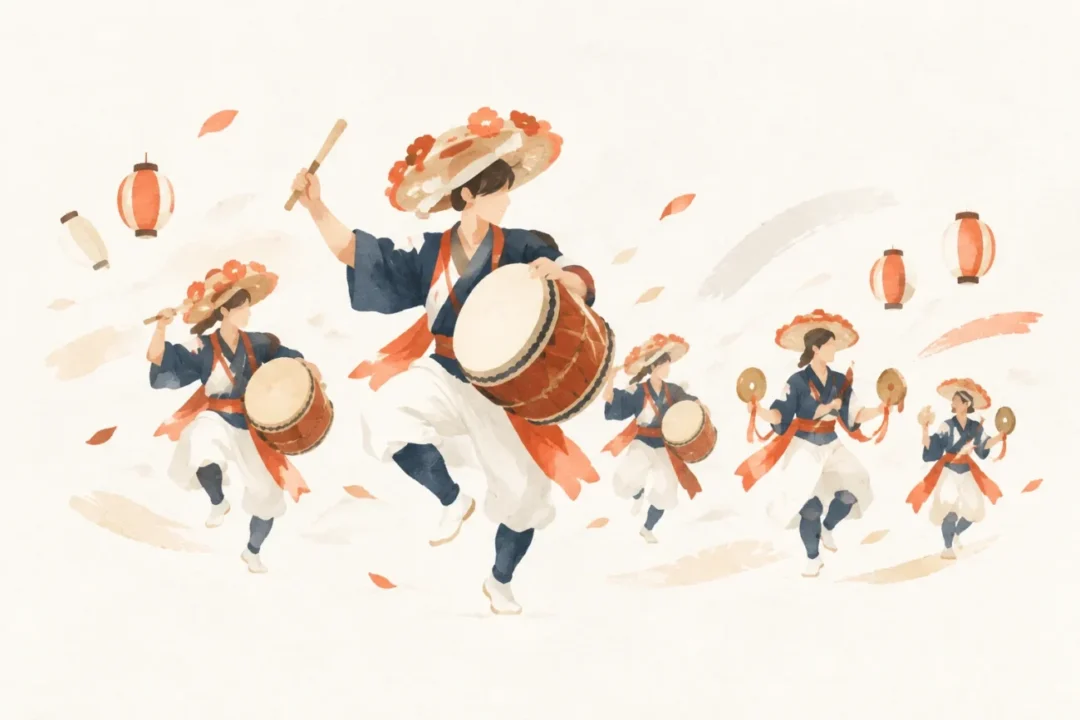
A ceremonial performance in Iriki, brought to life by kane bells, taiko drums, flower hats, and yahata flags
Motomura Gaku Taiko Odori (performing art associated with the annual festival at Suwa Shrine)

Festival information
EVENT INFORMATION- Location
- Suwa Shrine
- Area
- Kagoshima Prefecture・Satsumasendai City(From Tokyo: approx. 1 h 50 min–2 h 20 min · flight time only)Prefecture-level estimate to a main station or airport, not the venue. Airport access, check-in and onward travel are extra; remote areas and islands can take much longer.
- Highlights and activities
- Required number of participants
- The basic lineup consists of 20 people (12 kane players and 8 players).
- Last updated
- 2026/10/19
An intangible folk cultural property passed down at the annual festival of Suwa Shrine in Soeda, Iriki-cho, Satsumasendai City, centered on kane bells and taiko drums. Performers wearing flower hats and carrying yahata flags present Hitoniwa through the music and changes in formation.
About Motomura Gaku Taiko Odori (performing art associated with the annual festival at Suwa Shrine)
Motomura Gaku Taiko Odori is a local performing art passed down in connection with the annual festival at Suwa Shrine in Soeda, Iriki-cho, Satsumasendai City.
It centers on kane bells and taiko drums, and its costumes and yahata flags are also distinctive.
It is designated an intangible folk cultural property by Satsumasendai City and is recognized as a performing art closely associated with the local festival.
Source: 文化遺産データベース
Festival highlights
A highlight is the performers, with the kane players and taiko players each wearing distinct outfits and performing with vivid yahata flags on their backs.
The kane players wear flower hats and red shide streamers, while the taiko players wear fur hats and white coats.
During the performance, the formation spreads out horizontally, then changes into 2 circles and, finally, 4 concentric circles.
A ceremonial performance in Iriki, brought to life by kane bells, taiko drums, flower hats, and yahata flags
What to expect
The performance begins with “Irikomi,” followed by musical sections such as “Ukkon,” “Sasotto,” “Maki,” and “Hodoki,” and ends with “Sasotto.”
This sequence of musical sections is collectively called “Hitoniwa.”
The performers proceed while changing formation, then return to the entrance point toward the end and resume their original formation.
How to take part
必要人数:基本構成は20名(鉦12名、太鼓8名)です。
Location and access
- Venue and address
Suwa Shrine (Soeda, Iriki-cho, Satsumasendai City, Kagoshima Prefecture)
Address Soeda, Iriki-cho, Satsumasendai City, Kagoshima Prefecture
Accommodation and hotels PR
Showing nearby accommodation.
Prices and availability are current at the time of retrieval. For multi-night stays, only the first night’s price is shown. Confirm the final price and directions to the venue with the booking provider. Select your dates again when using the area search link. Search area: within 3 km of Central Kagoshima Prefecture / Satsumasendai City (the search is not centered on the festival venue)
Nearby attractions
The Iriki area is home to Iriki Fumoto, a group of samurai residences established as the central settlement of an outer castle town of the Satsuma Domain.
It is introduced as a component cultural property of Satsumasendai City’s Japan Heritage story, together with the performing art associated with the annual festival at Motomura Suwa Shrine.
It offers a way to learn about both the festival and the historic landscape of the Iriki area.
Source: 日本遺産「薩摩の武士が生きた町~武家屋敷群(麓)を歩く~」/薩摩川内市

新田神社
鹿児島県薩摩川内市にある神社
写真:ja:User:MK Products upload by Sakoppi / CC BY-SA 3.0
Photo source ·
薩摩川内市せんだい宇宙館
鹿児島県薩摩川内市にある科学展示館、天文台
Origins and History of Motomura Gaku Taiko Odori (performing art associated with the annual festival at Suwa Shrine)
No specific account of the origins or founding year of Motomura Gaku Taiko Odori has been confirmed.
It is currently designated as an intangible folk cultural property passed down locally as part of the Suwa Shrine annual festival.
Satsumasendai City preserves and passes down local folk performing arts in each community, including those handed down through rural festivals and shrine events.
Source: 薩摩川内市の郷土芸能/薩摩川内市
Official information
Satsumasendai City introduces local folk performing arts preserved and passed down in the community on its official website.
Motomura Gaku Taiko Odori is also listed in the Agency for Cultural Affairs’ Cultural Heritage Database.
Please check official announcements as they are released for the event date and information for the day.
Motomura Gaku Taiko Odori (performing art associated with the annual festival at Suwa Shrine) at a Glance
Motomura Gaku Taiko Odori is a traditional performing art associated with the annual festival at Suwa Shrine in Soeda, Iriki-cho, Satsumasendai City.
To the sound of kane bells and taiko drums, performers wearing flower hats and carrying yahata flags perform Hitoniwa, changing their formations and circular patterns.
Japanese Festivals.jp Editorial Team
Celebrating local culture and helping you discover a side of Japan you never knew.
Article updated: 2026/10/19
Submit information or a correction Submit photos of this festival