An autumn mass dance that fills the streets with Kagoshima folk songs and dance groups
Ohara Festival
Festival information
EVENT INFORMATION- Dates
- 2026/11/02 〜 2026/11/03Scheduled
- Season / frequency
- Every year on November 2 and 3 / Every year
- Location
- The tram-lined streets connecting Takami-Baba, Izuro, and Sanbashidori
- Area
- Kagoshima Prefecture・Kagoshima City(From Tokyo: approx. 1 h 50 min–2 h 20 min · flight time only)Prefecture-level estimate to a main station or airport, not the venue. Airport access, check-in and onward travel are extra; remote areas and islands can take much longer.
- Features
- Highlights and activities
- Participation / viewing
- Open to public participation / spectators welcome
- Required number of participants
- Up to 200 people per dance group
- Last updated
- 2026/10/19
A signature autumn festival in Kagoshima City, where colorful dance groups perform along Tenmonkan’s tram route to Kagoshima folk songs.
About Ohara Festival
Photo credits and terms of use
Photographer: Conner Dudfield File:Shibuya Kagoshima Ohara Matsuri May 28 2023.jpg / Wikimedia Commons / CC BY-SA 4.0 Own work by the contributorDisplay size only adjusted.May differ from the event currently featured.Photo credits and terms of use
Photographer: Sanjo File:Ohara Festival 2024 Marching Soka Gakkai.jpg / Wikimedia Commons / CC BY-SA 4.0 Own work by the contributorDisplay size only adjusted.May differ from the event currently featured.Photo credits and terms of use
Photographer: Sanjo File:Hana-densha Ohara Festival 2024.jpg / Wikimedia Commons / CC BY-SA 4.0 Own work by the contributorDisplay size only adjusted.May differ from the event currently featured.Ohara Festival is a dance-focused festival held every year on November 2 and 3 in central Kagoshima City.
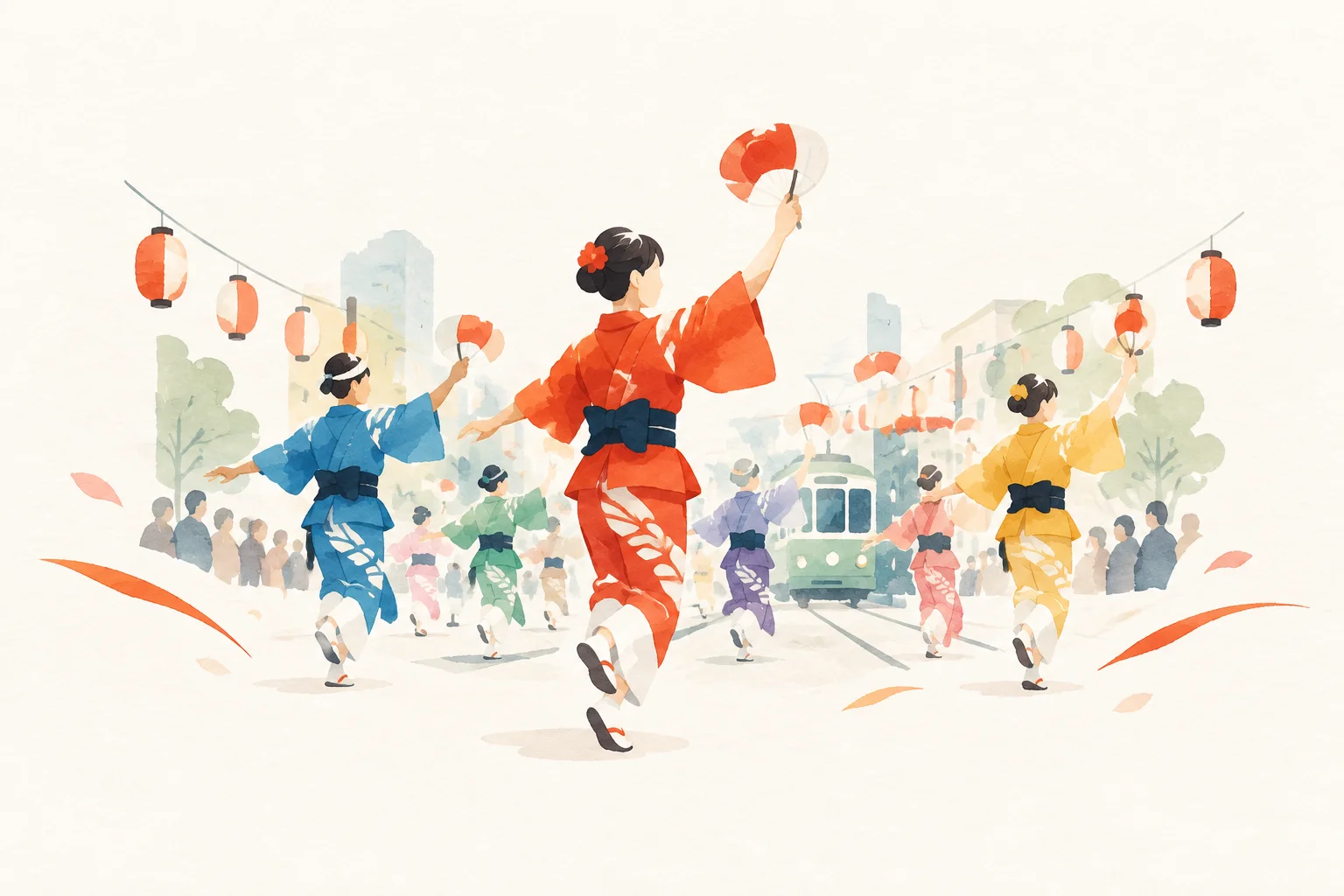
Dance groups in colorful costumes perform along the tram route to folk songs representative of Kagoshima.
The festival consists of a night festival and a main festival, and also features drumming, marching bands, and traditional performing arts.
It began in Showa 24 and is cherished as one of Kagoshima’s signature autumn events.
Festival highlights
The highlight is the mass dance, where dance groups perform together.
Groups in colorful, group-specific costumes brighten the tram route as they dance to Ohara-bushi, Kagoshima Hanya-bushi, and Shibuya Ondo.
The night festival features the mass dance and a competitive performance by Ogojo Taiko groups, while the main festival includes marching bands and the “Ohara 21” dance.
Other distinctive features include the flower-decorated tram, which runs until the day before the festival, and taiko performances inspired by “ogojo,” a Kagoshima dialect word meaning “woman.”
An autumn mass dance that fills the streets with Kagoshima folk songs and dance groups
What to expect
The festival consists of the night festival on November 2 and the main festival on November 3.
The night festival features the mass dance and a competitive performance by Ogojo Taiko groups. The main festival is divided into several sections featuring the mass dance, taiko drumming, marching bands, promotion of Shibuya and Kagoshima Ohara Festival, dance, and other events.
Dance groups perform choreography to songs such as Ohara-bushi, and choreography workshops are also offered for participating groups.
Traditional performing arts are scheduled at Centerrace Square on both days.
How to take part
Anyone can join the group dancing.
Participants enjoy dancing alongside the dance groups to Kagoshima favorites such as “Ohara-bushi,” “Kagoshima Hanya-bushi,” and “Shibuya Ondo.”
Dance workshops are also offered in advance, so first-time participants can learn the steps before joining the festivities.
In 2026, a total of 4 dance workshops will be held at Kagoshima Arena or Kamoike Community Center in October.
You can learn the choreography for Ohara-bushi, Hanya-bushi, and Shibuya Ondo. No reservation is needed for the workshops.
Source: 【2026年最新版】おはら祭 | イベント | 【公式】鹿児島市の観光・旅行情報サイト|かごしま市観光ナビ
Source: Ohara Festival | Events | VISIT KAGOSHIMA CITY | Official Tourist Information Site
Location and access
- Venue and address
The tram-lined streets from Takami-Baba via Izuro to Sanbashidori.
Around Tenmonkan, Kagoshima City, Kagoshima Prefecture.
- Train and bus
The Takami-Baba tram stop provides direct access to the venue, and Kagoshima-Chuo Station is also listed as the nearest station.
There are no direct buses.
- By car
There is no dedicated parking.
- Parking
There is no parking.
Source: おはら祭 - Wikipedia
Address Around Tenmonkan, Kagoshima City, Kagoshima Prefecture (Takami-Baba to Izuro to Sanbashidori)
Dates and season
In 2026, the festival will be held over 2 days, November 2 and the 3rd.
November 2 is the evening festival, scheduled from 6:50 p.m. to 8:20 p.m., with group dancing and an Ogojo taiko performance.
The main festival on November 3 is scheduled to run from 10:20 a.m. to 3:25 p.m., with group dancing, taiko performances, marching bands, dance, and more.
Accommodation and hotels PR
Showing nearby accommodation.
Prices and availability are current at the time of retrieval. For multi-night stays, only the first night’s price is shown. Confirm the final price and directions to the venue with the booking provider. Select your dates again when using the area search link. Search area: within 3 km of Central Kagoshima Prefecture / Kagoshima City (the search is not centered on the festival venue)
Tips for your visit
In 2026, the evening festival and main festival take place at different times, so choose when to visit based on the events you want to see.
The flower-decorated tram is scheduled to be parked near Tenmonkan-dori tram stop on the day of the festival, but visitors are asked not to touch the vehicle.
The flower-decorated tram may be delayed due to route conditions or suspended due to weather, so be sure to check its operating status when viewing it.
Source: 「おはら祭」を盛り上げるため、花電車『花3号』を運行します。|鹿児島市交通局|人に環境にやさしい市電・市バス
Nearby attractions
Nearby attractions include Tenmonkan, Centerrace Tenmonkan, the Kagoshima City Tourist Information Center (Tenmonkan), Maruya Gardens, and Yamakataya.
The Kagoshima City Tourist Information Center is in the heart of Tenmonkan and distributes Kagoshima sightseeing brochures and provides information in multiple languages.
It is described as about a 1-minute walk from Tenmonkan-dori tram stop, making it a convenient place to visit when combining the festival with sightseeing around the city.
Source: 鹿児島市観光案内所(天文館) | 観光スポット | 【公式】鹿児島県観光サイト かごしまの旅

いおワールドかごしま水族館
鹿児島市営水族館

かごしま近代文学館
鹿児島県鹿児島市にある文学館


仙巌園
鹿児島県鹿児島市にある大名庭園

南洲神社
鹿児島市にある神社

尚古集成館
鹿児島市にある博物館

川上天満宮
鹿児島県鹿児島市にある神社

Matsubara Shrine
鹿児島県鹿児島市にある神社

桜島ビジターセンター
鹿児島県立の科学展示館

桜島国際火山砂防センター
鹿児島県の博物館・美術館のスポットです。

照国神社
鹿児島市にある神社

石橋記念公園
鹿児島県鹿児島市浜町にある県立公園
Origins and History of Ohara Festival
Ohara Festival began in postwar Kagoshima City, driven by residents hoping for the city’s recovery.
It was newly launched in 1949 to mark the 60th anniversary of Kagoshima City’s incorporation, and initially included a costumed vehicle parade.
In 1961, a dance-group format inspired by Awa Odori was introduced, broadening participation to neighborhood associations and workplace groups.
Since 1968, the festival dates have been fixed as November 3, and in 1998, Shibuya Ondo and other dances were added to the mass dance.
Official information
Details of the 2026 Ohara Festival—including events, participant recruitment, venue, and schedule—are available in the event listing on the Kagoshima Prefecture tourism website, “Kagoshima no Tabi.”
Kagoshima City’s event information describes it as a festival held around Tenmonkan’s tram route and also lists a contact point.
Source: おはら祭について知りたい。|鹿児島市
Ohara Festival at a Glance
Ohara Festival is an autumn festival centered on a mass dance to folk songs, held around Tenmonkan in Kagoshima City.
In 2026, the night festival on November 2 and the main festival on November 3 are scheduled.
Along with lively dances by the dance groups, the program also includes taiko drumming, marching bands, traditional performing arts, and dance.
The festival uses a broad stretch of tram route in the city center, so it may be easier to enjoy if you decide in advance what you want to see and when.
Japanese Festivals.jp Editorial Team
Celebrating local culture and helping you discover a side of Japan you never knew.
Article updated: 2026/10/19
Submit information or a correction Submit photos of this festival