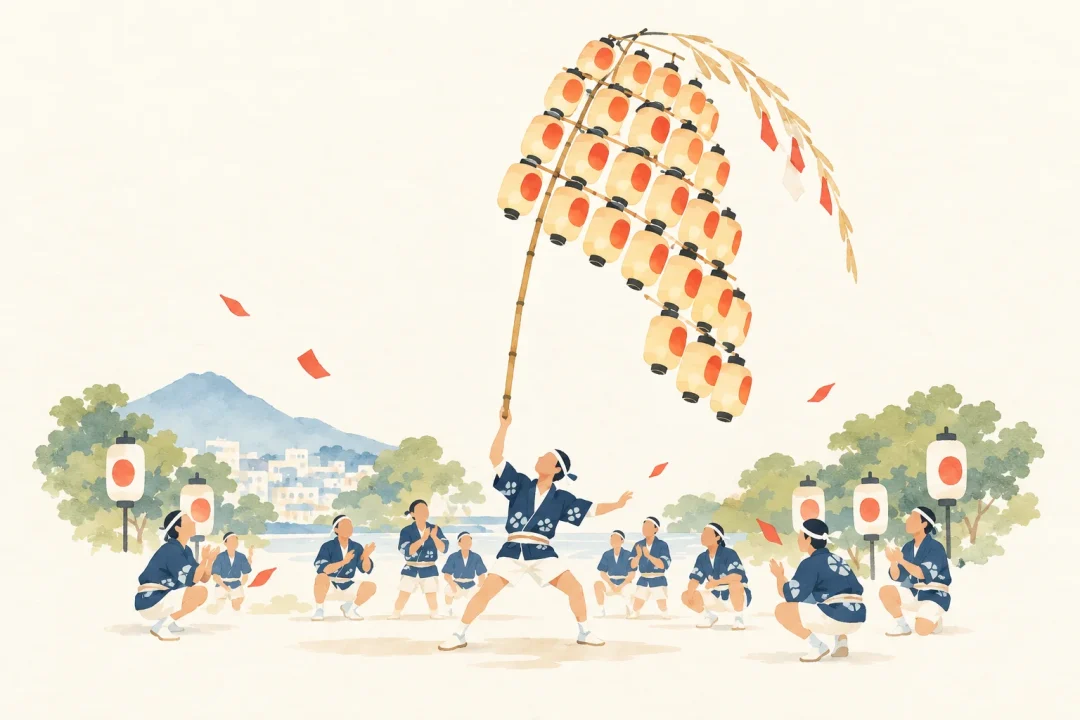
Entrusting hopes for a good harvest to willow, fire, and drums: a New Year ritual in Tsugaru
Tsugaru Nanokado Festival

Festival information
EVENT INFORMATION- Season / frequency
- day 7 of lunar month 1 (Iwakiyama Shrine and Saruka Shrine), day 29 of lunar month 1 (Oni Shrine) / Every year
- Location
- Iwakiyama Shrine, Oni Shrine, Saruka Shrine
- Area
- Aomori Prefecture・Hirosaki City, Hirakawa City(From Tokyo: approx. 3 h–3 h 30 min · bullet train)Prefecture-level estimate to a main station or airport, not the venue. Airport access, check-in and onward travel are extra; remote areas and islands can take much longer.
- Highlights and activities
- Wishes behind the festival
- Last updated
- 2026/10/19
This is a New Year festival in the Tsugaru region that uses willow branches and goō hōin talismans to predict crop yields and the weather. Distinctive rituals are held at three shrines in Hirosaki City and Hirakawa City.
About Tsugaru Nanokado Festival
The Tsugaru Nanokado Festival is a New Year event held at Iwakiyama Shrine and Oni Shrine in Hirosaki City, and Saruka Shrine in Hirakawa City, to predict crop yields and the weather.
The rituals use willow branches and goō hōin talismans for crop divination and prayers for a good harvest, and are closely connected to agriculture in the Tsugaru region.
After the rituals, people take willow branches home and may plant them along the ridges of rice paddies to pray for a good harvest.
The differences in events and names among the three shrines are also a distinctive feature of the festival.
Source: 津軽の七日堂祭 - 青森県庁ホームページ / 国指定文化財等データベース
Festival highlights
A highlight is the ritual of striking willow branches against a board and predicting the prospects for early-, mid-, and late-ripening rice based on how the tied slips of paper and rice ears fall.
At Iwakiyama Shrine, events include the sacred willow ritual, sacred talisman ritual, and Sanbyōshi ritual, with the sacred fire, drums, and movements of the large ritual wand serving as objects of divination.
At Saruka Shrine, visitors can see willow-related rituals and the tossing of sesame rice cakes; at Oni Shrine, there are events such as the sacred fire ritual and rice cakes cooked in an iron pot. Each shrine has its own distinct program.
Entrusting hopes for a good harvest to willow, fire, and drums: a New Year ritual in Tsugaru
What to expect
The events are conducted in places such as the shrine’s or shrine office by parishioner representatives, priests, and participants serving the shrine.
At Iwakiyama Shrine, events include divination using willow branches, prayers to ward off illness with goō hōin talismans, and the Sanbyōshi ritual, which predicts the weather from the harmony of fire, drums, and ritual streamers.
At Oni Shrine, the events proceed in this order: sacred fire, sacred willow, talisman, three-beat ritual, and rice cakes cooked in an iron pot. At the end, people take home rice cakes wrapped in paper and willow branches.
How to take part
The rites involve , volunteers, and people who have gathered. After the event, there is a custom of taking home willow branches and praying for a good harvest.
At Saruga , attendees take home scattered willow branches and sesame mochi, while at Oni Jinja, attendees are given an o-hineri containing mochi.
Check the information provided by each venue to find out whether general visitors can take part in the rites.
Location and access
- Venue and address
The festival is held at Iwakiyama Shrine, Oni Shrine (Hirosaki City), and Saruka Shrine (Hirakawa City).
Event venue 青森県弘前市、平川市 岩木山神社
This map uses the venue name. Check the official guide for the event area and entrances.
Dates and season
Each year, the event is held at Iwakiyama Jinja and Saruga Jinja on day 7 of lunar month 1, and at Oni Jinja on day 29 of lunar month 1.
As the three shrines hold the event at different venues and on different days, take care not to confuse the shrine you intend to visit.
Tips for your visit
The venues and events differ among the three shrines, so it is important to check in advance which shrine’s Nanokado Festival you plan to see.
Customs such as breaking off willow branches to take home and distributing rice cakes take place as the rituals proceed.
The rituals at Iwakiyama Shrine are described as being held with the worship hall doors open in the severe winter cold, so it is a good idea to dress warmly.
Source: 神人一体の七日堂祭=126 | 陸奥新報
Origins and History of Tsugaru Nanokado Festival
The name Nanokado Festival is said to come from combining the fact that it is held on day 7 of lunar month 1 with the word “dō” (hall).
A diary kept by the wealthy Kanakiya merchant in Gata, Hirosaki City, contains an entry recording a visit to “Hyakuzawa Nanokado” in 1854, and is considered an early record of the festival’s name.
In 2009, the rituals held at the three shrines were selected as an Intangible Folk Cultural Property requiring measures such as documentation, and in 2022 they were designated an Aomori Prefecture Intangible Folk Cultural Property.
Official information
The Aomori Prefectural Board of Education’s cultural property guide provides the name, location, viewing period, preservation group, and designation status.
The Hirosaki City Board of Education’s Cultural Properties Division and the Hirakawa City Board of Education’s Local History Museum are listed as contacts.
For information about events at each shrine and guidance on the day, you can check with the board of education in the area where the shrine is located.
Tsugaru Nanokado Festival at a Glance
The Tsugaru Nanokado Festival is a New Year folk event passed down at three shrines in Hirosaki City and Hirakawa City, where people pray for good harvests and divine the weather.
Rituals involving willow branches, goō hōin talismans, fire, drums, and rice cakes unfold at each shrine, conveying the region’s agricultural beliefs in a tangible way.
The dates according to the old lunar calendar and the venues vary by shrine, so it is a good idea to check your destination and the event information before visiting.
Japanese Festivals.jp Editorial Team
Celebrating local culture and helping you discover a side of Japan you never knew.
Article updated: 2026/10/19
Submit information or a correction Submit photos of this festival