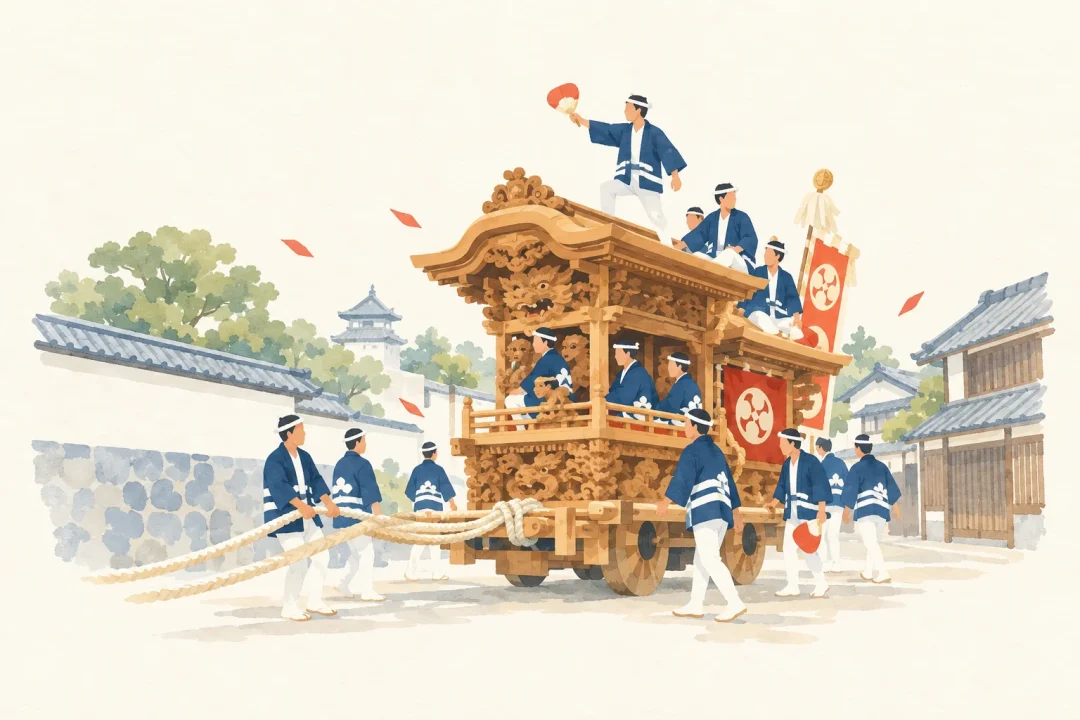
A secret rite in Tahara, passed down without being seen
Ne Matsuri

Festival information
EVENT INFORMATION- Season / frequency
- Around the old New Year (from late January to around February) / Every year
- Area
- Aichi Prefecture・Tahara City(From Tokyo: approx. 1 h 40 min–2 h · bullet train)Prefecture-level estimate to a main station or airport, not the venue. Airport access, check-in and onward travel are extra; remote areas and islands can take much longer.
- Last updated
- 2026/10/19
A sleeping festival in Kobe-cho, Tahara City, Aichi Prefecture, in which the sacred object is moved between 2 shrines. A sacred rite deeply rooted in the community, where protection comes from not watching the procession.
About Ne Matsuri
The Ne Matsuri is a sacred rite associated with 2 shrines in Kobe-cho, Tahara City, Aichi Prefecture: Hisamaru Shrine and Kobe Omiya Shinmei Shrine.
Around the old New Year, a procession moves the sacred object between the shrines, but there is a strict taboo against seeing it.
During the festival, nearby residents are said to shut their doors and spend the time quietly, leaving the town seemingly deserted.
The local custom of protecting the rite by not watching it is itself a major feature of the festival.
Source: 寝祭り - Wikipedia
Festival highlights
The greatest highlight is that, unlike at most festivals, not watching the procession is the proper conduct to observe.
The procession carrying the from Hisamaru to Kobe Ōmiya Shinmeisha is said to proceed quietly along a route of about 600 meters, taking thirty to forty minutes.
The following day, a rite returns the shintai, and this round trip between the two shrines shapes the festival.
Rather than being a spectacle to watch, the festival is distinctive in that the entire community supports the rites while keeping out of sight.
A secret rite in Tahara, passed down without being seen
What to expect
In the present-day rites, priests and shrine representatives gather at Hisamaru Jinja and, after opening remarks and other proceedings, form a Gosenkō procession carrying a box containing the shintai to Shinmeisha.
A Gosenkō report ceremony is held at Shinmeisha, after which the people involved return temporarily to Hisamaru Jinja.
On the following Day of the Rooster, the shintai is returned from Shinmeisha to Hisamaru Jinja, and on the Day of the Dog, rites and a report ceremony are held at Kaminokama Jinja.
How to take part
Nematsuri has been passed down as a in which people must not directly watch the procession carrying the shintai.
This is not a festival where members of the public join or watch the procession. Notices ask people to avoid passing through the surrounding area while the rites are taking place.
To respect local customs, anyone wishing to participate must follow guidance from the shrine or the community.
It is said that a ceremony of apology is held at a later date if someone happens to see it.
Location and access
- Address
Tahara City
Host municipality 愛知県田原市
This map shows the surrounding area, not the exact venue location.
Dates and season
It is usually held around the first Days of the Monkey and Rooster, excluding the first three days of the lunar New Year, and falls around late January to February.
The rites center on the shintai’s movement over two days and continue with a report ceremony the following day.
Because the date varies according to the lunar calendar and the Chinese zodiac, check separate announcements for the specific schedule.
Accommodation and hotels PR
Showing nearby accommodation.
Prices and availability are current at the time of retrieval. For multi-night stays, only the first night’s price is shown. Confirm the final price and directions to the venue with the booking provider. Select your dates again when using the area search link. Search area: within 3 km of Central Aichi Prefecture / Tahara City (the search is not centered on the festival venue)
Tips for your visit
At the Ne Matsuri, an important local rule is not to watch the procession carrying the sacred object or the rites directly.
As the festival approaches, signs asking people to avoid using nearby roads are put up, and on the day, the area around the shrine is said to be deserted.
Please do not come near to watch or try to find the procession; follow the signs and local guidance.
If someone accidentally sees it, a custom is said to have developed of receiving prayers at the Apology Festival.
Origins and History of Ne Matsuri
There is still no generally accepted account of the origins or precise history of the Ne Matsuri.
One of the oldest known records is the 1707 work Mikawa Suzume, which describes a festival for Hisamaru on the Saru and Tori days of the New Year, when parishioners shut their doors and did not go outside.
The 1712 work Wakan Sansai Zue contains a similar account and indicates that the festival’s origins had already been forgotten.
Since the modern era, the form of the rites has changed, and today the festival centers on a procession that moves the sacred object between the 2 shrines.
Ne Matsuri at a Glance
The Ne Matsuri is a sacred rite at which watching is prohibited, passed down at Hisamaru Shrine and Kobe Omiya Shinmei Shrine in Kobe-cho, Tahara City.
The festival centers on a procession that moves the sacred object between the 2 shrines, followed by rites for its return and a report.
There are several theories about its origins, and a 1707 record also describes the custom of shutting doors and not going outside.
Visitors should not come for the purpose of watching, and it is important to respect the community’s quiet observance and the rule to avoid using the roads.
Japanese Festivals.jp Editorial Team
Celebrating local culture and helping you discover a side of Japan you never knew.
Article updated: 2026/10/19
Submit information or a correction Submit photos of this festival