A Wakasa children’s event that welcomes New Year’s good fortune with blessing sticks and chants
Fukui’s Toiwai and Kitsunegari
Festival information
EVENT INFORMATION- Season / frequency
- Koshogatsu around January 14
- Location
- The settlements of Kitada, Sakajiri, Nakadera, Sano, and Shinjo in Mihama Town
- Area
- Fukui Prefecture・Mihama Town(From Tokyo: approx. 2 h 50 min–3 h 20 min · bullet train)Prefecture-level estimate to a main station or airport, not the venue. Airport access, check-in and onward travel are extra; remote areas and islands can take much longer.
- Features
- Wishes behind the festival
- Age restrictions
- Children from preschool age through junior high school
- Last updated
- 2026/11/22
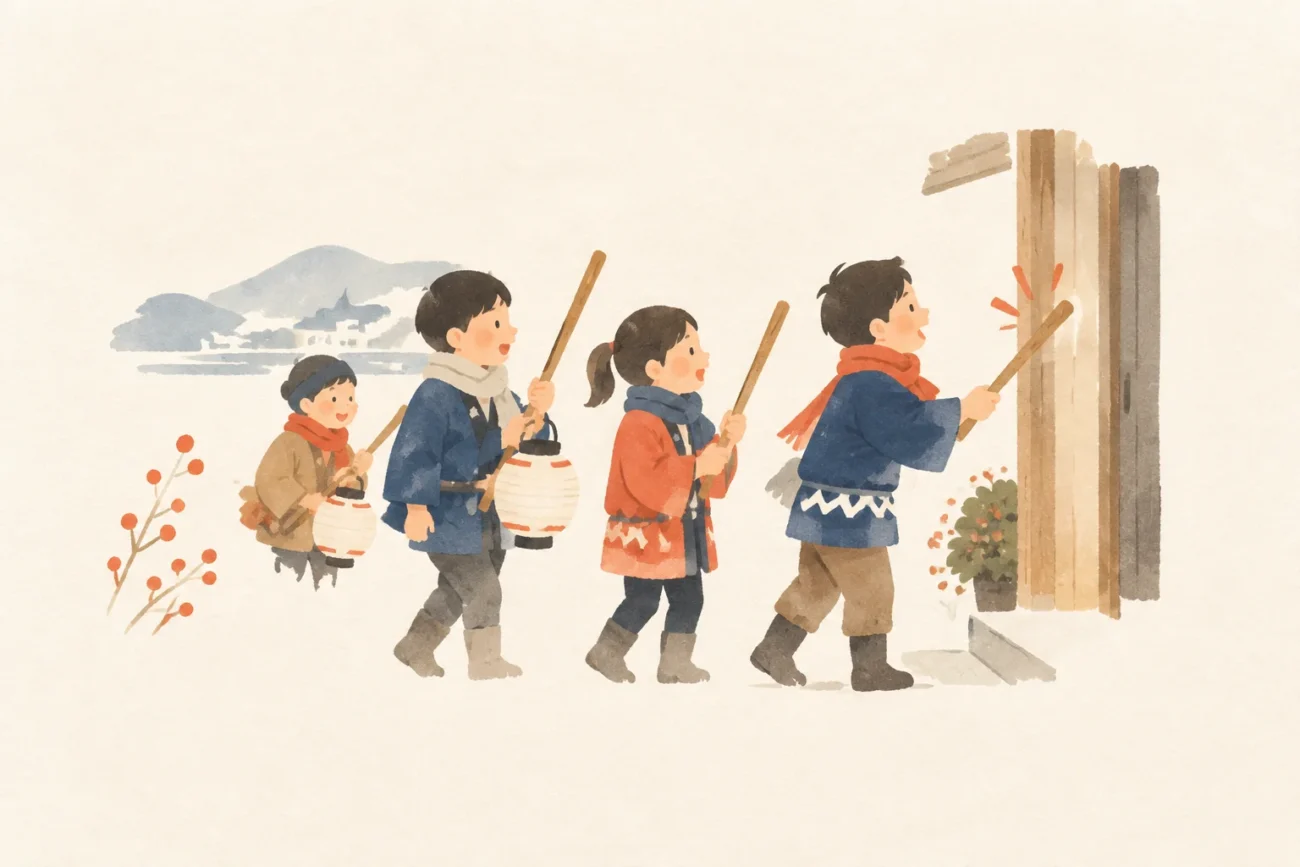
In the settlements of Mihama Town, children visit homes carrying blessing sticks, tapping doorways and the ground as they sing chants. This Koshogatsu event from the Wakasa region is a prayer for a good harvest and freedom from illness and misfortune in the New Year.
About Fukui’s Toiwai and Kitsunegari
Fukui’s Toiwai and Kitsunegari are children’s events held during Koshogatsu in the Wakasa region.
In Mihama Town, the event takes place in the settlements of Kitada, Sakajiri, Nakadera, Sano, and Shinjo. Children visit homes, tapping doorways and the ground with blessing sticks and singing celebratory songs.
Toiwai and Kitsunegari were originally separate events, but in some parts of Fukui they are now held together as a single village visit. The tradition has been passed down as a way of praying for a good harvest and freedom from illness and misfortune.
Festival highlights
A highlight is watching children walk through the settlement with blessing sticks, tapping doorways and the ground as they sing chants.
Sumac or willow is used for the blessing sticks. Some examples are made by shaping wood into a mallet or rod and decorating it with designs such as a sacred jewel or pine, bamboo, and plum.
Each settlement has its own distinctive implements. In the Sakajiri district of Mihama Town, a mallet-shaped implement about forty centimeters long and fifteen centimeters across is used, while in the Nakadera district, a smaller implement decorated with pine, bamboo, and plum is used.
A Wakasa children’s event that welcomes New Year’s good fortune with blessing sticks and chants
What to expect
During the event, children from preschool age through junior high school carry blessing sticks as they visit homes throughout the settlement.
They tap doorways and the ground in front of houses, sing short chants or celebratory songs, then receive a token of thanks from the residents before heading to the next home.
Among the children walking with older companions, the oldest serves as the “taisho” (leader), guiding the group through the village and calling out the chants.
How to take part
対象年齢:幼児から小中学生までの子供たち
Location and access
開催地域:美浜町北田・坂尻・中寺・佐野・新庄の各集落
関連施設:美浜町歴史文化館(福井県美浜町河原市8-8)
- By car
Near the Wakasa-Mihama Interchange on the Maizuru-Wakasa Expressway
自転車:JR小浜線 美浜駅から自転車で行ける距離
Event venue 福井県美浜町 美浜町北田
This map uses the venue name. Check the official guide for the event area and entrances.
Dates and season
- Season
Koshogatsu around January 14
Accommodation and hotels PR
Showing nearby accommodation.
Prices and availability are current at the time of retrieval. For multi-night stays, only the first night’s price is shown. Confirm the final price and directions to the venue with the booking provider. Select your dates again when using the area search link. Search area: within 3 km of Central Fukui Prefecture / Mihama Town (the search is not centered on the festival venue)
Tips for your visit
The event is not staged for spectators; it takes place in the lanes of residential neighborhoods.
Dates vary by settlement. Some hold the event in the afternoon on the fourteenth or on a nearby Sunday to accommodate school and work schedules.
Those wishing to observe are advised to contact the relevant municipal board of education before visiting to ask about dates and access.
Nearby attractions
Materials related to the event, such as iwai-bo (blessing sticks) and photographs, can be viewed year-round at the Mihama Town Historical and Cultural Museum.
The museum has held special exhibitions displaying the blessing sticks and photographs from each district.
The address is 8-8 Kawaraichi, Mihama Town, Fukui Prefecture.

若狭国吉城歴史資料館
日本の福井県三方郡美浜町にある博物館
Origins and History of Fukui’s Toiwai and Kitsunegari
Toiwai was an event to anticipate good fortune by welcoming it in the New Year. Kitsunegari was a separate event to ward off misfortune: the fox, seen as a symbol of harmful animals, was driven to the village boundary to send misfortune away.
Because the two events took place around the same time during Koshogatsu (the Little New Year), they gradually became less distinct in Fukui, and more communities are said to have combined them into a single village visit.
The form seen today is said to date back to the Edo period. On March 28, 2019, it was designated a National Selected Intangible Folk Cultural Property.
Official information
Mihama Town introduces Fukui’s Toiwai and Kitsunegari as a National Selected Intangible Folk Cultural Property held in Kitada, Sakajiri, Nakadera, Sano, and Shinjo.
Information on cultural heritage describes them as Koshogatsu events passed down in the Wakasa region, explaining the blessing sticks, chants, and prayers for a good harvest and freedom from illness and misfortune.
Fukui’s Toiwai and Kitsunegari at a Glance
Fukui’s Toiwai and Kitsunegari are Koshogatsu events passed down in Mihama Town, including in the settlements of Kitada, Sakajiri, Nakadera, Sano, and Shinjo.
Children visit homes, tapping doorways and the ground with blessing sticks as they sing chants, praying for a good harvest and freedom from illness and misfortune.
Toiwai and Kitsunegari, said to date back to the Edo period, were originally separate events: one to anticipate good fortune and the other to ward off misfortune. In some communities, they have become a single village visit.
Sources and references
Japanese Festivals.jp Editorial Team
Celebrating local culture and helping you discover a side of Japan you never knew.
Article updated: 2026/11/22