10 Giant Festivals Held in Autumn 2026: Looking Back at Their Impact Across Japan

Festivals that offer a sense of scale and power take many forms—not just and taikodai, but giant mortars, pots, stones, and even rabbits. This article introduces festivals held in autumn 2026 where their sheer scale was a major attraction.
Giant mochi pounding with many people working the mallet together, a huge pot cooking tens of thousands of servings, and boat-shaped dashi moving through town—each festival expresses scale differently. Look back at memorable autumn festivals while comparing the impact created by their ties to local food culture, , and traditional performing arts.
Furusato Hyappemochi Festival (Iwamizawa, Hokkaido)

- Dates
- 2026/09/19 〜 2026/09/20
- Season / frequency
- Autumn, mid-September / Every year
- Location
- Around the 4jō-dōri special venue, Sakae-dōri, 4jō-dōri, and 3jō-dōri
- Area
- Hokkaido・Iwamizawa City
- Participation / viewing
- Spectators welcome
- Participation fee
- Free admission
The Furusato Hyappemochi Festival expresses hopes for a bountiful harvest and celebrates Iwamizawa-grown glutinous rice throughGiant-mortar mochi poundingan autumn festival that expresses the season through.A giant mortar 2.2 meters in diameter and weighing 5.5 tonsThe yoitomake method drops a 200-kilogram mallet from a height of about 5 meters into the giant mortar, creating an impressive spectacle accompanied by and shouts. You can also enjoy mochi tossing and food stalls.
Highlights of the Furusato Hyappemochi Festival

Photo credits and terms of use
ja:利用者:Dddeco / http://ja.wikipedia.org/wiki/%E3%83%95%E3%82%A1%E3%82%A4%E3%83%AB:Hyappei.JPG
05:29, 26 September 2007 . . Dddeco (talk | contribs) 1,600 × 1,200 (939,965 bytes) (ふるさと百餅祭り(北海道岩見沢市) 2007年9月17日撮影 撮影者:Dddeco {{GFDL}} Category:岩見沢市の画像) / Photo source / CC BY-SA 3.0(may not be from the event edition featured)

Photo credits and terms of use
SelEle-MS / Own work / Photo source / CC BY-SA 3.0(may not be from the event edition featured)
The main attraction is mochi pounding in a giant mortar measuring 2.2 meters in diameter and weighing 5.5 tons. Many people pull ropes to raise a 200-kilogram mallet to a height of about 5 meters, then drop it to pound the mochi using the “yoitomake method.”
Feel the power of a giant mallet striking the mortar up close, accompanied by taiko and shouts. The freshly pounded mochi is served in sweet red bean soup, and you can also enjoy the longevity mochi toss and Hyappemochi Market.

Watch not only the moment the mallet falls, but also how everyone works together.
Location and access
- Venue and address
-
Held around the intersection of 4jō-nishi 2-chōme in Iwamizawa City, on Sakae-dōri (1jō-nishi 2-chōme to 5jō-nishi 2-chōme), 4jō-dōri (4jō-nishi 1-chōme to 4jō-nishi 5-chōme), and 3jō-dōri (3jō-nishi 2-chōme to 3jō-nishi 3-chōme).
- Train and bus
-
It is a 5-minute walk from Iwamizawa Station on the JR Hakodate and Muroran lines to the special venue on 4jō-dōri. During the event, local bus routes are diverted.
- By car
-
Traffic restrictions will be in effect on some sections of 4jō-dōri and Sakae-dōri near the venue, and entry will be prohibited.
- Parking
-
There is no parking lot. Information is available on using paid parking lots.
AddressAround the intersection at 4-jo Nishi 2-chome, Iwamizawa, Hokkaido
Shige-yanagi Hachimangu Matsuribune (Azumino, Nagano)
- Dates
- 2026/09/19 〜 2026/09/20
- Season / frequency
- Around the autumn equinox / Every year
- Location
- Shige-yanagi Hachimangu and the Shige-yanagi district
- Area
- Nagano Prefecture・Azumino City
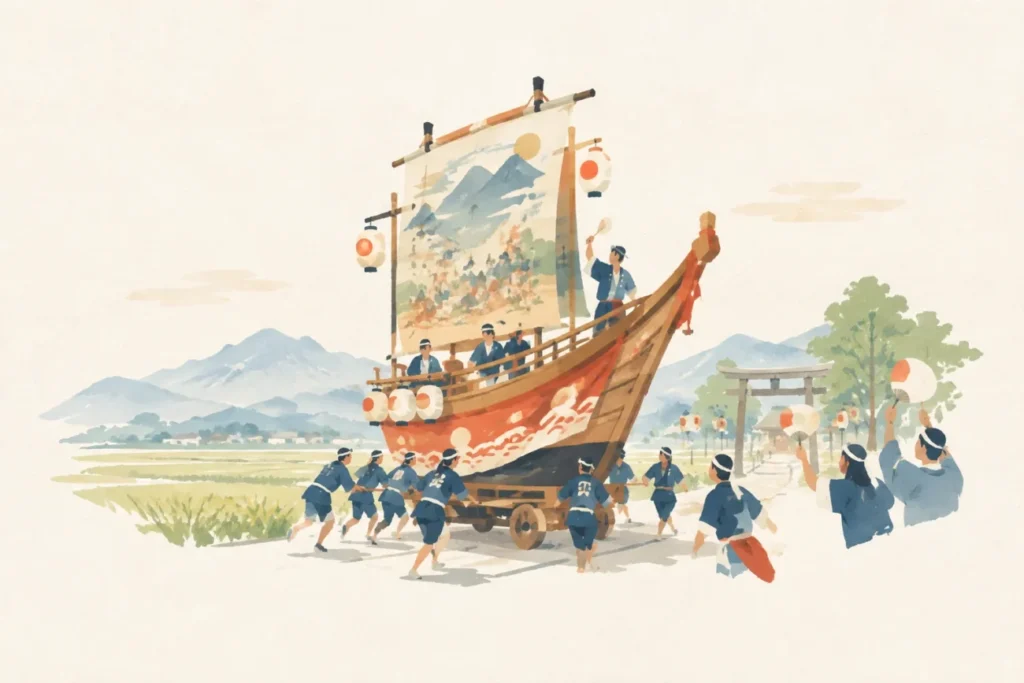
At Shige-yanagi Hachimangu Matsuribune,A boat-shaped dashi about 15 meters long and 5 meters highmoves through the Shige-yanagi district, where rice fields stretch into the distance. The boat is decorated with a historical picture scroll made of wooden figures. On the Hachimangu grounds, it circles the Senzu Stone 3 times, after which members of the preservation associationvigorously rock the boat back and forth. The ongoing ceremony accompanied by is also a highlight.
Highlights of Shige-yanagi Hachimangu Matsuribune
The highlight is seeing a large boat-shaped dashi move through rice fields with ears of rice stretching into the distance. The boat is towed across the Shige-yanagi district from a place called Isemiya in the east to the banks of the Manzu River in the west. After entering the Hachimangu grounds, it circles the Senzu Stone 3 times. Following the shinji, members of the preservation association vigorously rock the boat back and forth in a motion called “fune o aogu.”

Looking at the rice-field scenery and the large boat-shaped dashi together really conveys the festival’s distinctive character!
Location and access
- Venue and address
-
Shige-yanagi Hachimangu, Shige-yanagi district, Minamihotaka, Toyoshina, Azumino City
Venue長野県安曇野市 重柳八幡宮および重柳地区
A map searched by venue name.実際の開催範囲はお祭りの案内をご確認ください。
Japan’s Best Imoni Festival (Yamagata City, Yamagata)
- Dates
- 2026/09/20
- Season / frequency
- Sep / Every year
- Location
- The banks of the Mamigasaki River in Yamagata City (near Sōgetsu Bridge)
- Area
- Yamagata Prefecture・Yamagata City
- Participation / viewing
- Open to public participation / spectators welcome
- Participation fee
- For advance registration, a contribution of 600 yen or more gets you 1 numbered ticket. At on-site registration, a contribution of 700 yen or more, or 1 sponsorship ticket, gets you 1 numbered ticket. Shuttle bus fares: 300 yen one way for high school students and older, 100 yen for elementary and junior high school students, free for preschool children.
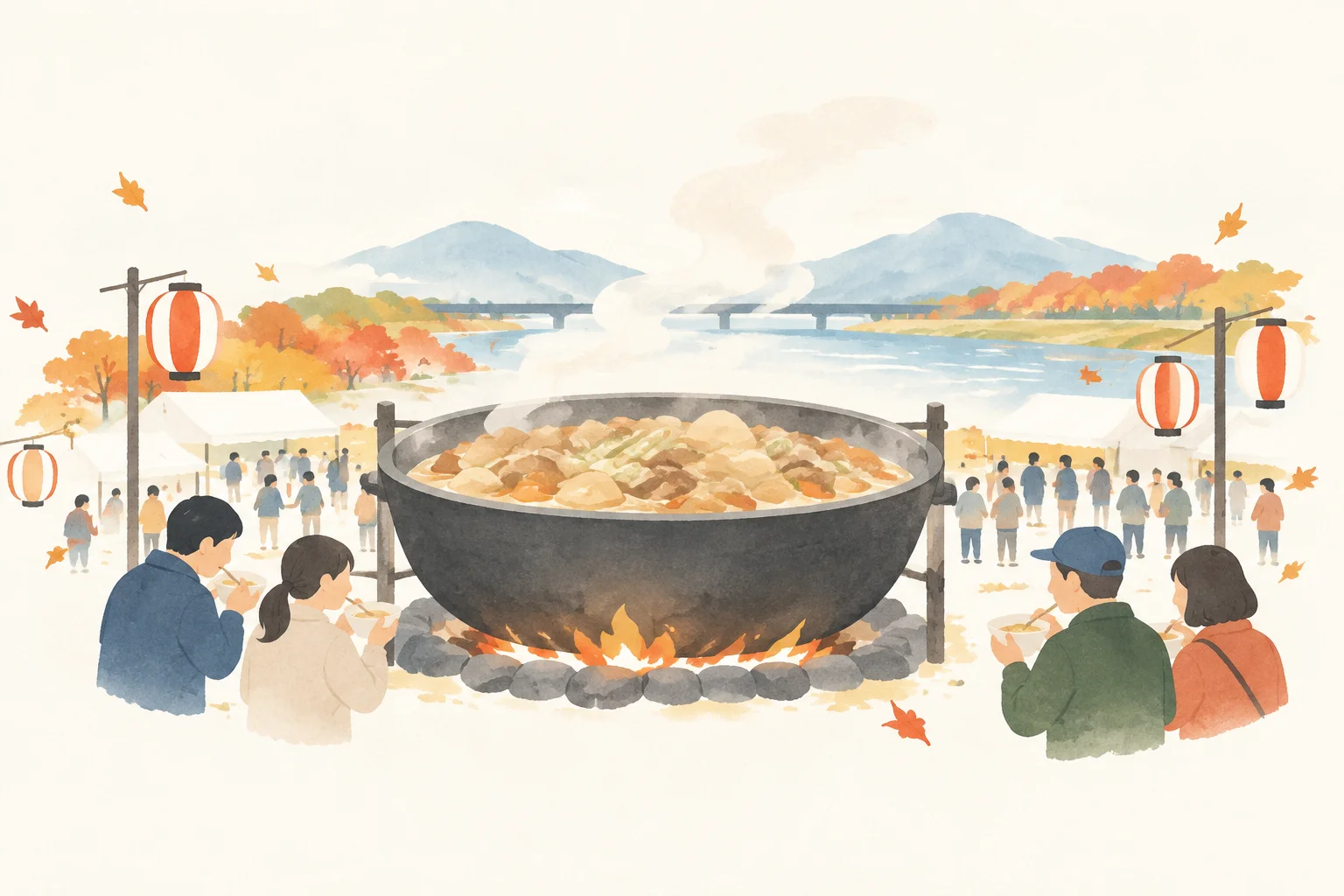
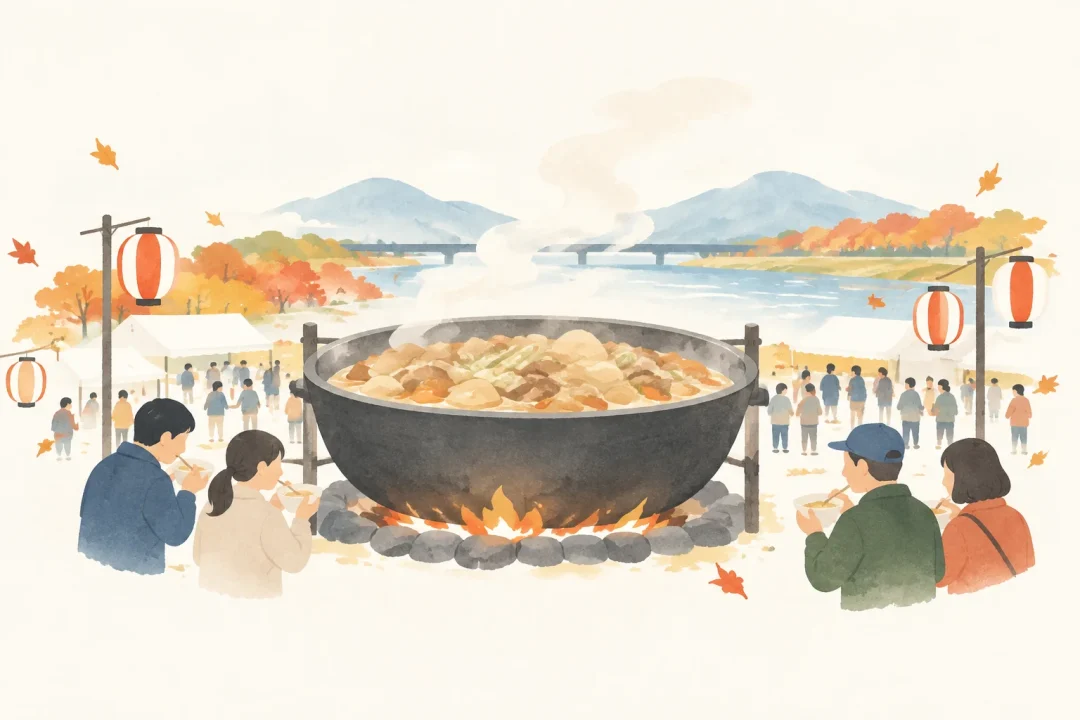
The Japan’s Best Imoni Festival celebrates Yamagata’s food culture withThe 6.5-meter-diameter “Nabетarō III”a festival where you can enjoy. In 2026,About 30,000 servings of imonischeduled to be cooked, and the size of the giant pot itself is a major attraction.
You can enjoy Yamagata-style beef in soy sauce and Shōnai-style pork in miso, along with vendor booths and stage events.
Highlights of the Japan’s Best Imoni Festival

Photo credits and terms of use
U-D.I.E. / Own work / Photo source / CC BY-SA 4.0(may not be from the event edition featured)

Photo credits and terms of use
Clione Salad / Own work / Photo source / CC BY-SA 3.0(may not be from the event edition featured)

Photo credits and terms of use
punimoe / P9071176 / Photo source / CC BY 2.0(may not be from the event edition featured)
The main attraction is the 6.5-meter-diameter “Nabеtarō III.” In 2026, about 30,000 servings of imoni are scheduled to be cooked in this giant pot, which visitors can see up close at the venue. There are also booths run by sponsoring organizations and companies, local food for sale, and stage events, so you can enjoy the whole program—not just the giant pot.

It’s fun to compare the two flavors along with the spectacle of the giant pot, meow~
Location and access
- Venue and address
-
The banks of the Mamigasaki River in Yamagata City (near Sōgetsu Bridge)
- Train and bus
-
Take a Yamakō bus bound for Numano-be from the east exit of JR Yamagata Station and get off at the Yamagata Fire Station stop. The one-way fare is 280 yen. For the return trip, take a local bus from the Yamagata Fire Station stop toward Yamagata Station.
- By car
-
The area near the venue is subject to traffic restrictions, and cars cannot enter directly. Please use the shuttle bus from the designated parking lot.
- Parking
-
You can use the Yamagata Prefectural Office parking lot (about 800 spaces) or the Yamagata City Public Wholesale Market (about 500 spaces). The shuttle bus runs from 8 a.m. to 4 p.m. Fares are 300 yen one way for general passengers, 100 yen for elementary and junior high school students, and free for preschool children.
AddressThe banks of the Mamigasaki River in Yamagata City (near Sōgetsu Bridge)
Indian Waterwheel Festival (Chitose, Hokkaido)
- Dates
- 2026/09/26 〜 2026/09/27
- Season / frequency
- Mid- to late September / Held as an annual event
- Location
- Roadside Station Salmon Park Chitose
- Area
- Hokkaido・Chitose City
- Participation / viewing
- Spectators welcome
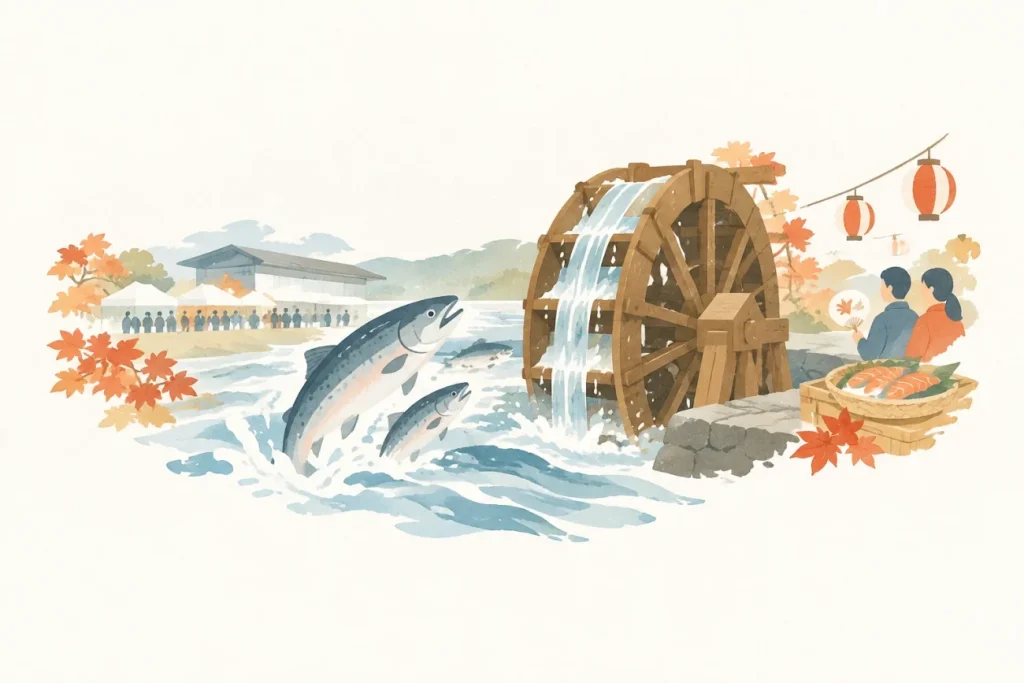
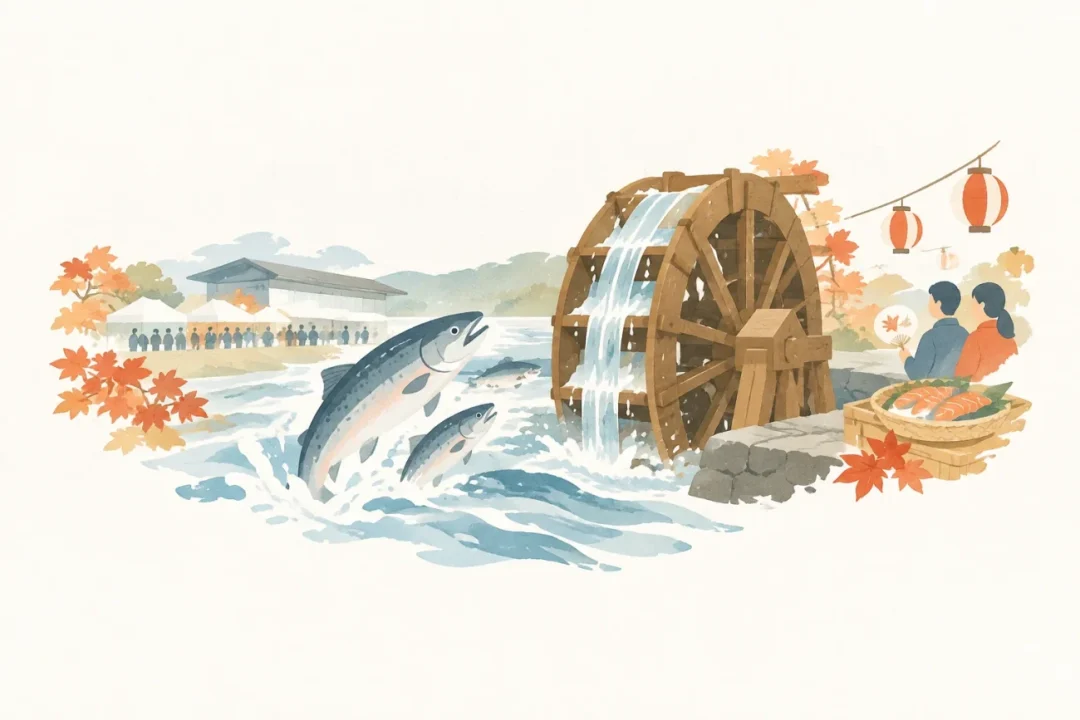
The Indian Waterwheel Festival is centered on salmon swimming up the Chitose River andA water-powered fish wheelan autumn event centered onThe wheel splashing as it turnsconveys the natural flow of the water and the history of fishing in the area.
There are highlights beyond the giant equipment, including salmon hot pot, salmon roe bento, log-sawing races, and yamame fishing.
Highlights of the Indian Waterwheel Festival
The main attraction is seeing salmon swimming up the Chitose River and the Indian waterwheel turning in the current up close. The wheel catches salmon while splashing water, creating a scene that symbolizes autumn in Chitose.
You can also enjoy local specialties such as salmon hot pot and salmon roe bento, as well as log-sawing races, yamame fishing, and stage events.
Enjoy the autumn in Chitose while watching the waterwheel turn and the salmon swim upstream.
Location and access
- Venue and address
-
Roadside Station Salmon Park Chitose (2-4-2 Hanazono, Chitose, Hokkaido)
- Train and bus
-
About a 15-minute walk from JR Chitose Station. Bus information is currently being checked.
- By car
-
About 10 minutes from Chitose IC on the Dōō Expressway.
- Parking
-
200 spaces, free. Crowds are expected during the event, and visitors arriving by car are directed to use the temporary parking lot at Salmon Park Chitose. In 2026, the temporary parking lot at Sumiyoshi Softball Field was designated.
Address2-4-2 Hanazono, Chitose, Hokkaido
Hōrai Festival (Hakusan, Ishikawa)
- Dates
- 2026/10/03 〜 2026/10/04
- Season / frequency
- Saturday and Sunday in early October every year / Every year
- Location
- In the Tsurugi district of Hakusan City
- Area
- Ishikawa Prefecture・Hakusan City
- Participation / viewing
- Spectators welcome
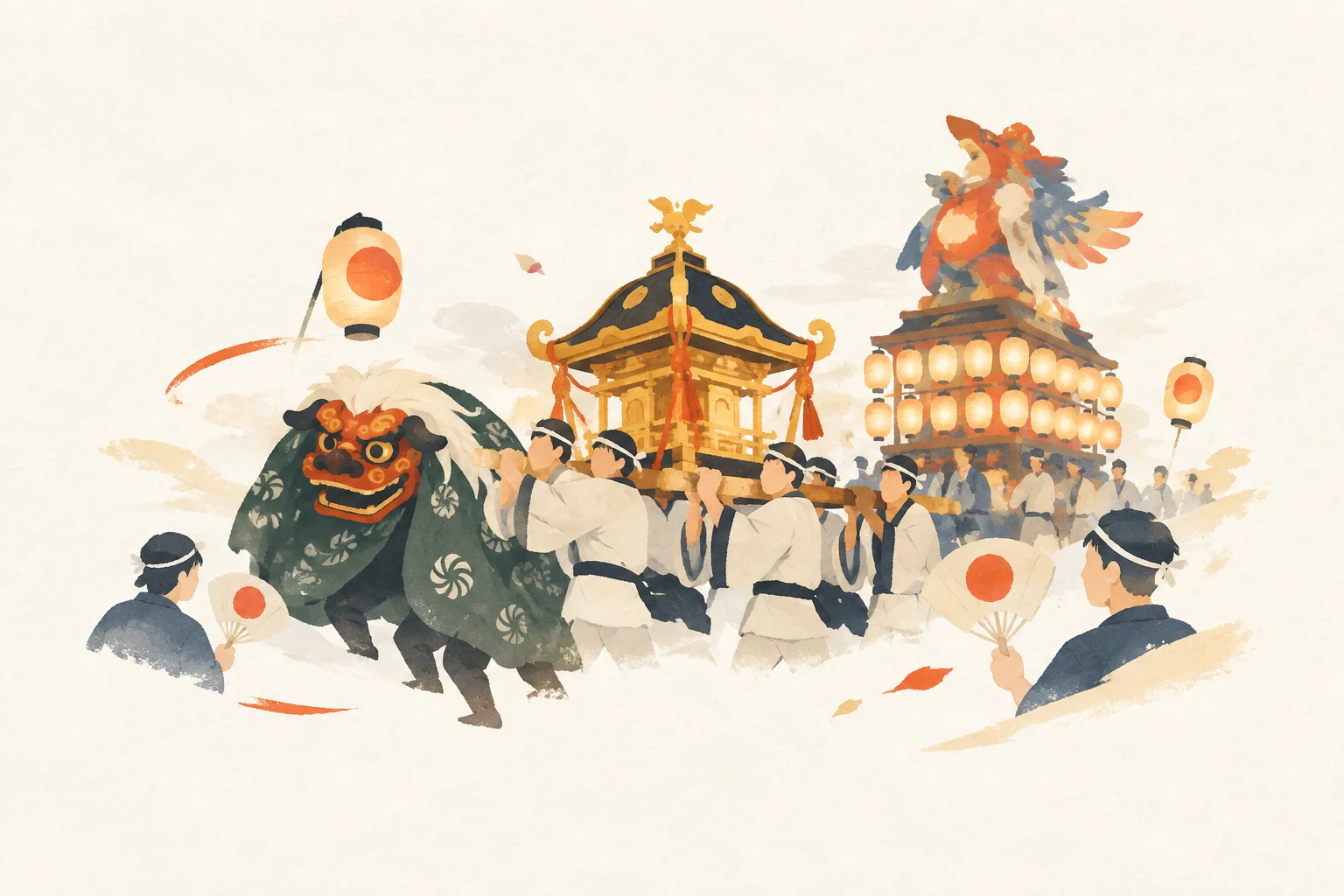
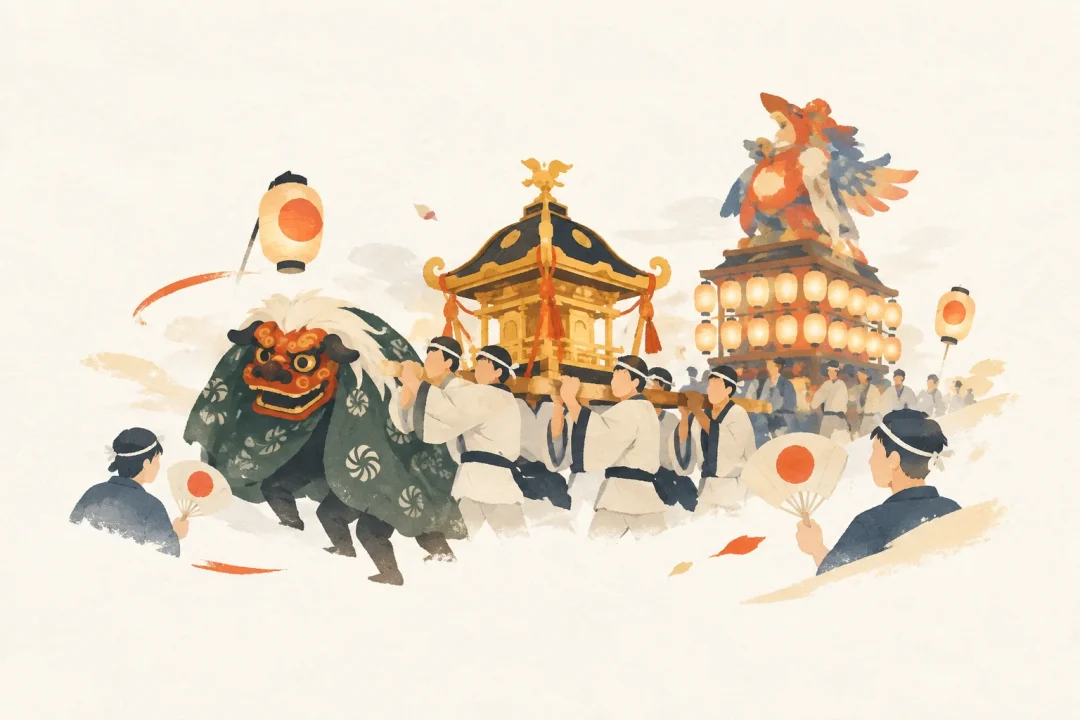
At the Hōrai Festival, , performers,Floats made by each neighborhoodare paraded through the Tsurugi district of Hakusan City.Giant figures about 5 meters tallis made each year with a distinctive design based on subjects such as historical military commanders and kabuki performances, and its appearance changes when illuminated at night. The stick-spinning display and the mikoshi proceeding up steep stone steps are also striking.
Highlights of the Hōrai Festival

Photo credits and terms of use
Kabutosashi / photo taken by Kabutosashi / Photo source / CC BY-SA 3.0(may not be from the event edition featured)

Photo credits and terms of use
Kabutosashi / photo taken by Kabutosashi / Photo source / CC BY-SA 3.0(may not be from the event edition featured)

Photo credits and terms of use
Kabutosashi / photo taken by Kabutosashi / Photo source / CC BY-SA 3.0(may not be from the event edition featured)
The main attraction is the approximately 5-meter-high floats made each year with a distinctive design by each neighborhood. Giant figures based on subjects such as historical military commanders and kabuki performances join the procession and move through town. The shishimai performers put on a stick-spinning display, and at night the floats are lit up, taking on a different appearance from the daytime.
The scene of a mikoshi going up and down steep stone steps is also emblematic of the festival.
Comparing the floats’ changing appearance by day and night really brings out their individual character!
Location and access
- Venue and address
-
In the Tsurugi district of Hakusan City. The address is 118 Mi, Hizume-cho, Hakusan, Ishikawa (the address given for Kinkengu).
- Train and bus
-
Tsurugi Station on the Hokuriku Railroad Ishikawa Line is listed. Bus information is currently being checked.
- By car
-
From Hakusan IC, head south on National Route 157 for 30 minutes.
- Parking
-
Information about festival parking is currently being checked. Because of traffic restrictions, visitors are advised to use public transportation whenever possible.
Address118 Mi, Hizume-cho, Hakusan City, Ishikawa Prefecture
Kakegawa Festival (Kakegawa, Shizuoka)

- Dates
- 2026/10/09 〜 2026/10/11
- Season / frequency
- Early October every year / Held annually. The Kakegawa Grand Festival is held every 3 years, with the Kakegawa Small Festival in the 2 intervening years.
- Location
- The central district around Kakegawa Station
- Area
- Shizuoka Prefecture・Kakegawa City
- Participation / viewing
- Open to public participation / spectators welcome
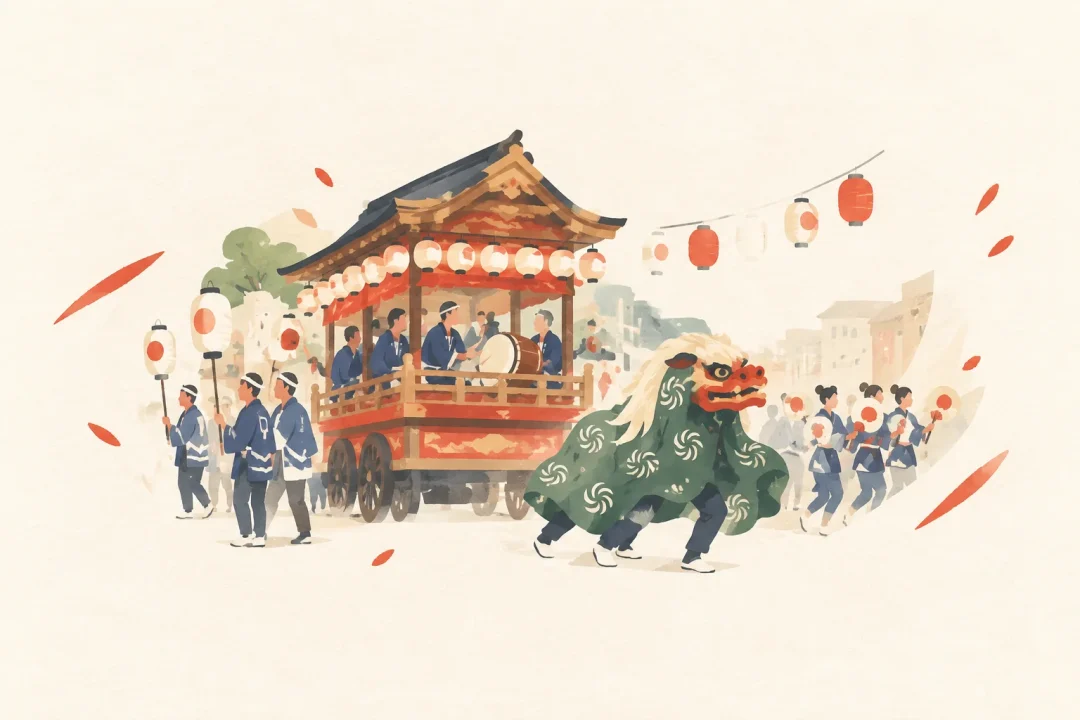
The Kakegawa Festival isInvolving 7 shrines and 41 neighborhoodsand features float processions, shishimai, and performances by each neighborhood.The tegi-awase and teppana when floats pass each otheralong with major performances such as the Great Lion and the Yakko Procession.
Its appeal lies in the scale of multiple floats and performances coming together amid the castle town and streets of the old Tōkaidō.
Highlights of the Kakegawa Festival

Photo credits and terms of use
Tourism and CP Division / https://www.city.kakegawa.shizuoka.jp/opendata/dataset/11600.html / Photo source / CC BY 4.0(may not be from the event edition featured)

Photo credits and terms of use
Tourism and CP Division / https://www.city.kakegawa.shizuoka.jp/opendata/dataset/11600.html / Photo source / CC BY 4.0(may not be from the event edition featured)

Photo credits and terms of use
観光・CP課 / 掛川祭・大祭の写真 – オープンデータサイト / 掛川市ウェブサイト / Photo source / CC BY 4.0(may not be from the event edition featured)
Highlights include the tegi-awase and teppana when floats pass each other, as well as the varied performances handed down in each neighborhood. At the grand festival, “Kankaramachi,” “Great Lion,” and “Yakko Procession” appear as the three main attractions. Performances include a three-lion dance, a large lion, and a procession in which feathered spears are passed from person to person. You can also enjoy hayashi, shamisen, and hand dances on the floats.
Location and access
- Venue and address
-
Held in the central district around Kakegawa Station.
- Train and bus
-
Get off at Kakegawa Station on the Tōkaidō Line (Shinkansen) or the Tenryū Hamanako Railway. During the festival, bus routes will be diverted, and delays due to traffic congestion are expected.
- By car
-
During the festival, cars cannot enter the central district, and general vehicle traffic is prohibited in principle. If arriving by car, use a paid parking lot near Kakegawa Station.
- Parking
-
The Ōtemon parking lot is unavailable from 6 p.m. to 9 p.m. on October 9, 2026, and from 9 a.m. to 9 p.m. on October 10 and the 11th.
Venue静岡県掛川市 掛川駅周辺の中心市街地
A map searched by venue name.実際の開催範囲はお祭りの案内をご確認ください。
Toyohama Chōsa Festival (Kan’onji, Kagawa)

- Dates
- 2026/10/09 〜 2026/10/11
- Season / frequency
- For 3 days from the 2nd Friday of October each year / Once a year
- Location
- Toyohama district, including Toyohama Hachiman Shrine and Ichinomiya Shrine
- Area
- Kagawa Prefecture・Kan’onji City
- Participation / viewing
- Spectators welcome
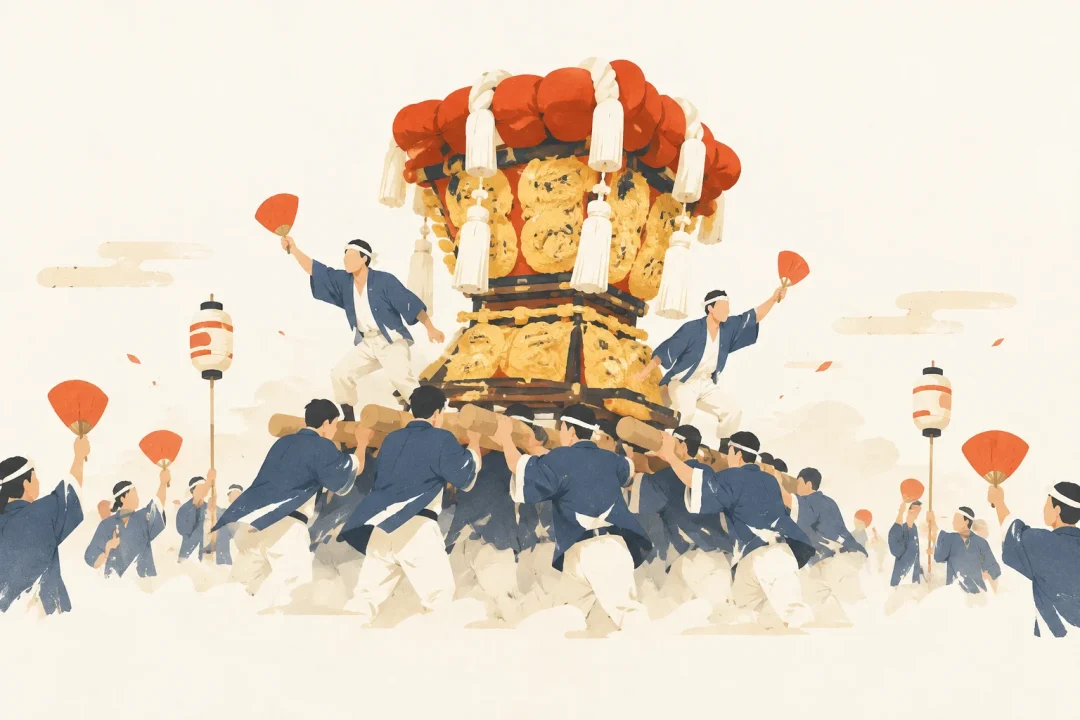
Toyohama Chōsa Festival isTaikodai decorated with gold-thread embroideryis carried through the district in an autumn festival procession. On the final day,All 23 gather at Ichinomiya Shrinefor a spirited carrying contest accompanied by shouts.
The outlines of the taikodai lit by lanterns and illuminations at night, as well as their lavish decorations by day, enhance the impact of this giant festival.
Highlights of the Toyohama Chōsa Festival

Photo credits and terms of use
Araiyasushige / Own work / Photo source / CC BY-SA 4.0(may not be from the event edition featured)
The highlight is the “kakikurabe,” where multiple chōsa gather to compete in strength and skill. On the final day, all 23 taikodai gather at Ichinomiya Shrine, where people maneuver the giant floats amid spirited shouts.
At night, lanterns and illuminations bring out the gold-thread decorations and the outlines of the taikodai, giving them a different kind of splendor from the daytime.
To appreciate the taikodai, notice the embroidery by day and the lights at night.
Location and access
- Venue and address
-
Toyohama district, including Toyohama Hachiman Shrine and Ichinomiya Shrine. The main address provided is Ichinomiya Shrine (156 Himehama, Toyohama-cho, Kan’onji, Kagawa 769-1601).
- Train and bus
-
About a 10-minute walk (900 m) or a 3-minute taxi ride (950 m) from JR Toyohama Station. From JR Kan’onji Station, take the shared bus to near Suga Intersection.
- By car
-
About 4 minutes (1.5 km) from Ōnohara IC on the Takamatsu Expressway.
- Parking
-
Toyohama Elementary School, Toyohama Junior High School, the former Fujibo site, and Ichinomiya Beach are listed as temporary parking lots.
Address156 Himehama, Toyohama-cho, Kanonji City, Kagawa Prefecture 769-1601 (Ichinomiya Shrine)
Kōnosu Fireworks Festival (Kōnosu, Saitama)

- Dates
- 2026/10/10
- Season / frequency
- Early October / Once a year
- Location
- Nukata Sports Ground
- Area
- Saitama Prefecture・Kōnosu City
- Participation / viewing
- Open to public participation / spectators welcome
- Participation fee
- Free (some paid viewing seats available)
The Kōnosu Fireworks Festival launches fireworks over the Arakawa riverbedA fireworks festival launching about 20,000 fireworksis.The finale, “Hōō Ranbu”features a series of fireworks of shaku-dama size and above, while the four-shaku-dama makes its presence felt through its distinctive sound and reach.
It is also distinctive for being organized with public participation, reflecting hopes for local commercial and industrial development and for children.
Highlights of the Kōnosu Fireworks Festival
The highlights are the finale, “Hōō Ranbu,” and the four-shaku-dama. Hōō Ranbu features a series of fireworks of shaku-dama size and above, and the combination of music and fireworks is also said to be part of its appeal. Enjoy about 20,000 fireworks and the impact of large shells over the Arakawa riverbed.
Location and access
- Venue and address
-
Nukata Sports Ground (1073-1 Nukata, Kōnosu, Saitama).
- Train and bus
-
About a 40-minute walk from JR Kōnosu Station. On October 10, 2026, some services on the community bus “Flower-go” are scheduled to be suspended due to traffic restrictions and road congestion.
- By car
-
Crowds are expected around the venue. Check which areas and times are subject to traffic restrictions before you visit.
- Parking
-
Nukata paid parking lot and Yoshimi General Sports Park parking lot are listed.
Address1073-1 Nukata, Kōnosu, Saitama Prefecture
National Jumbo Rabbit Festival (Daisen, Akita)

- Dates
- 2026/10/17 〜 2026/10/18
- Season / frequency
- The 3rd Saturday and Sunday of October every year / Every year
- Location
- Donpan Square (around the Daisen City Nakasen Government Office)
- Area
- Akita Prefecture・Daisen City
- Participation / viewing
- Spectators welcome
- Participation fee
- Free
The National Jumbo Rabbit Festival is a judging contest where visitors compare large white rabbits that have been raised in the Nakasen area of Daisen City.A judging contest comparing large white rabbitsis.Jumbo class: 8 kilograms or moreThere are categories judged on body length and weight, as well as the combined weight of 3 rabbits, and rabbits are assessed not only for size but also for shape and coat.
Activities such as a weight-guessing contest and mochi pounding are also held.
Highlights of the National Jumbo Rabbit Festival

Photo credits and terms of use
JumboUsagi / Own work / Photo source / CC BY-SA 3.0(may not be from the event edition featured)
The main attraction is a judging contest where you compare not only the jumbo rabbits’ size but also their shape and coats. Judging takes place in several categories, including jumbo class for rabbits weighing 8 kilograms or more, categories judged on body length and weight, and “set jumbo,” which compares the combined weight of 3 rabbits.
Other activities include a weight-guessing contest, mochi pounding, and a puzzle competition, so there is more to enjoy than the judging contest alone.
Look at not only their weight but also differences in shape and coat, meow~
Location and access
- Venue and address
-
Donpan Square (in front of the Daisen City Nakasen Branch Office). The address is 141 Chabatake, Kitanagano, Daisen, Akita.
- Train and bus
-
A 5-minute walk from JR Ugo-Nagano Station. Take the Ugo Kotsu bus to the Ugo-Nagano Station stop, then walk 5 minutes.
- By car
-
About 30 minutes from Ōmagari IC on the Akita Expressway via National Route 105. From Morioka IC on the Tōhoku Expressway, it is about 50 minutes via National Route 105.
- Parking
-
100 spaces, free.
Address141 Chabatake, Kitanagano, Daisen, Akita
Ōinoko Festival (Hiroshima City, Hiroshima)

- Dates
- 2026/11/07 〜 2026/11/08
- Season / frequency
- The 1st Saturday and Sunday of November every year / Every year
- Location
- Fukuro-machi Park
- Area
- Hiroshima Prefecture・Hiroshima City
- Participation / viewing
- Spectators welcome
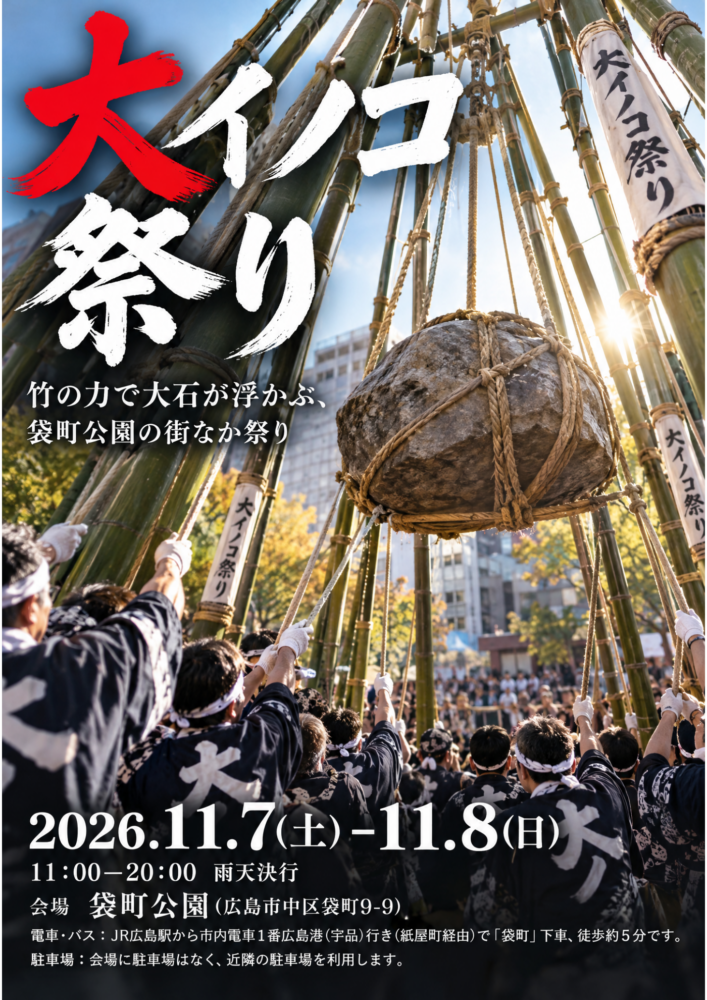
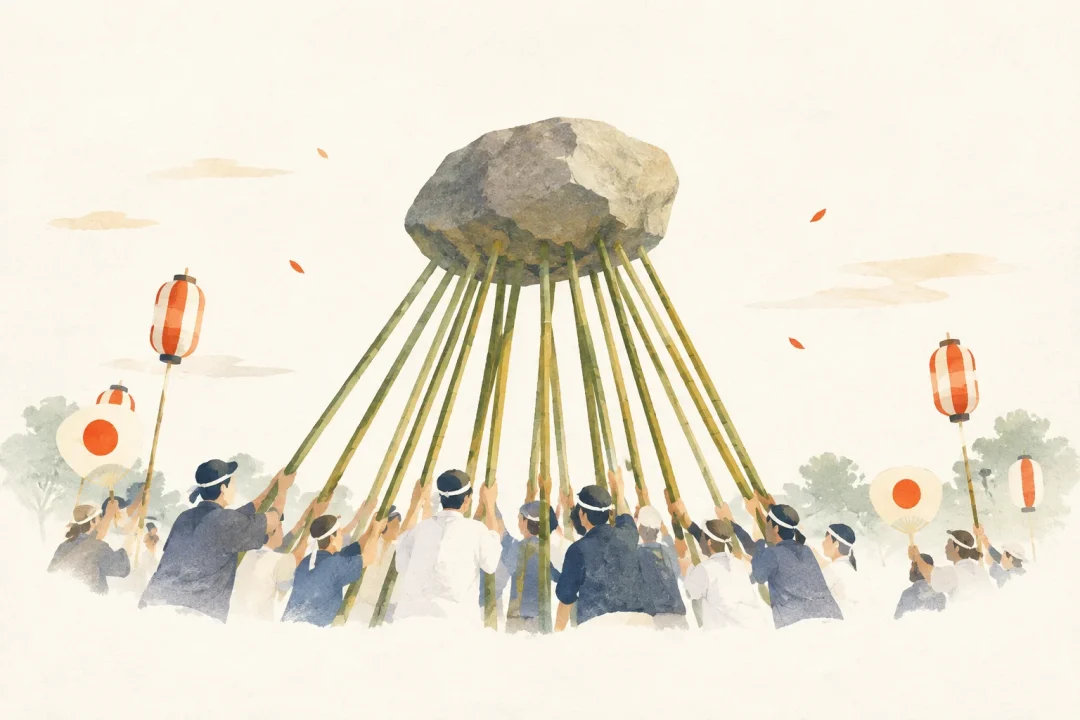
The Ōinoko Festival, held in Fukuro-machi Park,using 88 bamboo poles,Raise a huge stone weighing about 1.5 tons into the aircommunity event. The “Inoko Installation,” which suspends the stone using the tension of the bamboo, creates a distinctive scene in which a giant structure appears in an urban park.
The presence of the citizens’ group supporting the festival is also notable as part of its deep roots in the community.
Highlights of the Ōinoko Festival

Photo credits and terms of use
Rukashii / Own work / Photo source / CC BY-SA 4.0(may not be from the event edition featured)

Photo credits and terms of use
Rukashii / Own work / Photo source / CC BY-SA 4.0(may not be from the event edition featured)

Photo credits and terms of use
Rukashii / Own work / Photo source / CC BY-SA 4.0(may not be from the event edition featured)
The main attraction is the moment when 88 bamboo poles are used to raise a huge stone weighing about 1.5 tons into the air. The mechanism itself—lifting a stone using the tension of bamboo—has become a distinctive scene that symbolizes the festival.
You can see the structure made of a huge stone and bamboo up close in Fukuro-machi Park, an urban park.
It’s interesting to observe up close how the bamboo is arranged to support the stone and how its tension works.
Location and access
- Venue and address
-
Fukuro-machi Park (9-9 Fukuro-machi, Naka Ward, Hiroshima City)
- Train and bus
-
About 10 minutes by streetcar (any line except Line ⑤) from the south exit of JR Hiroshima Station to Hatchōbori stop, then about a 5-minute walk
Address9-9 Fukuromachi, Naka Ward, Hiroshima
At a glance
Looking back at the giant festivals held in autumn 2026, it becomes clear that their impact comes from more than sheer size.Local hopes, food culture, and shinjiand inherited techniques,giant mortars and pots, dashi, taikodai, and stoneswere tied to them.
Some festivals offer food to enjoy, like mochi pounding and imoni, while others let you compare skill and strength through float processions, carrying contests, and judging competitions. Checking when events take place and what they involve—and learning about the background of festivals that catch your interest—can deepen your perspective when you look up information next time.
Festivals related to this article

Furusato Hyappomochi Festival
An autumn festival that powerfully celebrates Iwamizawa’s harvest with a giant mortar

Shigeyanagi Hachiman Shrine Festival Boat
A great boat crossing golden fields: an autumn dedication ritual passed down in Shigeyanagi
Japan’s No. 1 Imoni Festival
Yamagata’s autumn flavors in a giant pot: the grand stage of imoni culture
Indian Water Wheel Festival
A Chitose fall festival featuring salmon runs and the impressive water wheel
Hōrai Festival
An autumn festival that fills Tsurugi’s streets with giant floats and a mikoshi
Kakegawa Festival
The castle town of Kakegawa brought to life by dashi and lions, with a neighborhood festival passed down through generations
Toyohama Chosa Festival
An autumn festival that fills Toyohama with the sound of drums and lavishly decorated chosa

Kōnosu Fireworks Festival
Kōnosu’s enormous fireworks and Hōō Ranbu, echoing across the Arakawa riverbed


Dai Inoko Festival
A festival in the heart of the city, where a large stone floats through the power of bamboo
