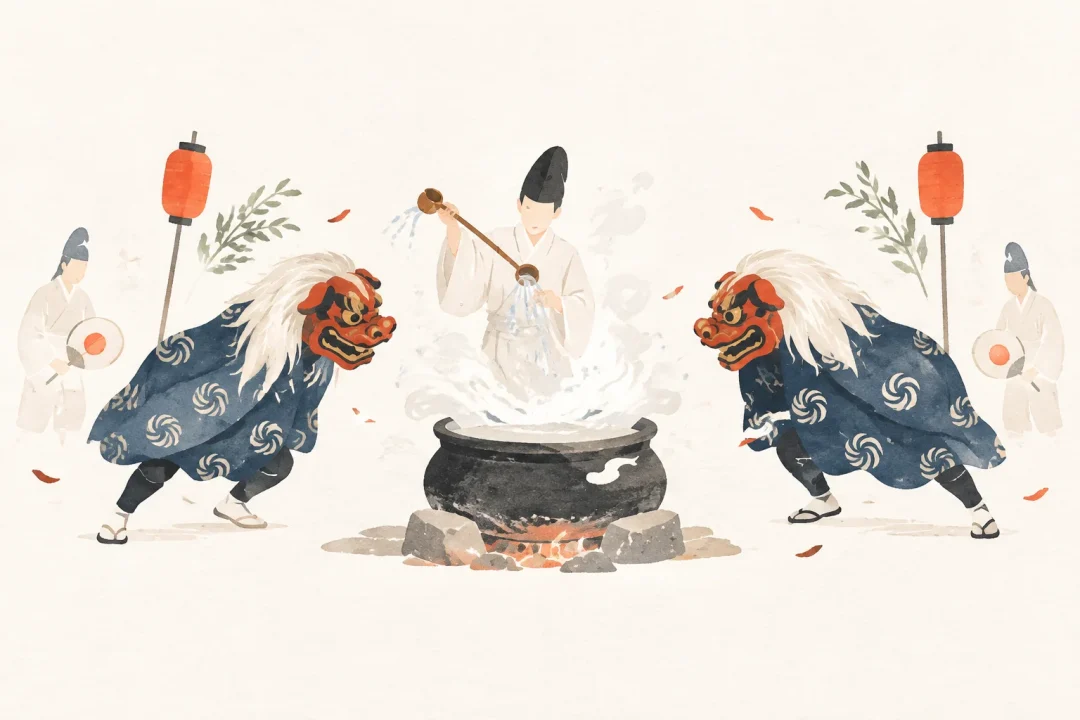
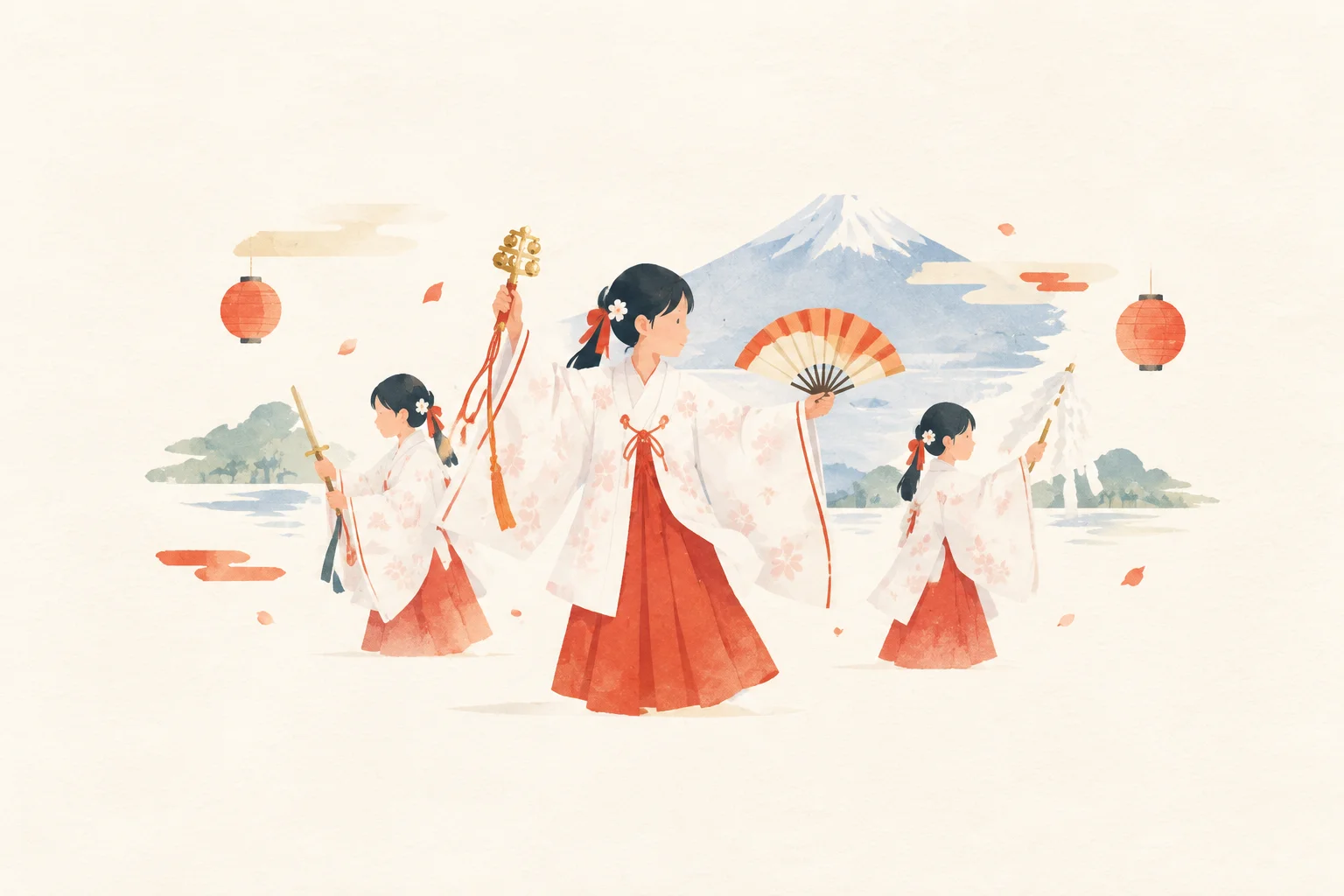
A chigo kagura at Kawaguchi Asama Shrine, with 5 dances performed using bells and ritual implements
Kawaguchi Chigo-mai
Festival information
EVENT INFORMATION- Season / frequency
- Every year, April 25 and July 28 / Twice a year
- Area
- Yamanashi Prefecture・Fujikawaguchiko Town(From Tokyo: approx. 1 h 30 min–2 h · limited express)Prefecture-level estimate to a main station or airport, not the venue. Airport access, check-in and onward travel are extra; remote areas and islands can take much longer.
- Highlights and activities
- Last updated
- 2026/10/19
Kawaguchi Chigo-mai is a chigo performed by girls and passed down at Kawaguchi Asama Shrine in Fujikawaguchiko Town. Dances featuring bells, , fans, and swords are performed in the during the festivals in April and July.
About Kawaguchi Chigo-mai
Kawaguchi Chigo-mai is a folk performing art passed down at Kawaguchi Asama Shrine in Kawaguchi, Fujikawaguchiko Town, Yamanashi Prefecture.
Girls selected from among the perform in the worship hall at the Magomi Festival in April 25 and the Daidai Goshinkaku Festival in July 28.
Locally, it is also called “Odaidai,” after the Daidai Kagura, and it has been designated an Important Intangible Folk Cultural Property of Japan.
Festival highlights
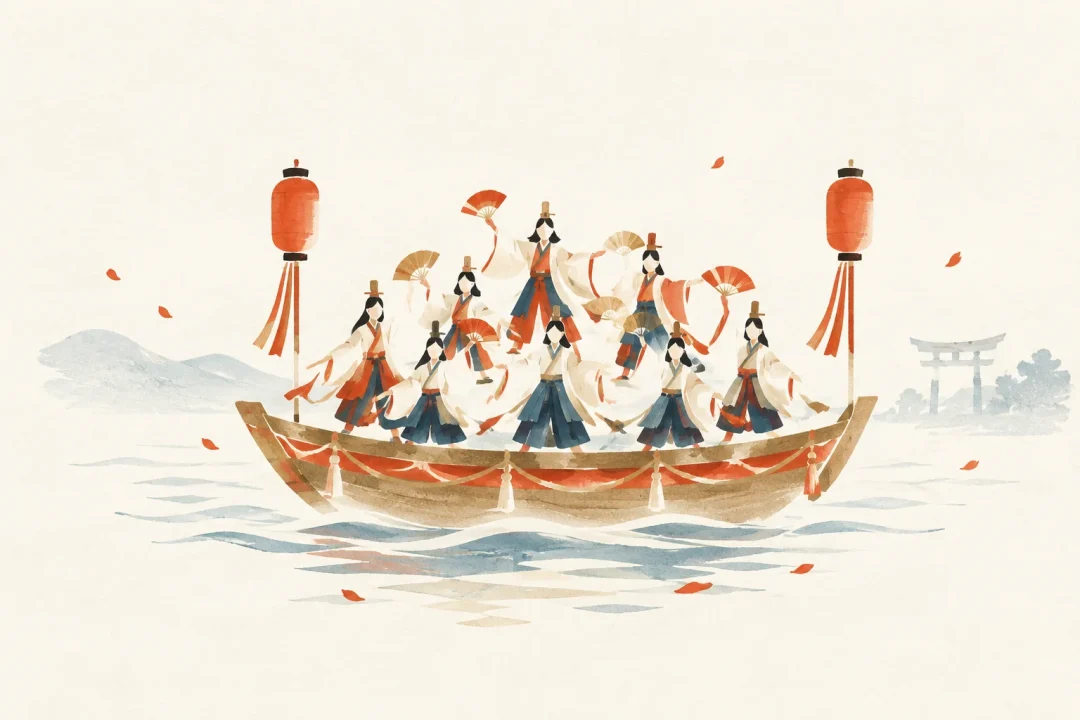
Highlights include the young dancers dressed in white robes layered with scarlet chihaya or jinbaori jackets and adorned with yoraku ornaments and tenkan crowns, as well as their graceful dances performed with bells, gohei, fans, and swords.
The program consists of 5 dances: the gohei dance, fan dance, sword dance, Happo dance, and Miyameguri dance.
In the Happo dance, the dancers face the four cardinal directions as well as the four diagonal directions. In the Miyameguri dance, they circle 3 times from the worship hall to the area in front of the main shrine.
Source: 国指定文化財等データベース
A chigo kagura at Kawaguchi Asama Shrine, with 5 dances performed using bells and ritual implements
What to expect
The performance takes place in the worship hall. At the flute’s “call,” the young dancers bow, take up their ritual implements, and begin to dance.
The musical accompaniment consists of drums, kako, and flute. The dancers mainly use sliding steps, combining them with movements that face the four or eight directions.
All 5 dances are performed at the Daidai Goshinkaku Festival in July, while 3 dances—the gohei, fan, and sword dances—are performed at the annual festival in April.
Location and access
- Address
Fujikawaguchiko Town
Host municipality 山梨県富士河口湖町
This map shows the surrounding area, not the exact venue location.
Dates and season
It is usually performed at the Magomi Festival on April 25 and the Daidai Kagura Festival on July 28.
In April, 3 dances are performed: the Gohei Dance, Fan Dance, and Sword Dance. In July, 5 dances are performed, adding the Dance of the Eight Directions and the Shrine-Circuit Dance.
Accommodation and hotels PR
Showing nearby accommodation.
Prices and availability are current at the time of retrieval. For multi-night stays, only the first night’s price is shown. Confirm the final price and directions to the venue with the booking provider. Select your dates again when using the area search link. Search area: within 3 km of Central Yamanashi Prefecture / Fujikawaguchiko Town (the search is not centered on the festival venue)
Nearby attractions
At the venue, Kawaguchi Asama Shrine, you can see seven cedars said to be 1,200 years old, the beautiful stone known as part of an ancient stone structure, and the remains of a Jomon-period ritual site.
Within walking distance, the sites also include the " of the Sky," a place for worshipping Mount Fuji from afar, and Haha no Shirataki Falls, which has a subsidiary shrine.
Alongside the festival, you can visit highlights within the connected with Kawaguchi’s faith and natural surroundings.

冨士御室浅間神社
山梨県富士河口湖町にある神社

山梨県立富士山世界遺産センター
山梨県富士河口湖町にある世界遺産のガイダンス施設

河口浅間神社
山梨県富士河口湖町にある神社

河口湖ステラシアター
山梨県富士河口湖町にある野外音楽堂

河口湖美術館
山梨県富士河口湖町にある美術館

河口湖音楽と森の美術館
山梨県富士河口湖町の美術館

西湖いやしの里根場
日本の山梨県富士河口湖町にある野外博物館
Origins and History of Kawaguchi Chigo-mai
Kawaguchi Chigo-mai has been passed down in Kawaguchi, a prosperous Oshi town that served as a base for pilgrimages up Mount Fuji, in connection with Kawaguchi Asama Shrine’s Daidai Kagura.
Evidence of Daidai Kagura confraternities in the Edo period, a drum inscribed with a date from the Genroku era, and a jinbaori jacket made in 1848 tell of the tradition’s background.
It was designated an Intangible Folk Cultural Property of Yamanashi Prefecture in 1960 and an Important Intangible Folk Cultural Property of Japan in 2017.
Source: 河口の稚児舞 - Wikipedia
Official information
Kawaguchi Asama Shrine’s official website provides information about festivals and events, including the 2026 annual grand festival and the Daidai Goshinkaku Festival.
Source: 河口浅間神社 公式サイト
Kawaguchi Chigo-mai at a Glance
Kawaguchi Chigo-mai is a chigo kagura consisting of 5 dances performed by girls at Kawaguchi Asama Shrine.
The dancers perform with bells, gohei, fans, and swords, combining sliding steps with movements that face the four directions, at the festivals in April and July.
Connected to Kawaguchi’s religious traditions and Oshi culture, it is a local performing art that has also been designated an Important Intangible Folk Cultural Property of Japan.
Japanese Festivals.jp Editorial Team
Celebrating local culture and helping you discover a side of Japan you never knew.
Article updated: 2026/10/19
Submit information or a correction Submit photos of this festival