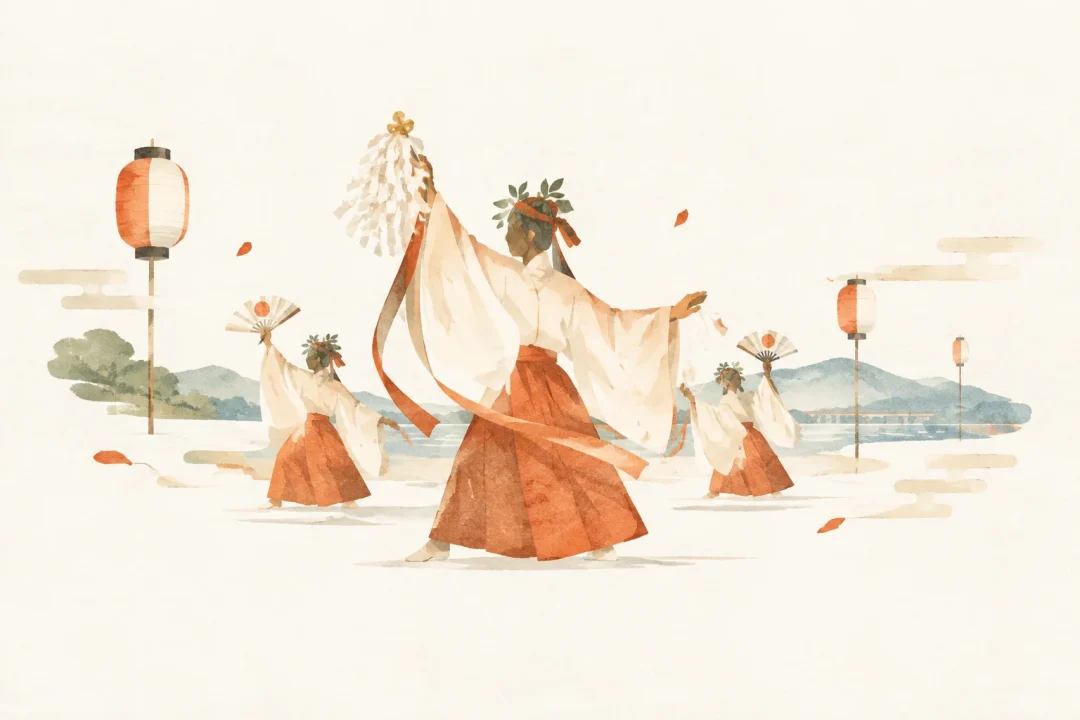
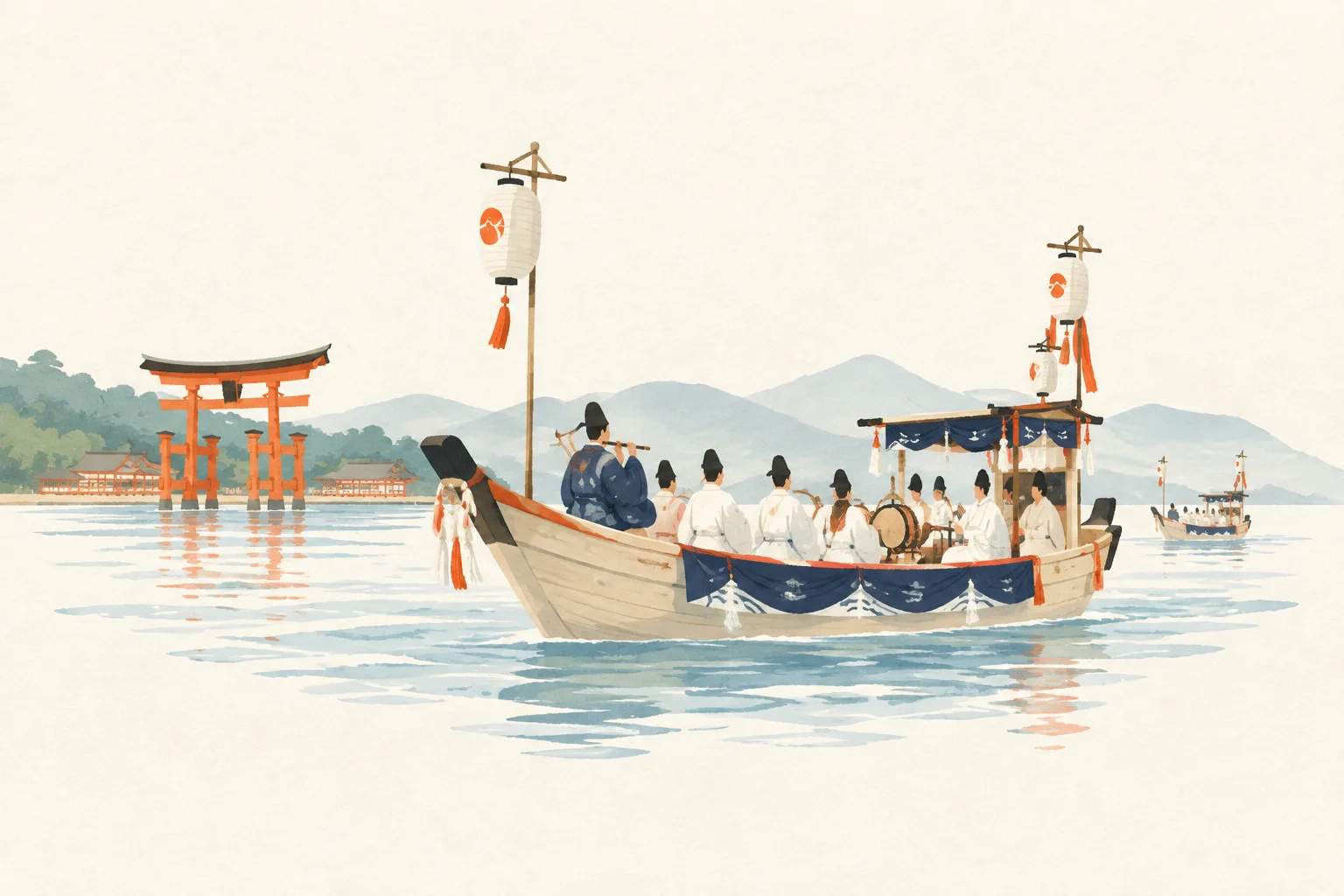
A Heian-era scene unfolds on Miyajima as the gozasen glides across the water to the sound of gagaku
Kangen-sai
The 2026 edition of Kangen-sai has ended.
Festival information
EVENT INFORMATION- Dates
- 2026/07/30Ended
- Season / frequency
- day 17 of lunar month 6 / Every year
- Location
- Itsukushima Shrine and the surrounding area
- Area
- Hiroshima Prefecture・Hatsukaichi City(From Tokyo: approx. 3 h 50 min–4 h 20 min · bullet train)Prefecture-level estimate to a main station or airport, not the venue. Airport access, check-in and onward travel are extra; remote areas and islands can take much longer.
- Features
- Highlights and activities
- Participation / viewing
- Spectators welcome
- Last updated
- 2026/10/19
This longstanding boat ritual takes place on the waters around Miyajima, as the gozasen performs gagaku while visiting Itsukushima Shrine and shrines on the opposite shore.
About Kangen-sai
Kangen-sai is a boat festival representing Miyajima, held to console the deities of Itsukushima Shrine.
It is said that Taira no Kiyomori incorporated the courtly pastime of playing gagaku into a on Miyajima, where it developed against the backdrop of the Seto Inland Sea.
The sight of the gozasen traveling between the shrine and the opposite shore as gagaku is performed reflects Miyajima's faith and traditions, in which the sea and shrine buildings are closely connected.
Source: 管絃祭|行事|一般社団法人宮島観光協会
Festival highlights
The main highlight is the sight of the lavishly decorated gozasen gliding across the water as gagaku is performed.
Bonfires are lit on both sides of the bow, and more than 20 lanterns are illuminated, making the boat stand out against the sea at night.
Toward the end, the gozasen makes 3 circuits of the narrow masu-shaped basin while gagaku is performed, bringing the festival to its climax.
A Heian-era scene unfolds on Miyajima as the gozasen glides across the water to the sound of gagaku
What to expect
The festival begins with the departure ceremony at the main hall of Itsukushima Shrine. The carrying the deity is then taken to the gozasen offshore from the Great Gate.
After performing a ritual in front of the Great Torii Gate, the gozasen heads to Jigozen Shrine while gagaku is performed, stopping along the way to wait for the tide to come in.
It then visits Nagahama Shrine and Omoto Shrine before returning to Itsukushima Shrine for the return ceremony.
How to take part
Visitors can watch the event.
Location and access
- Venue and address
Itsukushima Shrine and the surrounding area.
The gozasen travels from Itsukushima Shrine on the Miyajima side past the Great Torii Gate to Jigozen Shrine, Nagahama Shrine, and the area around Omoto Shrine on the opposite shore.
- Train and bus
Take either the JR West Miyajima Ferry or Miyajima Matsudai Kisen from Miyajimaguchi Pier to Miyajima.
The crossing takes 10 minutes.
- By car
Since Miyajima is not well suited to sightseeing by car, visitors are advised to park at Miyajimaguchi and take a ferry.
- Parking
Parking is available near Miyajimaguchi Pier.
Check local information for parking locations and congestion.
Source: アクセス|一般社団法人宮島観光協会
Event venue 広島県廿日市市 嚴島神社及び
This map uses the venue name. Check the official guide for the event area and entrances.
Dates and season
2026 event information (the listed dates have passed)
Kangen-sai is held every year on day 17 of lunar month 6.
In 2026, it was scheduled for July 30 (Thursday), with the departure ceremony at 15:00, departure from the main shrine at 16:00, arrival at Jigozen Shrine at 19:20, and return to the main shrine at 23:00.
Times may change significantly depending on the tide level and currents on the day.
Accommodation and hotels PR
Showing nearby accommodation.
Prices and availability are current at the time of retrieval. For multi-night stays, only the first night’s price is shown. Confirm the final price and directions to the venue with the booking provider. Select your dates again when using the area search link. Search area: within 3 km of Central Hiroshima Prefecture / Hatsukaichi City (the search is not centered on the festival venue)
Tips for your visit
The gozabune’s progress is affected by the tides and currents, so it may not proceed at the times indicated.
The event continues into the night, with the return to the scheduled for 23:00.
You need to take a boat to Miyajima. If you’re visiting by car, the guidance is to park at Miyajimaguchi and then take the ferry.
Nearby attractions
The festival takes place at Itsukushima Shrine, whose buildings appear to float on the sea. The Great Torii Gate, Takabutai stage, and Hiyoke-mae are among the features of the .
Miyajima is also home to other shrines and temples, including Senjokaku Pavilion and its five-story pagoda at Toyokuni Shrine, Daiganji Temple, and Daishoin Temple.
These sites offer a chance to experience Miyajima's religious culture alongside a visit to Kangen-sai's setting.
Source: 観光スポット|一般社団法人宮島観光協会

ウッドワン美術館
広島県の博物館・美術館のスポットです。

三翁神社
広島県廿日市市宮島町にある神社

厳島神社
広島県廿日市市の厳島(宮島)にある神社

宮島水族館
広島県廿日市市にある水族館

広島大学大学院統合生命科学研究科附属宮島自然植物実験所
広島県廿日市市の厳島にある教育・研究施設

速谷神社
廿日市市にある神社
Origins and History of Kangen-sai
Kangen-sai is said to have begun when Taira no Kiyomori brought to Miyajima a courtly pastime involving gagaku that was enjoyed in Heian-kyo, incorporating it into a Shinto ritual.
During the Heian period, the entire island was regarded as a deity, and people could not live there. As a result, boats carrying gagaku traveled from Jigozen Shrine on the opposite shore to Itsukushima Shrine.
It is said that people began living on the island from the Kamakura period onward, and the festival took its current form, departing from Itsukushima Shrine and stopping at Jigozen Shrine.
Source: 管絃祭 - Wikipedia
Official information
The Kangen-sai guide from the Miyajima Tourism Association provides information on event dates, scheduled times, the festival program, and the origins of the gozasen.
Information on getting to Miyajima and parking around Miyajimaguchi is available in the association's access guide.
Kangen-sai at a Glance
Kangen-sai is a boat festival and Shinto ritual at Itsukushima Shrine, in which the gozasen travels between Miyajima and the opposite shore while gagaku is performed.
Highlights include the boats lit by bonfires and lanterns, the route past Jigozen Shrine and Nagahama Shrine, and the nighttime ceremony returning to Itsukushima Shrine.
In 2026, it was scheduled for July 30; note that times may change due to tide levels and currents.
Japanese Festivals.jp Editorial Team
Celebrating local culture and helping you discover a side of Japan you never knew.
Article updated: 2026/10/19
Submit information or a correction Submit photos of this festival