A Dedication Sumo Match with an Invisible Rice Spirit on Omishima
Hitori-zumo

The 2026 edition of Hitori-zumo has ended.
Festival information
EVENT INFORMATION- Dates
- 2026/06/19Ended
- Season / frequency
- It is held annually during the Otaue Festival on day 5 of lunar month 5 and Nukiho on day 9 of lunar month 9. / Every year
- Location
- Ōyamazumi Shrine
- Area
- Ehime Prefecture・Imabari City(From Tokyo: approx. 1 h 25 min–1 h 45 min · flight time only)Prefecture-level estimate to a main station or airport, not the venue. Airport access, check-in and onward travel are extra; remote areas and islands can take much longer.
- Wishes behind the festival
- Last updated
- 2026/10/19
A traditional Shinto rite on Omishima in Imabari, in which a lone wrestler performs a match against a rice spirit in the sacred rice paddy at Ōyamazumi Shrine.
About Hitori-zumo
Hitori-zumo is a held at Ōyamazumi Shrine in Miyaura, Omishima-cho, Imabari, Ehime Prefecture.
During the Otaue Festival and Nukiho ceremony, a wrestler faces an invisible rice spirit in front of the sacred rice paddy.
It is a precious local performing art passed down through generations and designated an Ehime Prefecture Intangible Folk Cultural Property.
It can be seen as a distinctive festival that brings together agriculture, Shinto ritual, and performing arts dedicated to the gods.
Source: 一人相撲 - えひめの文化財(たから)
Festival highlights
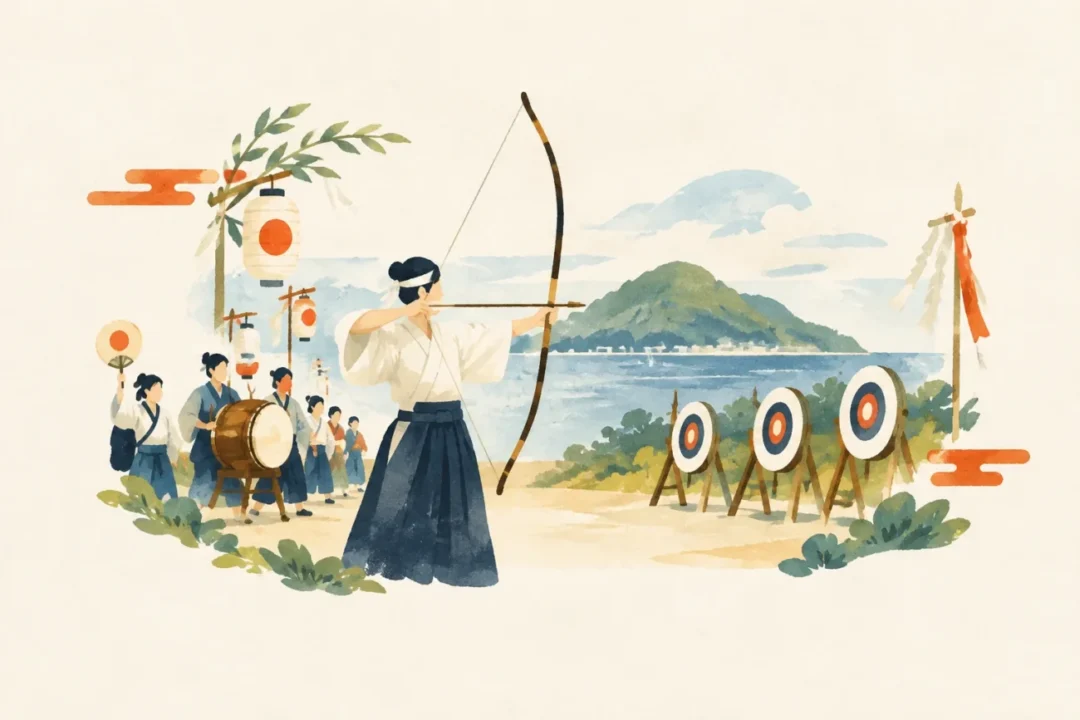
The main highlight is that a lone wrestler performs a sumo match as if facing an invisible rice spirit.
Holding a gunbai, the referee bows before the shrine and calls out, “Konata Seirei” and “Kata ya Ichiriki-yama.”
In addition to the earlier single-match contest, a three-match format has also been performed since the Meiji period, with one wrestler portraying both sides in pushing bouts and throws.
The presence of , shrine maidens, young women taking part in the rice-planting ceremony, and shrine representatives around the ring also creates a distinctly ceremonial atmosphere.
A Dedication Sumo Match with an Invisible Rice Spirit on Omishima
What to expect
The event takes place after the Otaue Festival or Nukiho ceremony, in a permanent ring set up in front of the sacred rice paddy.
The referee makes announcements, and the wrestler enters the ring to the gunbai and calls, performing a match against the spirit alone.
Through gestures such as stomping the ring, pretending to receive ritual water, and scattering salt, the wrestler performs a contest of strength with an unseen opponent.
This dedication unites the ritual etiquette of a Shinto ceremony with the movements of sumo.
Location and access
- Venue and address
Ōyamazumi Shrine (3327 Miyaura, Omishima-cho, Imabari).
- Train and bus
Information is available on taking a route bus from Matsuyama to the Miyaura Port area via Imabari, stopping at places such as Kamiura BS and Omishima BS, and getting off at “Ōyamazumi Shrine-mae” or “Ōyamazumi Shrine.”
From in front of Imabari Station, take either a Setouchi Bus express or a Setonaikai Kōtsū rapid service and get off at “Ōyamazumi Shrine.”
- By car
About 10 minutes from Omishima IC.
- Parking
The shrine’s parking information says, “None (free municipal parking available nearby).”
Tourist information lists 13 spaces beside the gate and 50 free spaces at the nearest municipal parking lot, Fuji Park.
Source: 大山祇神社 | 観光スポット | 観光情報 | 今治市
Address 3327 Miyaura, Omishima-cho, Imabari
Dates and season
2026 Event Information (The listed dates have passed)
In 2026, the Ōyamazumi Shrine Otaue Festival (Hitori-zumo) was listed for June 19.
Source: 大山祇神社御田植祭(一人角力) | イベント | 今治市
Accommodation and hotels PR
Showing nearby accommodation.
Prices and availability are current at the time of retrieval. For multi-night stays, only the first night’s price is shown. Confirm the final price and directions to the venue with the booking provider. Select your dates again when using the area search link. Search area: within 3 km of Central Ehime Prefecture / Imabari City (the search is not centered on the festival venue)
Nearby attractions

かわら館
愛媛県今治市にある博物館

ところミュージアム大三島
愛媛県今治市大三島にある現代彫刻の美術館
写真:-- 地方の田舎もの ( 会話 ) 2022年9月3日 (土) 13:14 (UTC) / CC BY 3.0
Photo source ·
タオル美術館ICHIHIRO
愛媛県今治市にある美術館

今治市伊東豊雄建築ミュージアム
愛媛県今治市大三島にある建築美術館

今治市大三島美術館
愛媛県今治市大三島にある美術館

今治市大西藤山歴史資料館
愛媛県今治市に所在する考古学博物館

今治市岩田健母と子のミュージアム
愛媛県今治市大三島にある美術館

今治市河野美術館
愛知県今治市にある美術館

今治市玉川近代美術館
愛媛県今治市にある美術館

Kamo Shrine
愛媛県今治市にある神社

Ōyamazumi Shrine
愛媛県今治市大三島にある神社

愛媛文華館
愛媛県の博物館・美術館のスポットです。
Origins and History of Hitori-zumo
Hitori-zumo is recorded as a Shinto ritual dating back to the Edo period.
The Mishima Monjo Ōhōri Nikki records sumo matches held on May 5 and September 9 in 1707, and a 1735 record also describes a ritual called “Seto no Hitori-zumo.”
In earlier times, it was a single-match contest, but a three-match format came into use from the Meiji period onward.
It was designated an Ehime Prefecture Intangible Cultural Property in 1964 and is now passed down as a prefecture-designated Intangible Folk Cultural Property.
Official information
Event information is available in Imabari City’s event listings.
The official website of Ōyamazumi Shrine, the venue, is also listed.
An overview and the history of the cultural property are featured in Ehime Prefecture’s “Cultural Properties of Ehime.”
Hitori-zumo at a Glance
Hitori-zumo is a Shinto ritual dedicated during Ōyamazumi Shrine’s Otaue Festival and Nukiho ceremony, depicting a contest of strength with a rice spirit.
Through the referee’s announcements and gestures such as wielding the gunbai, stomping the ring, and scattering salt, a single wrestler performs a match against an unseen opponent.
It appears in records from 1707 and 1735, carrying on a tradition dating back to the Edo period.
A prefecture-designated Intangible Folk Cultural Property that offers a glimpse into Omishima’s agricultural culture and dedication arts.
Japanese Festivals.jp Editorial Team
Celebrating local culture and helping you discover a side of Japan you never knew.
Article updated: 2026/10/19
Submit information or a correction Submit photos of this festival