The sounds of classical court dance and music passed down in Yachi and Jionji
Hayashike Bugaku

Festival information
EVENT INFORMATION- Season / frequency
- Annually on September 14 and 15, or May 5 / Dedicated in conjunction with an annual festival or Buddhist service
- Location
- The stone stage within the grounds of Yachi Hachiman Shrine and the area near the gate of Jionji Temple in Sagae City
- Area
- Yamagata Prefecture・Kahoku Town and Sagae City(From Tokyo: approx. 2 h 30 min–3 h · bullet train)Prefecture-level estimate to a main station or airport, not the venue. Airport access, check-in and onward travel are extra; remote areas and islands can take much longer.
- Highlights and activities
- Wishes behind the festival
- Participation / viewing
- Spectators welcome
- Last updated
- 2026/10/19
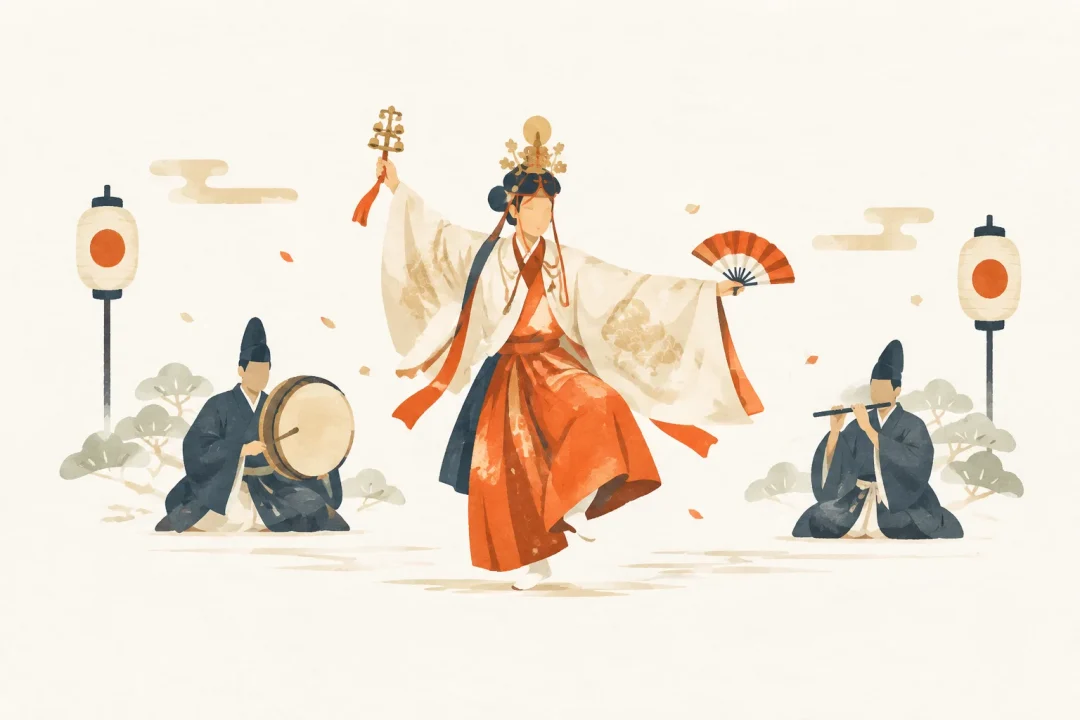
Hayashike , passed down mainly at Yachi Hachiman Shrine in Yachi, Kahoku Town, Yamagata Prefecture, is a traditional performing art in which dances handed down since ancient times are dedicated at local festivals. The 10 dances and the sounds of the ryūteki flute, drums, and shōko gong are presented at Yachi Hachiman Shrine and Jionji Temple in Sagae City.
About Hayashike Bugaku
Hayashike Bugaku is a form of court dance and music passed down through the family, which serves Yachi Hachiman Shrine in Yachi, Kahoku Town, Yamagata Prefecture.
It is performed at events such as the autumn annual festival at Yachi Hachiman Shrine and the spring Buddhist services held at Jionji Temple in Sagae City.
It carries on dance and music traditions introduced from the Korean Peninsula and China in ancient times, preserving a distinctive form closely connected to local festivals.
In 1981, it was designated an Important Intangible Folk Cultural Property.
Source: 国指定文化財等データベース
Festival highlights
Highlights include the 10 dances passed down through the Hayashi family, as well as the costumes, movements, and instrumental sounds on stage.
The following dances have been passed down and are performed mainly by the Hayashi family: Enbu, Sandai, Sanju, Taiheiraku, Amma, Ninomai, Kaerijoraku, Bato, Ryōō, and Nasori.
The music played on the ryūteki flute, drums, and shōko gong is also distinctive. A unique playing technique has been passed down in which the rim of a drum is struck in place of a kakko drum.
The sounds of classical court dance and music passed down in Yachi and Jionji
What to expect
For performances, a stage is set up in conjunction with the annual festival at Yachi Hachiman Shrine or Buddhist services at Jionji Temple, and the dances passed down through the Hayashi family are performed.
Some pieces are danced mainly by the Hayashi family, while Taiheiraku, the children’s dance Kaerijoraku, and Bato are also performed by people outside the family.
In the children’s dances, young children perform, and tradition holds that the heir to the Hayashi family performs Enbu for the first time at age 13.
How to take part
Visitors can watch the event.
Location and access
- Venue and address
It is performed on the stone stage within the grounds of Yachi Hachiman Shrine or near the gate of Jionji Temple in Sagae City.
- Train and bus
One suggested route is to travel from JR Tokyo Station to JR Sakurambo-Higashine Station, then take a taxi into Kahoku Town.
- By car
A route from central Tokyo via the Tohoku Expressway, Yamagata Expressway, and Tohoku-Chuo Expressway to the Kahoku Town Safflower Museum via Higashine IC is listed.
Source: 山形の文化財検索サイト「山形の宝 検索navi」 / 山寺が支えた紅花文化 基本情報|日本遺産ポータルサイト
Event venue 山形県河北町、寒河江市 谷地八幡宮境内の石舞台
This map uses the venue name. Check the official guide for the event area and entrances.
Dates and season
Hayashi bugaku is usually dedicated on September 14 and 15 during the autumn of Yachi Hachiman-gu.
It is also performed at Jionji Temple in Sagae City on May 5, which coincides with the spring Buddhist service or Issaikyo-e.
Nearby attractions
Places closely associated with Hayashike Bugaku include the performance venues Yachi Hachiman Shrine and Jionji Temple in Sagae City.
Attractions in Kahoku Town also include the Kahoku Town Safflower Museum, Michi-no-Eki Kahoku “Buratto Pia,” and Kahoku Town Children’s Zoo.
It is a good idea to check the distance and travel time from the Hayashike Bugaku venues to each facility, as well as opening status, before visiting.
Source: 河北町観光なび | 雛とべに花の里・河北町観光協会の公式サイト「河北町観光なび」です。旬な情報満載で河北町にお越しの際は是非ご覧下さい。
Origins and History of Hayashike Bugaku
The origins of Hayashike Bugaku are linked to the account of Hayashi Echizen recorded in the Hayashi family’s history of bugaku.
Tradition holds that in Jōgan 2 (860), Hayashi Echizen came to Ushu with the monk Ennin and performed bugaku at the Konpon Chūdō hall of Yamadera, an event regarded as the origin of the family’s tradition.
It was later passed down through the Hayashi family of Yachi Hachiman Shrine. Today, the 10 dances are preserved as a tradition passed from parent to one child and kept from outsiders.
In 1981, it was designated a national Important Intangible Folk Cultural Property.
Official information
The Agency for Cultural Affairs’ Database of Nationally Designated Cultural Properties and other sites, Yamagata Prefecture’s cultural property search site, and its cultural property information page provide an overview of Hayashike Bugaku and its performance venues.
Hayashike Bugaku is a nationally designated Important Intangible Folk Cultural Property, and its preservation group is the Yachi Bugaku Preservation Society.
Hayashike Bugaku at a Glance
Hayashike Bugaku is a traditional form of court dance and music passed down mainly at Yachi Hachiman Shrine in Yachi, Kahoku Town, and closely connected to local festivals.
Highlights include the 10 dances, music played on the ryūteki flute, drums, and shōko gong, and the distinctive way the tradition is passed down through the Hayashi family.
It is performed annually at the Yachi Hachiman Shrine festival in September and at Buddhist services at Jionji Temple in Sagae City on May 5.
Japanese Festivals.jp Editorial Team
Celebrating local culture and helping you discover a side of Japan you never knew.
Article updated: 2026/10/19
Submit information or a correction Submit photos of this festival