An ancient festival passed down in Hohoku, where deities from the mountains and the coast meet
Hamaide Festival

Festival information
EVENT INFORMATION- Season / frequency
- Once every 7 years, around April / Once every 7 years
- Location
- Tago Shrine, Horikiri, and the Doigahama festival grounds
- Area
- Yamaguchi Prefecture・Shimonoseki City(From Tokyo: approx. 1 h 35 min–1 h 55 min · flight time only)Prefecture-level estimate to a main station or airport, not the venue. Airport access, check-in and onward travel are extra; remote areas and islands can take much longer.
- Highlights and activities
- Wishes behind the festival
- Participation / viewing
- Spectators welcome
- Last updated
- 2026/10/19
Hamaide Festival, held in Hohoku Town, Shimonoseki City, Yamaguchi Prefecture, is a folk festival held once every 7 years, in which a and procession travel from Tago Shrine, through Horikiri, to Doigahama. Rituals bringing together communities from the mountains and the coast, as well as ceremonies performed by three groups that preserve ancient traditions, are passed down.
Photo credits and terms of use
Photographer: Hisenv File:Hamadonosai bizyutukanP1180454.JPG / Wikimedia Commons / CC BY-SA 4.0 Own work by the contributorDisplay size only adjusted.May differ from the event currently featured.About Hamaide Festival
Hamaide Festival is a periodic festival in which deities associated with Tago Shrine on the mountain side and the Kodama district on the sea side meet and make their way toward Doigahama.
The festival unfolds at Tago Shrine, Horikiri, and Doigahama, with a procession accompanied by a mikoshi, rites at Hamadono, and ceremonies performed by three groups.
One tradition describes it as a rite marking the reunion of a male and a female deity; it is also described as a festival praying for regional prosperity and order, and abundant harvests.
It is an Intangible Folk Cultural Property designated by Yamaguchi Prefecture, passed down through the cooperation of communities in the mountains and along the coast.
Source: 山口県/観光スポーツ文化部文化振興課/文化財・山口県の文化財
Festival highlights
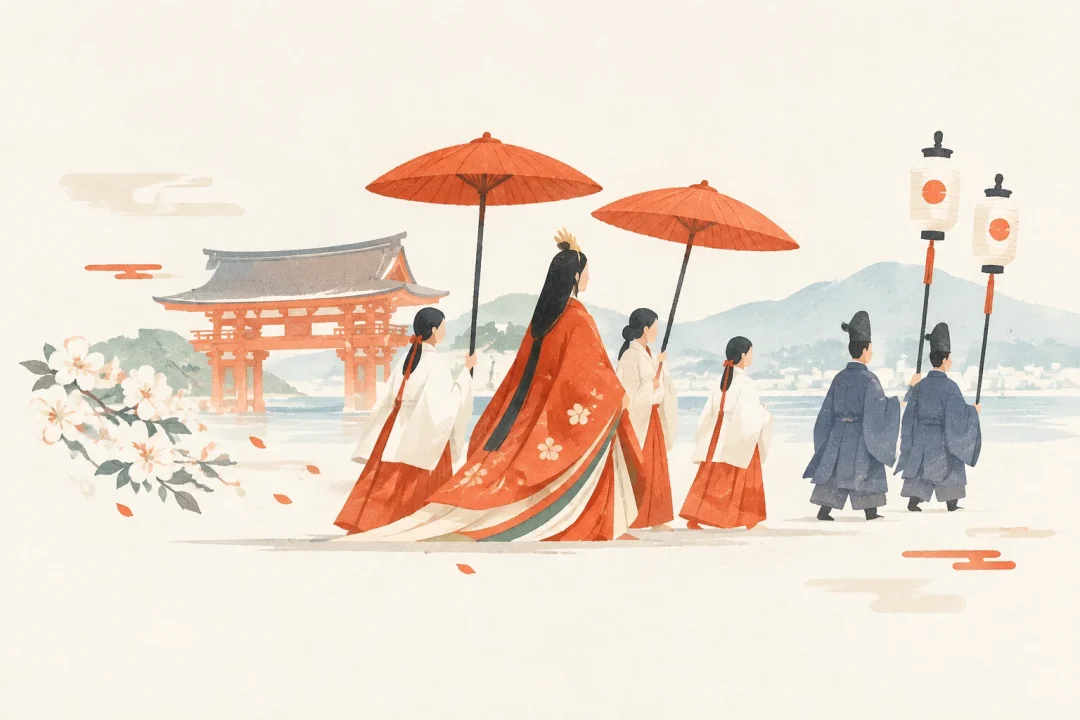
A highlight is the meeting ritual at Horikiri, where three processions, including those from Tago and Kodama, gather and exchange formal speeches.
Processions in traditional costumes make their way through the area, followed at the Doigahama festival grounds by ceremonies performed by the three groups: Shinkan-za, Namihara-za, and Okabayashi-za.
You can watch a sequence of distinctive rituals, including formal speeches and sword handling, a miko dance, three offerings of sacred sake, the hikime ritual, and the cutting of a yellowtail.
Source: 市報しものせき 2018年4月号テキスト版 - 下関市
An ancient festival passed down in Hohoku, where deities from the mountains and the coast meet
What to expect
On the day of the festival, processions set out from Tago Shrine and Jingu Kogo Shrine, and three processions join at Horikiri.
At the encampment, both sides perform formal speech rituals. After a ceremonial sake barrel is broken open, the procession forms up and proceeds to the Doigahama festival grounds.
Upon arrival, rites, ceremonies by the three groups, the yellowtail-cutting ritual, the placing of the meal, and a communal feast are held, and the festival concludes with the transfer of the deity.
In the yellowtail-cutting ritual, an ancient method is preserved in which the fish is cut with iron chopsticks and a knife, without using the hands.
How to take part
Local residents from areas including Tago and Kodama take on the central roles in the procession and ceremonies.
There are many roles, including the hana-miko, yamabushi, musicians, and the person who cuts the yellowtail. Preparation begins about 1 year before the festival, with role assignments, checks of costumes and equipment, and ritual practice.
However, no information is provided about whether general visitors can take on festival roles or whether there is an opportunity to participate on the day.
Visitors can watch the procession and rituals.
Location and access
- Venue and address
The festival takes place across the area from Tago Shrine, through Horikiri, to the Doigahama festival grounds.
The Doigahama festival grounds are the plaza beside the Doigahama Site and Anthropological Museum, and Horikiri is on the grounds of the JA Shimonoseki Hohoku Facilities Complex.
It is located in Hohoku Town, Shimonoseki City, Yamaguchi Prefecture.
Source: 浜出祭|観光スポット|【公式】山口県観光/旅行サイト おいでませ山口へ
Address Hohoku Town, Shimonoseki City, Yamaguchi Prefecture
Dates and season
- Season
Once every 7 years, around April
- Frequency
Once every 7 years
Accommodation and hotels PR
Showing nearby accommodation.
Prices and availability are current at the time of retrieval. For multi-night stays, only the first night’s price is shown. Confirm the final price and directions to the venue with the booking provider. Select your dates again when using the area search link. Search area: within 3 km of Central Yamaguchi Prefecture / Shimonoseki City (the search is not centered on the festival venue)
Tips for your visit
Since the procession moves between several locations, you may want to choose whether to visit Horikiri to see the meeting ritual or the Doigahama festival grounds to see the ceremonies performed by the three groups.
Follow staff instructions so as not to obstruct the procession or rituals, and observe quietly during religious rites.
Past event notices mention an instance when, due to severe weather, only the rites were held at a different venue, so be aware that plans may change depending on the weather.
Nearby attractions
Nearby attractions associated with the location of Hamaide Festival include the Tago Hydrangea Garden, Nakayama Shrine, the Former Tonoi Post Office Building, Hohoku Gorge, and Toyota Agricultural Park Minori-no-Oka.
The Doigahama Site and Anthropological Museum, one of the festival's main venues, is adjacent to the Doigahama festival grounds.
If you would like to learn about the festival alongside the area's history, you can also view related materials at the Doigahama Site and Anthropological Museum or the Hohoku Historical and Folklore Museum.

はい!からっと横丁
山口県下関市にある遊園地

下関市立しものせき水族館
山口県下関市にある水族館

下関市立歴史博物館
山口県下関市長府にある博物館

下関市立美術館
山口県下関市長府にある美術館

下関市立考古博物館
山口県下関市にある博物館

下関市立近代先人顕彰館
日本の山口県下関市にある博物館

下関市立長府博物館
山口県下関市長府にあった博物館
写真:Wiki708 at Japanese Wikipedia / CC BY-SA 3.0
Photo source ·
乃木神社
山口県下関市にある神社

亀山八幡宮
山口県下関市にある神社

大歳神社
山口県下関市にある神社

彦島八幡宮
山口県下関市にある神社

Iminomiya Shrine
山口県下関市にある式内社
Origins and History of Hamaide Festival
Traditions about the origins of Hamaide Festival include accounts that it was held to pray for victory against the Mongol invasions and other enemies, to console those killed in battle, or to quell epidemics, but its origins are not definitively established.
In local tradition, it has also been described as a rite celebrating the reunion of a male and a female deity associated with Itsukushima Shrine on the mountain side and Ebisu Shrine on the sea side, and the unity of the mountains and the coast.
During the Edo period, it is said to have been a large-scale procession involving warriors from several villages.
The oldest known written record is a festival document from Kyoho 9, and an agreement in Taisho 9 set the festival date as April 15.
Official information
Hamaide Festival is an Intangible Folk Cultural Property designated by Yamaguchi Prefecture, and its preservation association is the Hamaide Festival Cultural Property Preservation Association.
Details about the venue and an overview of the festival can be found in the festival introduction on Yamaguchi Prefecture's tourism website.
The Doigahama Site and Anthropological Museum in Shimonoseki also provides information about related materials and lists a phone number for inquiries.
Source: 浜出祭関連資料(リーフレット・冊子)のご案内 - 下関市
Hamaide Festival at a Glance
Hamaide Festival is a periodic festival in Hohoku Town, Shimonoseki City, where deities from the mountains and the coast meet, and local people come together through processions and religious rites.
Major highlights include the meeting ritual at Horikiri, the procession in colorful costumes, ceremonies by the three groups at the Doigahama festival grounds, and the yellowtail-cutting ritual.
Several traditions explain its origins, and it has carried prayers for unity between the mountains and the coast, regional prosperity, and abundant harvests.
Japanese Festivals.jp Editorial Team
Celebrating local culture and helping you discover a side of Japan you never knew.
Article updated: 2026/10/19
Submit information or a correction Submit photos of this festival