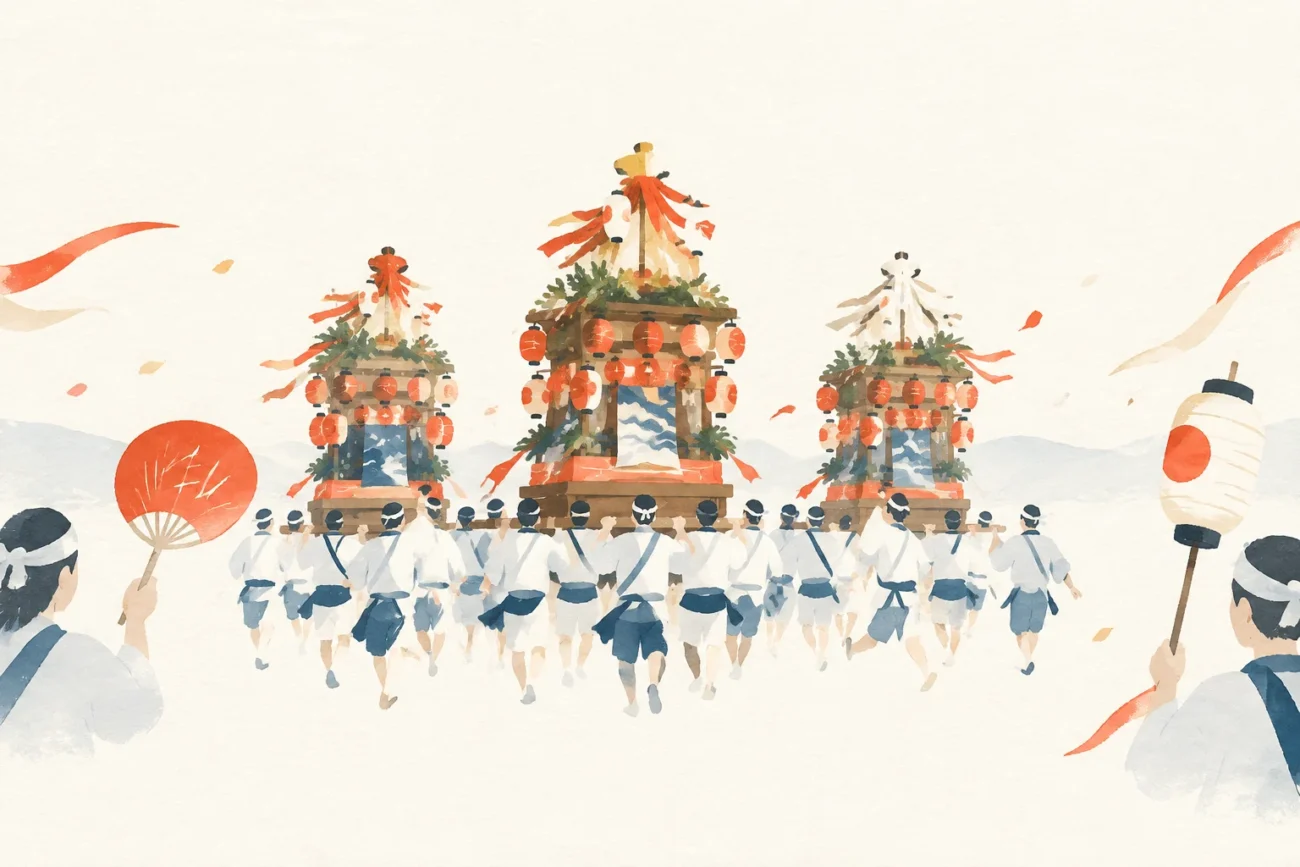
Three dashi race through Tsuyazaki in a summer prayer passed down through generations
Tsuyazaki Gion Yamakasa
The 2026 edition of Tsuyazaki Gion Yamakasa has ended.
Festival information
EVENT INFORMATION- Dates
- 第1期:2026/07/18Ended第2期:2026/07/19Ended
- Season / frequency
- Around mid-July each year / Every year
- Location
- Namiore Shrine, streets of Tsuyazaki Sengen
- Area
- Fukuoka Prefecture・Fukutsu City(From Tokyo: approx. 1 h 50 min–2 h 10 min · flight time only)Prefecture-level estimate to a main station or airport, not the venue. Airport access, check-in and onward travel are extra; remote areas and islands can take much longer.
- Features
- Highlights and activities
- Wishes behind the festival
- Participation / viewing
- Spectators welcome
- Last updated
- 2026/10/19
Three and spirited shouts ring through Tsuyazaki, Fukutsu. The Tsuyazaki Gion Yamakasa, held for around 300 years, is a local votive festival to purify the town and pray for good health and protection from illness.
About Tsuyazaki Gion Yamakasa
The Tsuyazaki Gion Yamakasa is a traditional event passed down in Tsuyazaki, Fukutsu City.
The three dashi of the Kita, Shinmachi, and Oka groups make a spirited run through the streets of Tsuyazaki Sengen.
It began around 300 years ago and has been preserved as a source of local pride.
It is also a votive festival in which the deity is welcomed aboard the dashi, the town is purified, and prayers are offered for good health and protection from illness.
Source: ふくおか祭前線〈津屋崎祇園山笠〉|グラフふくおか2026夏号 / 津屋崎祇園山笠 | イベント | 【公式】福岡県の観光/旅行情報サイト「クロスロードふくおか」
Festival highlights
The main highlight is the Oiyama, when dashi from the three groups start at Namiore Shrine and race through Tsuyazaki Sengen.
Men wearing shimekomi loincloths propel the dashi forward amid spirited shouts, building excitement throughout the town.
Each group wears a different color headband: the Kita group wears pink, the Shinmachi group wears yellow, and the Oka group wears red.
On the eve of the Oiyama, participants also take part in the Hadaka Mairi, carrying lanterns as they make their way to Miyajidake Shrine.
Three dashi race through Tsuyazaki in a summer prayer passed down through generations
What to expect
At the festival, each of the three groups builds its own dashi, which races through town during the Oiyama.
The evening before, participants take part in the Hadaka Mairi, carrying lanterns as they make their way to Miyajidake Shrine.
Local residents take on various roles, such as running alongside the dashi, splashing water, and preparing for the naorai gathering.
Spectators can enjoy watching the dashi proceed through town amid spirited shouts from along the route.
How to take part
As a local festival, it involves people of all ages, from children to older residents, who run alongside the dashi, splash water, and help prepare for the naorai gathering.
However, no information is provided about general recruitment for visitors to join a group or take part in operating a dashi.
If you’re visiting as a spectator, the basic rule is to watch from along the route without obstructing the procession or the movements of local residents.
Location and access
- Venue and address
Tsuyazaki Sengen, Tsuyazaki, Fukutsu City, Fukuoka Prefecture.
The Oiyama starts at Namiore Shrine and runs through the Tsuyazaki Sengen district.
- Train and bus
Take a Nishitetsu bus from Fukuma Station on the JR Kagoshima Main Line, get off at “Tsuyazaki Sengen-Nagomi (in front of the Tsuyazaki Branch of the Chamber of Commerce and Industry),” then walk about 3 minutes.
- Parking
A limited number of parking spaces are available at Tsuyazaki Sengen Nagomi.
Crowds are expected on the day, so visitors are advised to use public transportation.
Address Tsuyazaki Sengen, Tsuyazaki, Fukutsu City, Fukuoka Prefecture 811-3304
Dates and season
- Period 1
2026/07/18
- Period 2
2026/07/19
2026 Festival Information (The listed dates have passed)
In 2026, the Hadaka Mairi is scheduled for July 18 (Saturday), and the Oiyama for July 19 (Sunday).
The Hadaka Mairi is scheduled to see the first dashi enter the shrine at 6:40 p.m.; for the Oiyama, the first dashi is scheduled to enter the shrine at 7:50 a.m., with the race starting at 8:30 a.m.
The schedule combines the dashi procession starting from Namiore Shrine with the Hadaka Mairi on the eve of the festival.
Accommodation and hotels PR
Showing nearby accommodation.
Prices and availability are current at the time of retrieval. For multi-night stays, only the first night’s price is shown. Confirm the final price and directions to the venue with the booking provider. Select your dates again when using the area search link. Search area: within 3 km of Central Fukuoka Prefecture / Fukutsu City (the search is not centered on the festival venue)
Tips for your visit
As the yamakasa runs through town, please watch from a place where you won’t obstruct its progress.
According to the 2026 information, crowds are expected on the day, and visitors are encouraged to use public transportation.
A limited number of parking spaces are available at Tsuyazaki Sengen Nagomi, but availability is limited.
The Hadaka Mairi and Oiyama start at different times, so it’s best to leave early for the event you plan to attend.
Nearby attractions
Namiore Shrine, the starting point of the festival, has a close connection with the Tsuyazaki Gion Yamakasa.
Nearby is the Tsuyazaki Sengen district, whose streets once thrived on salt production and maritime trade.
The Tsuyazaki Sengen Folklore Museum Ai no Ie, Toyomura Sake Brewery’s Former Brewing Facility, and Tsuyazaki Sengen Nagomi are also introduced as nearby attractions.
The festival offers a chance to experience Tsuyazaki’s history and local scenery.

宮地嶽神社
福岡県福津市にある神社
Origins and History of Tsuyazaki Gion Yamakasa
The Tsuyazaki Gion Yamakasa is said to have originated in 1714, when the Gion deity was brought from Kushida Shrine in Hakata to Namiore Shrine in Tsuyazaki, and three dashi were dedicated.
It has continued as a festival praying for the driving away of epidemics and disasters, and for good health and protection from illness.
It was temporarily discontinued in 1963, but revived in 1975.
After overcoming a period of interruption, the festival continues to be handed down as a tradition that conveys local bonds and culture.
Source: 市指定の文化財/福津市
Official information
Official festival information is available on the official website and Instagram of Hikari no Michi DMO Fukutsu (FUKUTSU WAVE), as well as the official Tsuyazaki Sengen Nagomi website.
The official Namiore Shrine website also lists the Tsuyazaki Gion Yamakasa schedule in its Reiwa 8 annual festival calendar.
Source: 波折神社 | 福岡県福津市
Tsuyazaki Gion Yamakasa at a Glance
The Tsuyazaki Gion Yamakasa is a dashi festival that has been passed down for over 300 years in Tsuyazaki, Fukutsu City.
Highlights include the Oiyama, when dashi from the three groups race through town, and the Hadaka Mairi on the eve of the festival.
With prayers for the driving away of epidemics and disasters, and for good health and protection from illness, local residents share responsibilities to support the festival.
A visit can also include exploring the streets of Tsuyazaki Sengen and Namiore Shrine.
Japanese Festivals.jp Editorial Team
Celebrating local culture and helping you discover a side of Japan you never knew.
Article updated: 2026/10/19
Submit information or a correction Submit photos of this festival