Songs and improvised dance alive in Minamitane’s celebratory parlors
The parlor dance of Minamitane, Tanegashima
Festival information
EVENT INFORMATION- Area
- Kagoshima Prefecture・Minamitane Town(From Tokyo: approx. 1 h 50 min–2 h 20 min · flight time only)Prefecture-level estimate to a main station or airport, not the venue. Airport access, check-in and onward travel are extra; remote areas and islands can take much longer.
- Highlights and activities
- Wishes behind the festival
- Last updated
- 2026/10/19
A folk performing art of song and dance from Minamitane Town, long featured at celebrations. Guided by handclaps and call-and-response songs, performers express themselves using everyday objects.
About The parlor dance of Minamitane, Tanegashima
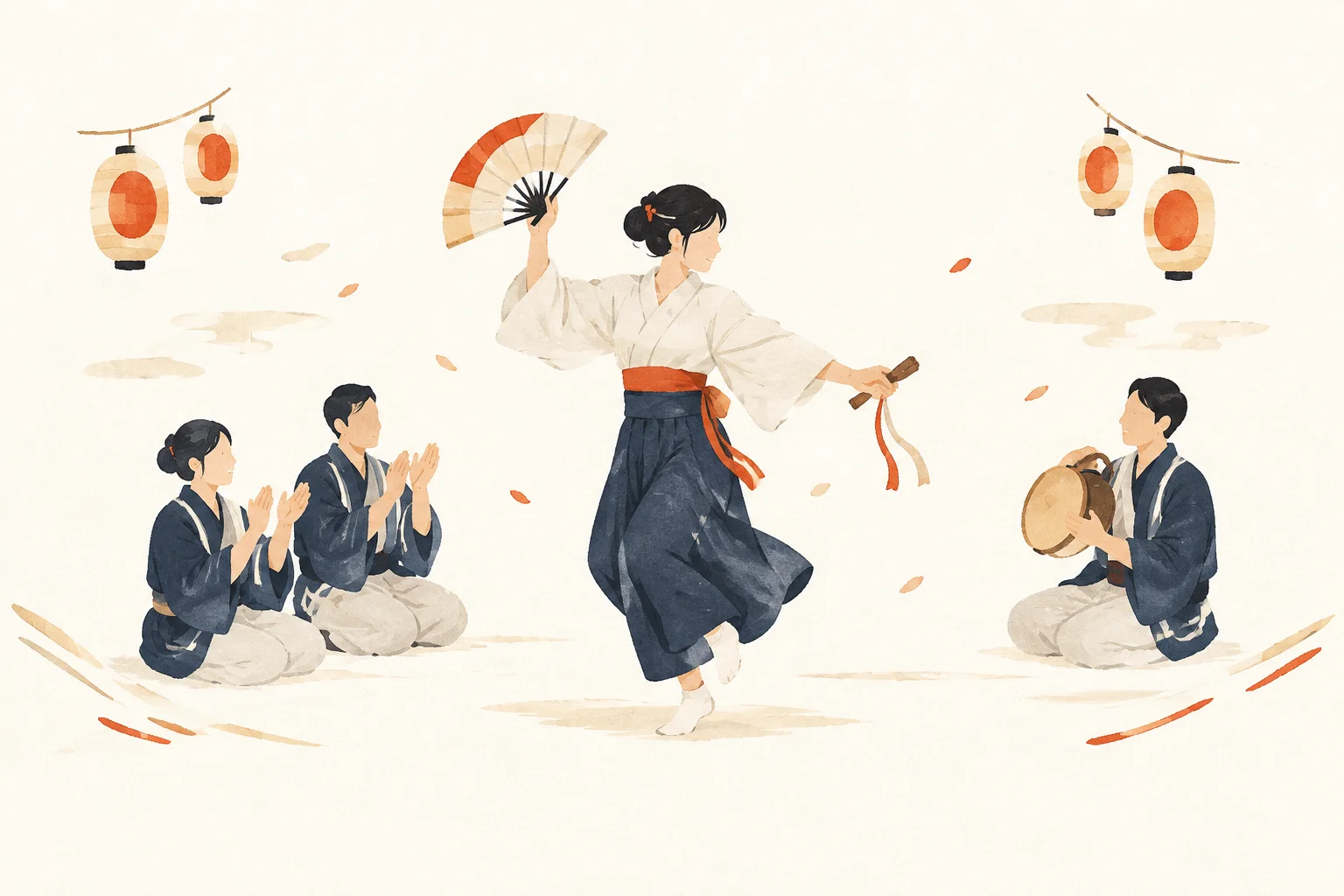
This is a song-and-dance performance presented at celebrations such as weddings and new-home celebrations in Minamitane Town, at the southern tip of Tanegashima.
As people gathered in a tatami room clap along, performers dance extemporaneously, weaving in local Tanegashima dialect.
Everyday objects and call-and-response songs are also used, and the performance has been passed down as a folk art that conveys Minamitane’s local character.
Source: 国指定文化財等データベース
Festival highlights
One highlight is the performers’ expressive approach: they build on set forms while adding their own flourishes to suit each theme.
Everyday props such as a parlor broom and hand towels are used, and the surrounding audience’s calls and the performers’ own songs create a call-and-response.
Some pieces, such as “Kani-mai” and “Bakkū-mai,” take the forms of animals as their theme, giving them a distinctive charm.
Songs and improvised dance alive in Minamitane’s celebratory parlors
What to expect
At celebratory gatherings, the usual sequence is for everyone to sing “Medeta-bushi” first, followed by the dance.
The dancers first bow to the gathering near the entrance, then move to the center and dance to the song.
During “Kaiko-mai” at the Little New Year, young men visit homes and perform a blessing dance in each home’s tatami room.
Location and access
- Address
Minamitane Town
Host municipality 鹿児島県南種子町
This map shows the surrounding area, not the exact venue location.
Accommodation and hotels PR
Showing nearby accommodation.
Prices and availability are current at the time of retrieval. For multi-night stays, only the first night’s price is shown. Confirm the final price and directions to the venue with the booking provider. Select your dates again when using the area search link. Search area: within 3 km of Central Kagoshima Prefecture / Minamitane Town (the search is not centered on the festival venue)
Nearby attractions

たねがしま赤米館
鹿児島県の博物館・美術館のスポットです。

宇宙科学技術館
種子島宇宙センター内にある施設
Origins and History of The parlor dance of Minamitane, Tanegashima
This dance is a performing art traditionally presented at celebrations in Minamitane Town, such as weddings and new-home celebrations.
The repertoire includes “Toritsashi-mai,” “Kani-mai,” “Bajō-mai,” “Miso-suri-mai,” “Hotoke-mai,” and “Bakkū-mai,” among others. Its distinctive features are the performers’ improvisation and the use of local dialect.
In 1995, it was selected by the Agency for Cultural Affairs as an Intangible Folk Cultural Property for which measures such as documentation should be undertaken, with the Hirayama Folk Culture Preservation Society designated as its preservation group.
Official information
It is listed in the Agency for Cultural Affairs’ Database of Nationally Designated Cultural Properties as an Intangible Folk Cultural Property for which measures such as documentation should be undertaken.
The preservation group is the Hirayama Folk Culture Preservation Society.
The parlor dance of Minamitane, Tanegashima at a Glance
The parlor dance of Minamitane, Tanegashima, is a folk performing art from Minamitane Town, performed to songs and handclaps at celebrations.
Its distinctive features include improvised dances using everyday objects and animal-themed pieces such as “Kani-mai” and “Bakkū-mai”.
“Kaiko-mai” is also performed at the Little New Year, expressing wishes for successful sericulture and a good harvest.
Japanese Festivals.jp Editorial Team
Celebrating local culture and helping you discover a side of Japan you never knew.
Article updated: 2026/10/19
Submit information or a correction Submit photos of this festival