An Otaue ceremony that traces traditional farming activities before the kami and carries forward prayers for a good harvest
The Otaue (Onda) at Tamukeyama Hachimangu Shrine
Festival information
EVENT INFORMATION- Season / frequency
- Every year on February 3 / 1 time per year
- Location
- Tamukeyama Hachimangu Shrine
- Area
- Nara Prefecture・Nara City(From Tokyo: approx. 3 h–3 h 30 min · bullet train + connecting train)Prefecture-level estimate to a main station or airport, not the venue. Airport access, check-in and onward travel are extra; remote areas and islands can take much longer.
- Highlights and activities
- Wishes behind the festival
- Last updated
- 2026/11/11
The Otaue (Onda) ceremony at Tamukeyama Hachimangu Shrine is a traditional event in Nara City in which rice-growing activities, from the Mizuguchi Festival to rice planting, are reenacted before the kami to pray for a good harvest.
About The Otaue (Onda) at Tamukeyama Hachimangu Shrine
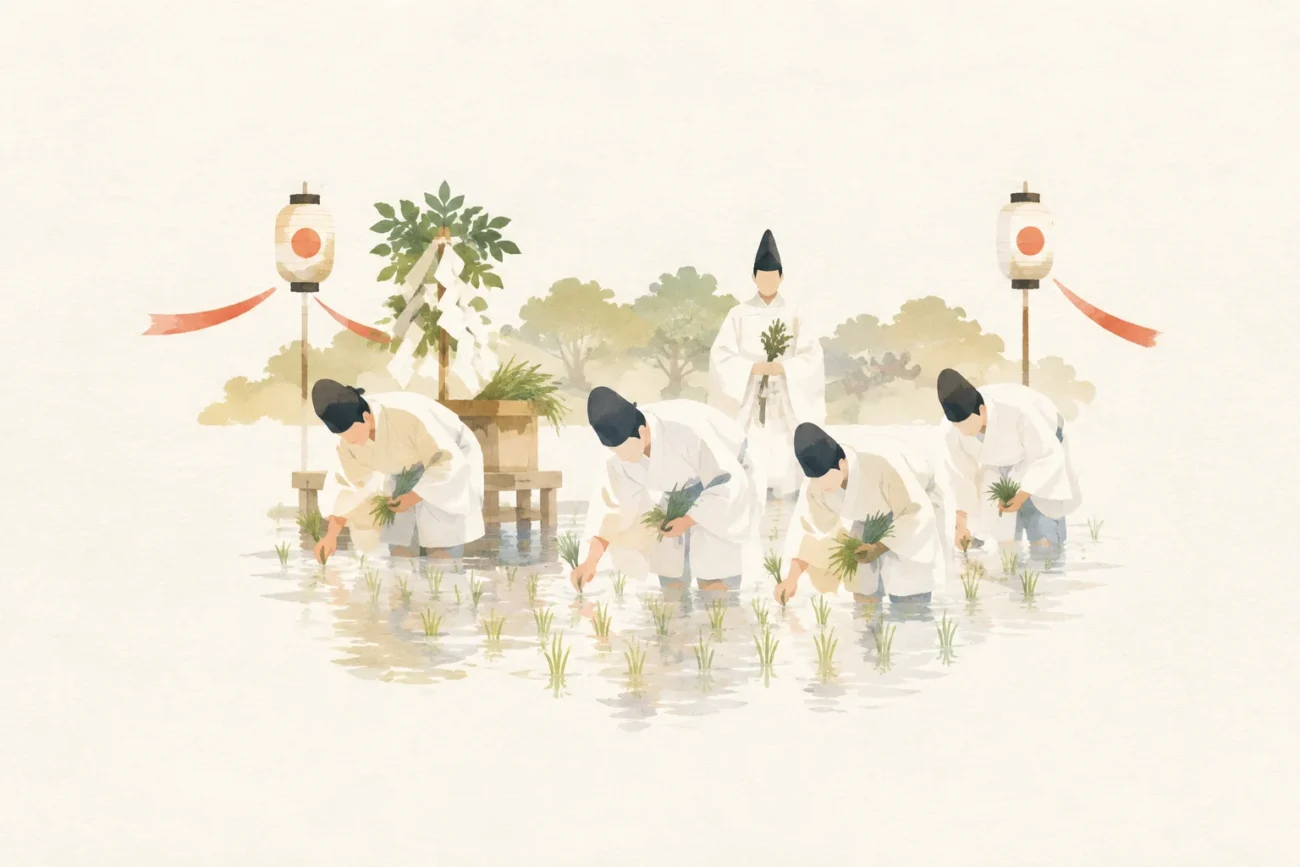
The Otaue (Onda) at Tamukeyama Hachimangu Shrine is an event held at the start of the year in which an ideal process for growing rice is performed for the kami and Buddhas, with prayers for a good harvest that year.
Centered on the ta-nushi, the ceremony proceeds from the Mizuguchi Festival at the seedling bed to rice planting, with lyrics in the style of Noh sung in call-and-response with the jiutai.
The ushiwarawa in the ox role and the saotome also appear. The ceremony, along with traditional items such as farming tools and masks, has been passed down at Tamukeyama Hachimangu Shrine in Zoshicho, Nara City.
It is also designated as a Nara City cultural property (intangible folk cultural property).
Festival highlights
A highlight is how the stages of rice cultivation are presented in sequence before the kami.
At the Mizuguchi Festival, small , kiriko, soybeans, and rice seeds are offered. The ceremony then proceeds through the first plowing, ox handling, leveling, fertilizing, and sowing.
A distinctive part of the sequence is when the ta-nushi scatters seeds in all four directions from a bucket, inspects the seedlings, then invites the saotome to plant rice.
The roles are shared among the ta-nushi, wearing an okina mask; the ushiwarawa, wearing an ox mask; the saotome; and the jiutai and hayashikata.
An Otaue ceremony that traces traditional farming activities before the kami and carries forward prayers for a good harvest
What to expect
The ceremony begins with the ta-nushi, ushiwarawa, saotome, and jiutai and hayashikata circling the while singing, then entering the through the rōmon gate.
After the Mizuguchi Festival, the ta-nushi turns the soil with a hoe. The ushiwarawa harnesses a plow and circles the haiden, then the ta-nushi levels the ground with an eburi.
The ceremony continues with the hikae-tsukai carrying grass for fertilizer, sowing, inspecting the seedlings, and inviting the saotome. Finally, the saotome offer pine seedlings.
After the ceremony, pine seedlings are distributed to and set up and enshrined at the water inlet when the seedling beds are prepared.
Location and access
- Venue and address
Tamukeyama Hachimangu Shrine, 434 Zoshicho, Nara City
Address 434 Zoshicho, Nara City
Dates and season
- Season
Every year on February 3
- Frequency
1 time per year
Accommodation and hotels PR
Showing nearby accommodation.
Prices and availability are current at the time of retrieval. For multi-night stays, only the first night’s price is shown. Confirm the final price and directions to the venue with the booking provider. Select your dates again when using the area search link. Search area: within 3 km of Central Nara Prefecture / Nara City (the search is not centered on the festival venue)
Nearby attractions

中野美術館
奈良県奈良市にある美術館

依水園
奈良県奈良市にある日本庭園
写真:Kimon Berlin ( Gribeco ) / CC BY-SA 4.0
Photo source ·
入江泰𠮷記念奈良市写真美術館
奈良県奈良市にある美術館

吉城園
奈良県奈良市の日本庭園

大和文華館
日本の私立美術館

奈良公園
奈良市の公園

奈良国立博物館
奈良市にある国立博物館

奈良市史料保存館
奈良県奈良市にある博物館

奈良県立美術館
奈良県奈良市にある美術館

寧楽美術館
奈良県奈良市にある博物館

平城京左京三条二坊宮跡庭園
奈良県奈良市三条大路にある庭園遺構

Tamukeyama Hachimangu Shrine
奈良県奈良市にある神社
Origins and History of The Otaue (Onda) at Tamukeyama Hachimangu Shrine
Records suggest that the Otaue at Tamukeyama Hachimangu Shrine was already being held in the late 16th century.
The shrine’s “Illustration of the Otaue Ceremony at Heijo Hachimangu Shrine” is a document from Bunsei 1 (1818), and it is believed that by then the ceremony had taken shape with roles and tools almost the same as those used today.
A record survives of the Ota being postponed in Eiroku 11 (1568).
In Heisei 7 (1995)April 12, it was designated as a Nara City cultural property (intangible folk cultural property).
Official information
The Nara City Cultural Properties Division’s guide to “The Otaue at Tamukeyama Hachimangu Shrine” provides details about the event, its origins, its cultural property designation, and the venue’s location.
The Otaue (Onda) at Tamukeyama Hachimangu Shrine at a Glance
The Otaue (Onda) at Tamukeyama Hachimangu Shrine is a Nara City-designated cultural property in which rice-growing activities are reenacted to pray for a good harvest.
From the Mizuguchi Festival through the first plowing, ox handling, sowing, and rice planting, the ta-nushi, ushiwarawa, saotome, and jiutai and hayashikata share the roles.
An illustrated map from Bunsei 1 (1818) and a record from Eiroku 11 (1568) also trace the long history of this tradition.
The venue is Tamukeyama Hachimangu Shrine (434 Zoshicho, Nara City).
Sources and references
Japanese Festivals.jp Editorial Team
Celebrating local culture and helping you discover a side of Japan you never knew.
Article updated: 2026/11/11