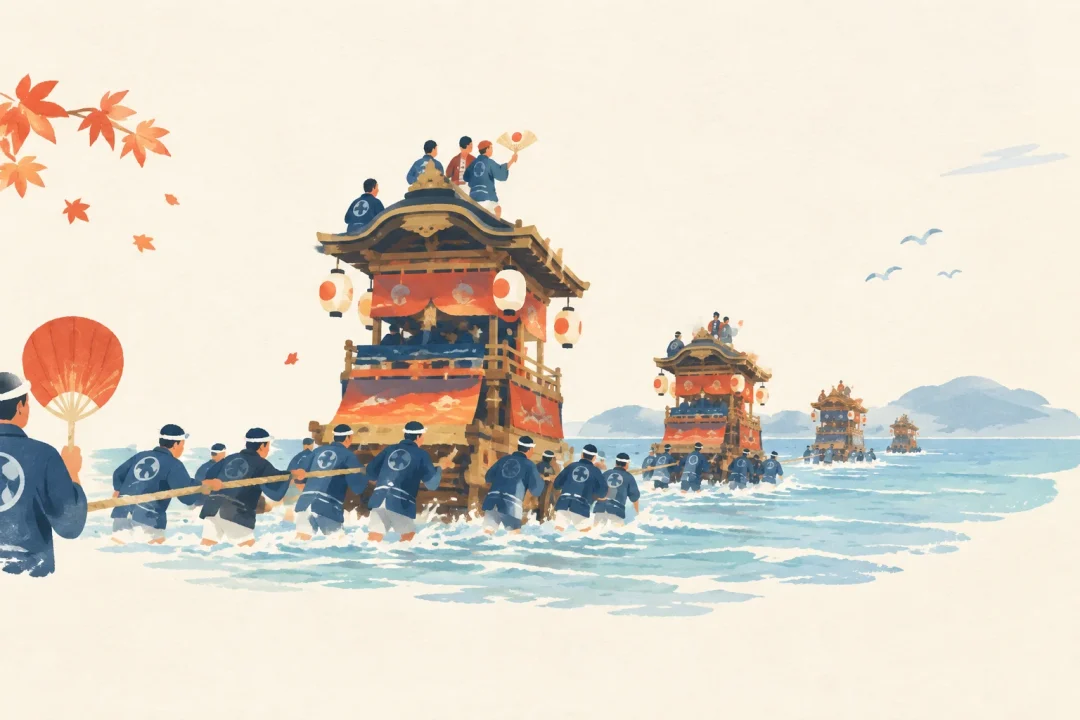
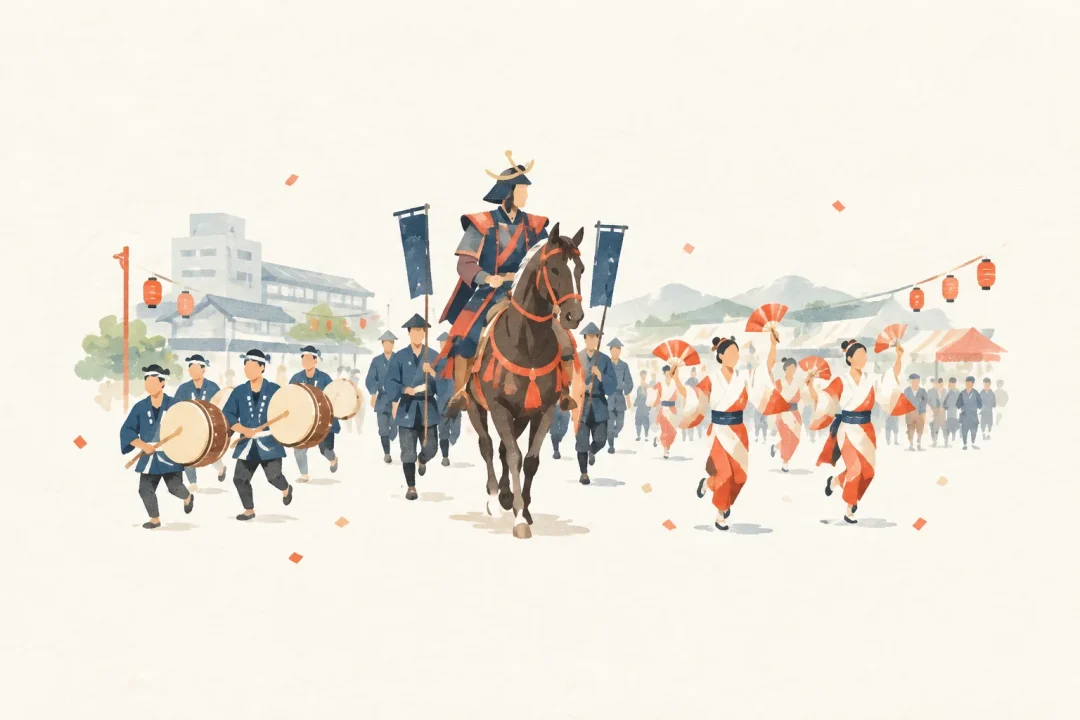
A festival scene in Kashiyama, Okazaki, brought to life by dashi and festival music
Suga Shrine Grand Festival

Festival information
EVENT INFORMATION- Season / frequency
- The 2nd Sunday of April in spring and the 2nd Sunday of October in autumn / Held in spring and autumn
- Location
- Centered on Suga Shrine, the procession travels as far as the area around Shinmei-gu Shrine
- Area
- Aichi Prefecture・Okazaki City(From Tokyo: approx. 1 h 40 min–2 h · bullet train)Prefecture-level estimate to a main station or airport, not the venue. Airport access, check-in and onward travel are extra; remote areas and islands can take much longer.
- Features
- Highlights and activities
- Participation / viewing
- Spectators welcome
- Last updated
- 2026/10/19
A traditional festival held at Suga Shrine in Kashiyama-cho, Okazaki City, where and a make their way through the town. 4 dashi and a flower-decorated float proceed to festival music, perform music at Shinmei-gu Shrine, and then return to Suga Shrine.
About Suga Shrine Grand Festival
Photo credits and terms of use
Photographer: Evelyn-rose File:Kashiyamacho-Suga-Jinja-2.jpg / Wikimedia Commons / CC0 Own work by the contributorDisplay size only adjusted.May differ from the event currently featured.Photo credits and terms of use
Photographer: Evelyn-rose File:Kashiyamacho-Suga-Jinja-1.jpg / Wikimedia Commons / CC0 Own work by the contributorDisplay size only adjusted.May differ from the event currently featured.Photo credits and terms of use
Photographer: Evelyn-rose File:Kashiyamacho-Suga-Jinja-4.jpg / Wikimedia Commons / CC0 Own work by the contributorDisplay size only adjusted.May differ from the event currently featured.The Suga Shrine Grand Festival is held at Suga Shrine in Kashiyama-cho, Okazaki City, Aichi Prefecture, and is also known as the Kashiyama Dashi Festival.
4 festival dashi and festival music make their way through the area. The festival is designated an intangible folk cultural property of Okazaki City.
This festival, passed down through generations in Kashiyama-cho, sees local pull dashi through the area around the shrine alongside a mikoshi.
Source: 須賀神社大祭 - Wikipedia
Festival highlights
Highlights include 4 dashi, each with a distinct style representing its group, and the Hana-gumi’s flower-decorated float.
Each float has its own distinctive design, from the Tena-Naga-Ashi-Naga carvings on the Ryujin dashi and the gold leaf and raden inlay on the Ebisu dashi to the ship-shaped design of the Irifune dashi.
Memorable scenes include the dashi and mikoshi procession, the musical performance at Shinmei-gu Shrine, and the signal fireworks and mochi throwing after the procession enters the shrine.
A festival scene in Kashiyama, Okazaki, brought to life by dashi and festival music
What to expect
The festival begins with raising the banners and purifying the dashi. Led by the year’s organizing group, the dashi, ceremonial items, and mikoshi depart from Suga Shrine.
The procession takes a break at a crossroads along the way. After joining up with the Hana-gumi group, it heads to Shinmei-gu Shrine for a musical performance.
The procession then retraces its route before entering Suga Shrine, followed by signal fireworks and mochi throwing.
How to take part
The role of pulling the dashi is mainly carried out by the six groups of ujiko from Kashiyama Town.
During the festival, ujiko pull the dashi and help lead the procession alongside the mikoshi and hayashi.
Location and access
- Venue and address
The procession centers on Suga Shrine (Miyamae, Kashiyama-cho, Okazaki City, 〒444-3622) and travels as far as the area around Shinmei-gu Shrine.
- Train and bus
From Meitetsu Motojuku Station, take a Meitetsu Bus bound for Kuragari Gorge and get off at Tsukiaki. The shrine is about a 5-minute walk from there.
- By car
About 5 minutes from the Okazaki-Higashi IC on the Shin-Tomei Expressway.
- Parking
There is no parking around the shrine.
Address 〒444-3622 Miyamae, Kashiyama-cho, Okazaki City
Dates and season
The spring festival is held on the second Sunday of April, and the autumn festival on the second Sunday of October.
The festival is held at different times in spring and autumn, with dashi and festival hayashi featured as part of the Suga Shrine festival.
Accommodation and hotels PR
Showing nearby accommodation.
Prices and availability are current at the time of retrieval. For multi-night stays, only the first night’s price is shown. Confirm the final price and directions to the venue with the booking provider. Select your dates again when using the area search link. Search area: within 3 km of Central Aichi Prefecture / Okazaki City (the search is not centered on the festival venue)
Tips for your visit
There is no parking near the venue, so if you plan to drive, check in advance where you can park.
By public transport, you can reach Suga Shrine from Motojuku Station by combining a bus ride with a walk.
The dashi procession travels from Suga Shrine to the area around Shinmei-gu Shrine, so keep its route in mind when choosing a viewing spot.
Nearby attractions

岡崎城
愛知県の城
Origins and History of Suga Shrine Grand Festival
Its origins are said by oral tradition to date back to the Edo period, and the 1875 (Meiji 8) Festival Records describe what it was like at the time.
It was originally held as a Gion Festival in lunar calendar: June, moved to April 14 in the late Meiji period, and in recent years has been held on the 2nd Sunday of April.
After a fire in 1893 (Meiji 26) destroyed the dashi, the 4 floats used today were built or purchased from 1895 (Meiji 28) onward. They were designated cultural properties in 1982 (Showa 57).
Official information
For information on the dates, venue, location, and access, see the Suga Shrine Grand Festival listing on Aichi Prefecture’s tourism website, Aichi Now.
Suga Shrine Grand Festival at a Glance
The Suga Shrine Grand Festival is a dashi festival passed down through generations in Kashiyama-cho, Okazaki City.
Local shrine parishioners pull 4 dashi, a flower-decorated float, and a mikoshi. After a musical performance at Shinmei-gu Shrine, they return to Suga Shrine.
With a history dating back to the Edo period and value as an intangible folk cultural property, the festival carries on local traditions through its spring and autumn celebrations.
Japanese Festivals.jp Editorial Team
Celebrating local culture and helping you discover a side of Japan you never knew.
Article updated: 2026/10/19
Submit information or a correction Submit photos of this festival