A Goto New Year event featuring battledore and shuttlecock and Tamaseseri
Shimo-Sakiyama Hetomato event
Festival information
EVENT INFORMATION- Season / frequency
- Every year, on the 3rd Sunday of January / Once a year
- Location
- The Shimo-sakiyama district, starting at Shirahama Shrine
- Area
- Nagasaki Prefecture・Goto City(From Tokyo: approx. 1 h 50 min–2 h 20 min · flight time only)Prefecture-level estimate to a main station or airport, not the venue. Airport access, check-in and onward travel are extra; remote areas and islands can take much longer.
- Features
- Highlights and activities
- Wishes behind the festival
- Participation / viewing
- Spectators welcome
- Participation fee
- Free
- Last updated
- 2026/10/20
Hetomato, passed down in the Shimo-Sakiyama area of Goto City, is a New Year folk event featuring battledore and shuttlecock, Tamaseseri, tug-of-war, and the dedication of a giant straw sandal. You can witness local customs for praying for good harvests and protection from misfortune along the route from Shirahama Shrine to Yamashiro Shrine.
About Shimo-Sakiyama Hetomato event
The Shimo-Sakiyama Hetomato event is a New Year folk event passed down since long ago in the Shimo-Sakiyama area of Goto City, Nagasaki Prefecture.
Designated a National Important Intangible Folk Cultural Property, the event begins at Shirahama Shrine and proceeds through a sumo match dedicated at the shrine, battledore and shuttlecock, Tamaseseri, tug-of-war, and the dedication of a giant straw sandal.
The event has been passed down as a way to divine whether the year will bring good or poor harvests and to pray for the prosperity of local livelihoods and protection from misfortune.
Local people divide up the roles and preserve the tradition at the shrines and along the route.
Source: 国指定文化財等データベース / 下崎山町のヘトマト | 一般社団法人五島市観光協会
Festival highlights
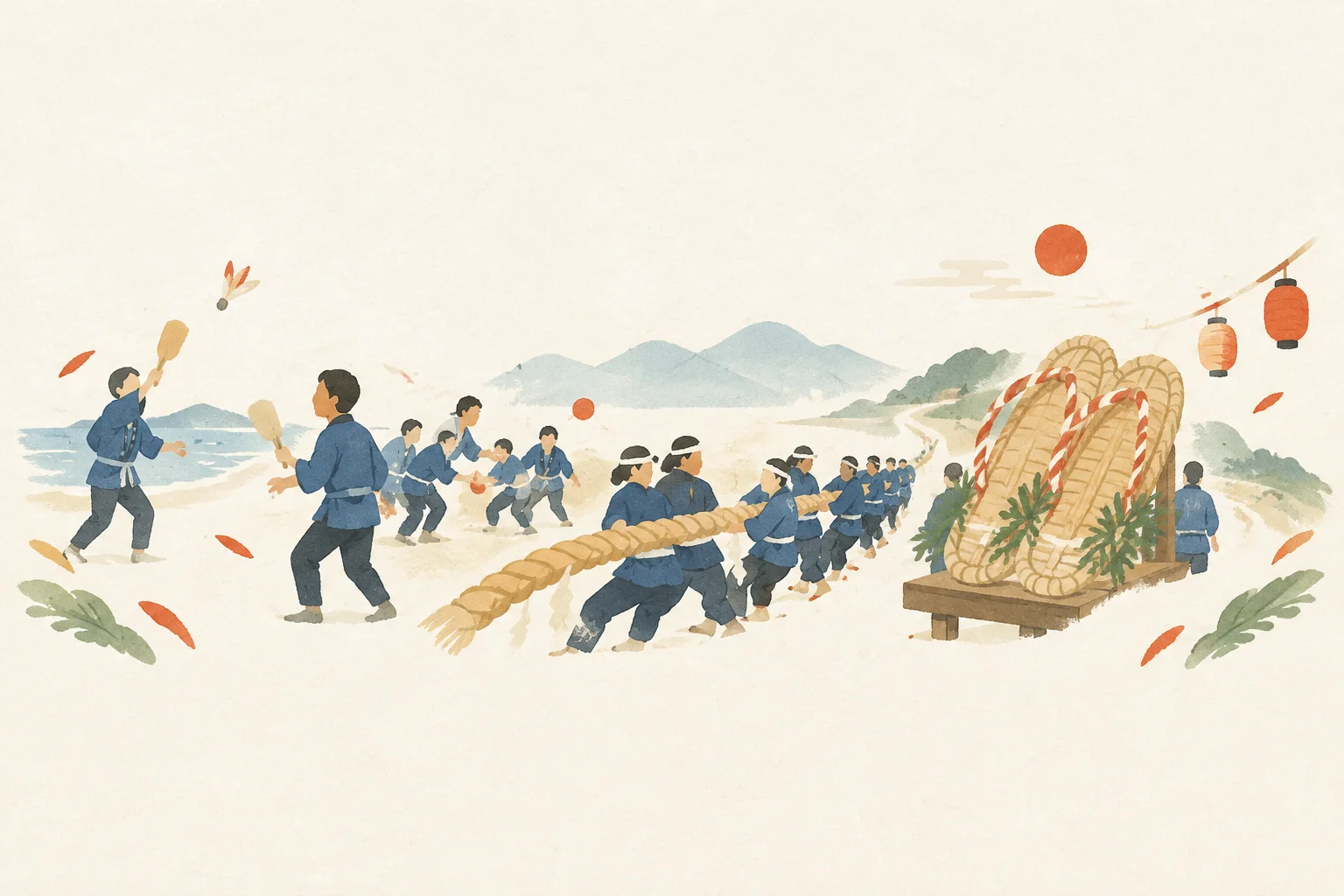
Highlights include a newly married woman playing battledore and shuttlecock atop a sake barrel, Tamaseseri, in which two teams compete to seize a straw ball, and a tug-of-war decided in 3 rounds.
The soot known as “hegura,” which participants smear on themselves, may also be smeared on onlookers, giving them a sense of being part of the event.
Toward the end, a giant straw sandal appears, and participants carry it toward Yamashiro Shrine while tossing a woman seated on it into the air.
The strength contests between men wearing fundoshi and the procession dedicating the sandal along the route create a distinctive atmosphere.
Source: ヘトマト(国指定重要無形民俗文化財) | イベント | 【公式】長崎観光/旅行ポータルサイト ながさき旅ネット / 「下崎山のヘトマト行事(重要無形民俗文化財)」を観に行きました! ~下崎山地区を訪ねて~ | 特集 | 五島の島たび【公式】- 長崎県五島市の観光・旅行情報サイト
A Goto New Year event featuring battledore and shuttlecock and Tamaseseri
What to expect
The event begins with a sumo match dedicated at Shirahama Shrine. It then moves from the shrine to the crossroads, where a procession carrying and a game of battledore and shuttlecock take place.
Next come Tamaseseri, in which participants throw a straw ball between them, and 3 rounds of tug-of-war, with the teams switching sides.
Finally, participants carry a giant straw sandal from the crossroads to Yamashiro Shrine and dedicate it to conclude the event.
Onlookers may also have soot smeared on their faces, offering a chance to experience the atmosphere of the event rather than simply watch.
How to take part
Visitors are welcome to watch, but residents of the Shimo-sakiyama district play the central role in carrying out the ritual.
You can watch freely along the procession route and see the festival up close.
Tamaseseri and the procession to offer the giant straw sandal involve vigorous activity, so please keep a safe distance as a spectator.
Visitors can watch freely along the procession route.
No information is provided about registration or reservations for visitors; the ritual itself is carried out mainly by residents of the Shimo-sakiyama district.
Admission is free.
Location and access
- Venue and address
Shimo-sakiyama-cho, Goto City, Nagasaki Prefecture; the Shimo-sakiyama district, starting at Shirahama Shrine / Shirahama Shrine address: 2430 Mukai-machi, Goto City, Nagasaki Prefecture 853-0022
- Train and bus
Not stated
- By car
Renting a car is convenient for getting around Fukue Island.
- Parking
Not stated
Address 2430 Mukai-machi, Goto City, Nagasaki Prefecture 853-0022 (Shirahama Shrine)
Dates and season
It takes place every year on the 3rd Sunday of January, from around 1 p.m. until evening.
The event begins with a sumo offering at Shirahama Shrine, followed in order by a procession carrying gohei, hanetsuki, Tamaseseri, and tug-of-war.
At the end, participants carry the giant straw sandal to Yamashiro Shrine and offer it, bringing the event to a close.
Accommodation and hotels PR
Showing nearby accommodation.
Prices and availability are current at the time of retrieval. For multi-night stays, only the first night’s price is shown. Confirm the final price and directions to the venue with the booking provider. Select your dates again when using the area search link. Search area: within 3 km of Central Nagasaki Prefecture / Goto City (the search is not centered on the festival venue)
Tips for your visit
Fukue Island can be cold in January, so be sure to dress warmly.
Tamaseseri and the procession to offer the giant straw sandal involve vigorous activity, and there are moments when soot is smeared on spectators. Do not get too close to the route; keep a safe distance.
The procession to offer the giant straw sandal travels from Shirahama Shrine to Yamashiro Shrine.
Nearby attractions
Nearby attractions introduced include Sakiyama Seaside Park, Minodake Garden, Goto Camellia Garden, Mount Onidake, and the Abunze Lava Coast.
If you would like to learn about Goto's history and folk events, the Goto Tourism and History Museum is another option.
The museum presents the history and culture of Goto in chronological order and also features Hetomato as a folk event.
Please check the opening status of each facility and how to get around individually before your visit.
Source: 五島観光歴史資料館 | 観光スポット | 【公式】長崎観光/旅行ポータルサイト ながさき旅ネット

五島観光歴史資料館
長崎県の博物館・美術館のスポットです。

白良ヶ浜万葉公園
長崎県の公園・庭園のスポットです。
Origins and History of Shimo-Sakiyama Hetomato event
There is no established explanation for the origin of the name Hetomato. Accounts include oral histories from elders tracing it back to the Meiji 20s, as well as a reference in the 1918 “Sakiyama Village Local History.”
Shrine sumo, once held at New Year, was incorporated into the present event around Showa 30.
Tamaseseri was discontinued for a time but has since been revived.
The event was designated a National Important Intangible Folk Cultural Property in 1987 and is passed down through the community's division of roles.
Source: ヘトマト|わたしたちの五島市
Official information
The Agency for Cultural Affairs' National Database of Designated Cultural Properties introduces the Shimo-Sakiyama Hetomato event as a nationally designated Important Intangible Folk Cultural Property.
Event announcements and visitor information are also available from the Goto City Tourism Association, Nagasaki Prefecture's tourism portal, and Goto City's official website.
The 2026 event was announced for January 18 (Sun).
Shimo-Sakiyama Hetomato event at a Glance
The Shimo-Sakiyama Hetomato event is a nationally designated Important Intangible Folk Cultural Property passed down in the Shimo-Sakiyama area of Goto City.
The event proceeds in order through a sumo match dedicated at the shrine, battledore and shuttlecock played atop a sake barrel, Tamaseseri, tug-of-war, and the dedication of a giant straw sandal. Participants pray for good harvests, the prosperity of local livelihoods, and protection from misfortune.
Distinctive customs include smearing soot on onlookers and tossing a woman into the air while she stands on the giant straw sandal.
In 2026, it was held on January 18.
Japanese Festivals.jp Editorial Team
Celebrating local culture and helping you discover a side of Japan you never knew.
Article updated: 2026/10/20
Submit information or a correction Submit photos of this festival