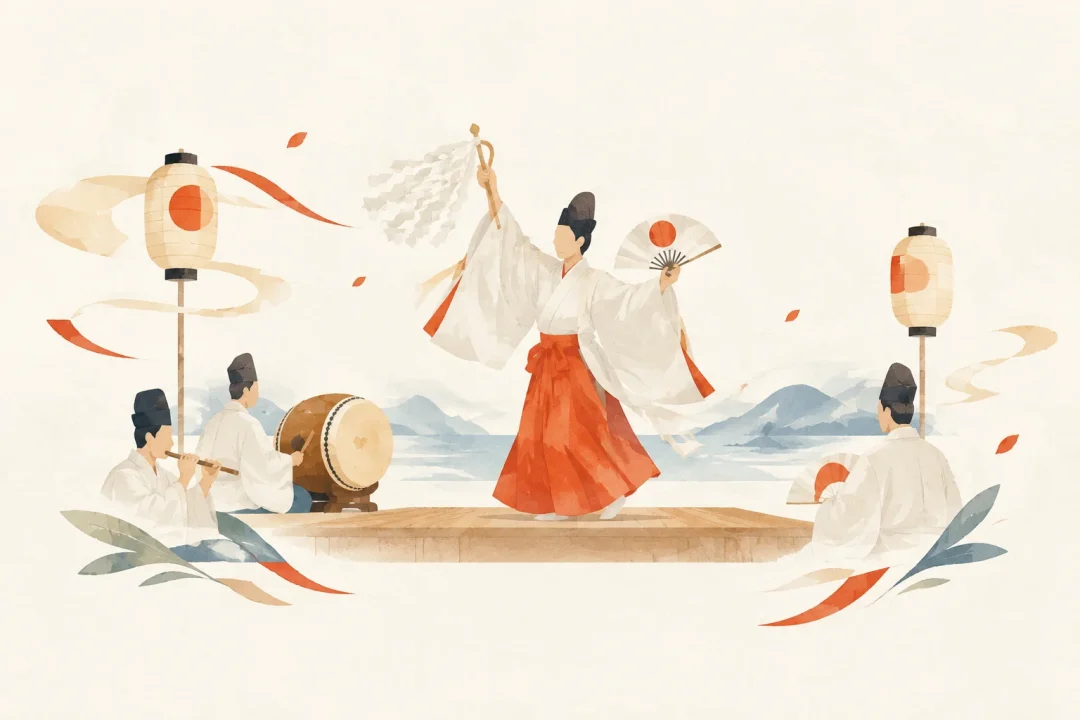
Arikawa Kagura: passed down on a 2-tatami-mat stage, accompanied by flute and taiko
Arikawa Kagura

The 2026 edition of Arikawa has ended.
Festival information
EVENT INFORMATION- Dates
- 2026/10/01 〜 2026/10/02Ended
- Season / frequency
- Autumn (dedicated at shrine festivals around the region, usually centered on October) / Every year
- Location
- Arikawa Shrine
- Area
- Nagasaki Prefecture・Shinkamigoto Town(From Tokyo: approx. 1 h 50 min–2 h 20 min · flight time only)Prefecture-level estimate to a main station or airport, not the venue. Airport access, check-in and onward travel are extra; remote areas and islands can take much longer.
- Features
- Highlights and activities
- Wishes behind the festival
- Participation / viewing
- Spectators welcome
- Last updated
- 2026/10/19
Arikawa Kagura, passed down at Arikawa Shrine in Shinkamigoto Town, is a traditional performing art presented on a dance floor about the size of 2 tatami mats, accompanied by flute and drums. A variety of dances are performed at the festival, offering a close-up look at the distinctive features of Goto Kagura, passed down in the region.
About Arikawa Kagura
Arikawa Kagura is kagura passed down at Arikawa Shrine and other shrines in Arikawago, Shinkamigoto Town, Nagasaki Prefecture, and performed at shrine festivals.
It is one of the forms of kagura passed down in the Goto Islands by local people.
A variety of dances unfold around a dance floor about the size of 2 tatami mats, accompanied by flute and taiko drums.
Goto Kagura is designated a National Important Intangible Folk Cultural Property.
Source: 有川神楽 - Wikipedia / 五島神楽【国指定重要無形民俗文化財】 | 体験 | 【公式】新上五島町観光なび
Festival highlights
The highlight is the dance, combining rustic charm and vigor, performed on a small floor about the size of 2 tatami mats.
Flute and taiko drum music, crisp movements, and ritual objects such as bells, wands, and swords are used in different dances.
The repertoire includes a wide range of dances, such as the , shrine maiden dance, and a dance in which mochi is tossed. It concludes with a dance to drive away evil, performed by a lion and a tengu.
Source: 五島神楽 / 国指定重要無形民俗文化財 | 特集 | 【公式】新上五島町観光なび
Arikawa Kagura: passed down on a 2-tatami-mat stage, accompanied by flute and taiko
What to expect
The festival includes kagura performances following the religious rites and the offering of tamagushi.
Arikawa Kagura has a repertoire of 28 dances, and different numbers of dances are performed during the eve festival and the main festival.
The first half features Zaraharai, Sayū-no-mai, and Arashio. The program concludes with Oshiki, the lion dance, and Hassen Hanayomai; mochi is tossed to worshippers during Hassen Hanayomai.
How to take part
In the past, the performers were mainly members of an organization called Miyakata; today, the preservation society supports the tradition.
In Heisei 19, the Arikawa Kagura Preservation Society was formed, opening its doors to many local residents.
In general, visitors watch the dances being offered while worshipping; there are no reservations or seats set aside for tourists.
Location and access
- Venue and address
Arikawa Shrine (1073-1 Arikawago, Shinkamigoto Town, Minamimatsuura District, Nagasaki Prefecture)
- Train and bus
A 2-minute walk from Kami-Arikawa bus stop.
Hamada bus stop is a 4-minute walk away, and Arikawa Agricultural Cooperative-mae bus stop is a 5-minute walk away.
- Parking
Parking may not be available.
Source: ⛩有川神社|長崎県南松浦郡新上五島町 - 八百万の神
Address 1073-1 Arikawago, Shinkamigoto Town, Minamimatsuura District, Nagasaki Prefecture 857-4211
Dates and season
2026 event information (the listed dates have passed)
The 2026 annual grand festival at Arikawa Shrine is scheduled for October 1 and October 2.
When the festival takes place over 2 days, a pre-festival celebration is held on the 1st day and the main festival on the 2nd day. The pre-festival celebration starts at around 19, and the main festival at around 10.
The kagura is offered following the of the reisai.
Accommodation and hotels PR
Showing nearby accommodation.
Prices and availability are current at the time of retrieval. For multi-night stays, only the first night’s price is shown. Confirm the final price and directions to the venue with the booking provider. Select your dates again when using the area search link. Search area: within 3 km of Central Nagasaki Prefecture / Shinkamigoto Town (the search is not centered on the festival venue)
Tips for your visit
The eve festival takes place at night, so take care on uneven ground and dress warmly when visiting.
There are no seats reserved or set aside for tourists, and some shrines may not have parking or restrooms.
Where religious rites and dedicatory dances take place, follow staff instructions and watch quietly without obstructing the paths used by worshippers and local residents.
Origins and History of Arikawa Kagura
The exact date when Arikawa Kagura was founded is unclear.
Kagura is believed to have existed in the Shimogoto area in the 16th century. It may have been transmitted after that time, or its spread may have been prompted by a record of kagura being offered in 1706.
It was passed down for generations mainly by shrine priests. With a shortage of successors, a preservation society was formed in 2007.
Official information
The Shinkamigoto Town Tourism Navi website provides information about the features of Goto Kagura, including Arikawa Kagura, the autumn grand festival, and the 2026 festival schedule.
Information is also provided about watching Goto Kagura and tourist-oriented kagura performances with the cooperation of preservation societies.
Arikawa Kagura at a Glance
Arikawa Kagura is a traditional performing art passed down at shrine festivals in Shinkamigoto Town.
A variety of dances are dedicated on a floor about the size of 2 tatami mats, using flutes, taiko drums, bells, and gohei wands.
The 2026 Arikawa Shrine Grand Festival takes place on October 1 and 2, with kagura performances to watch at the eve festival that night and the main festival the following day.
Japanese Festivals.jp Editorial Team
Celebrating local culture and helping you discover a side of Japan you never knew.
Article updated: 2026/10/19
Submit information or a correction Submit photos of this festival