Twenty-five masked figures weave a story of the Pure Land through three processions
Nijūgo Bosatsu Neri Kuyo
Festival information
EVENT INFORMATION- Season / frequency
- Every 3 years on August 16 / Once every 3 years
- Location
- Jōshin-ji (Kuhonbutsu Jōshin-ji)
- Area
- Tokyo Metropolis・Setagaya City(Within Tokyo: approx. 15 min–1 h by train (central areas))Prefecture-level estimate to a main station or airport, not the venue. Airport access, check-in and onward travel are extra; remote areas and islands can take much longer.
- Highlights and activities
- Last updated
- 2026/11/11
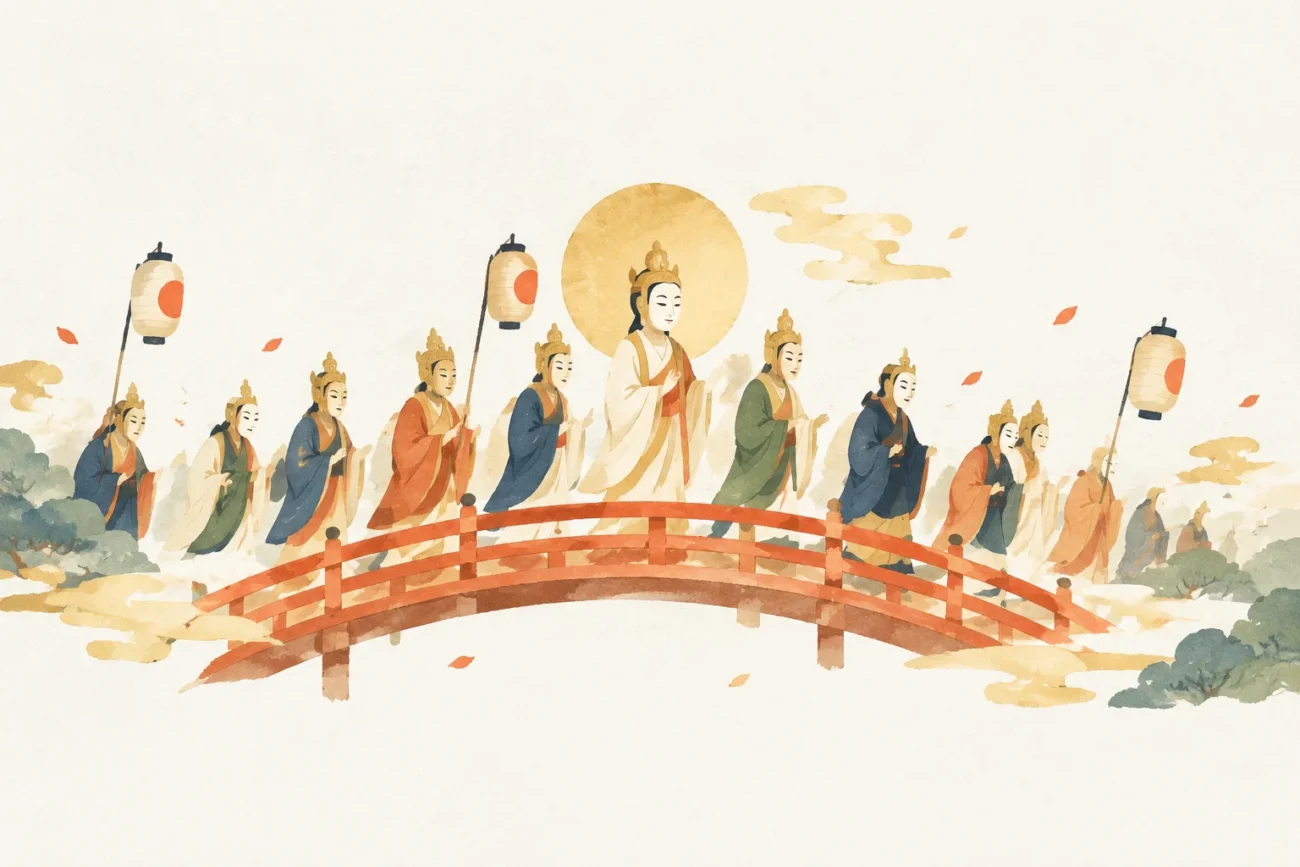
The Jūshinji Nijūgo Bosatsu Neri Kuyo is a folk performing art passed down at Jōshin-ji, in which people wearing masks of Buddhas and bodhisattvas cross a bridge to depict Amida Buddha’s descent to welcome the dead. Through the three processions of Raigo, Oso, and Genso, it portrays journeys to and from the Pure Land.
About Nijūgo Bosatsu Neri Kuyo
The Nijūgo Bosatsu Neri Kuyo is a folk performing art passed down at Jōshin-ji.
Also known as “Nijūgo Bosatsu Raigō-e” or “Omen Kaburi,” it features people wearing masks of Buddhas and bodhisattvas processing to depict Amida Buddha’s descent, accompanied by bodhisattvas.
In the Kanto region, its distinctive local feature is the performance of three processions: Raigo, Oso, and Genso.
Festival highlights
A highlight is the procession of people wearing wooden masks of Buddhas and bodhisattvas as they cross a temporary bridge.
In the Raigo procession, musicians playing instruments and the head priest and others chanting nenbutsu are followed by the Buddhas and bodhisattvas. In the Oso procession, a furikago scattering flower petals and other items, musicians, Buddhas and bodhisattvas, a palanquin carrying a wooden statue of Kaseki Shōnin, and children process across the bridge.
In Genso, the participants return from Sanbutsudō to the main hall, completing the three processions.
Twenty-five masked figures weave a story of the Pure Land through three processions
What to expect
The main hall represents this shore, while the Jōbon-dō represents the other shore; the procession makes three circuits across the bridge between them.
First comes Raigo, as the Buddhas and bodhisattvas cross from the Jōbon-dō to the main hall; next is Oso, as they return from the main hall to the Jōbon-dō with a wooden statue of Kaseki Shōnin; finally, Genso brings them back from the Jōbon-dō to the main hall.
The Buddhas and bodhisattvas carry banners, instruments, and other items. Because their masks limit their vision, each has an attendant.
Location and access
- Venue
Jōshin-ji (Kuhonbutsu Jōshin-ji)
Event venue 東京都世田谷区 浄真寺
This map uses the venue name. Check the official guide for the event area and entrances.
Dates and season
- Season
Every 3 years on August 16
- Frequency
Once every 3 years
Accommodation and hotels PR
Showing nearby accommodation.
Prices and availability are current at the time of retrieval. For multi-night stays, only the first night’s price is shown. Confirm the final price and directions to the venue with the booking provider. Select your dates again when using the area search link. Search area: within 3 km of Central Tokyo Metropolis / Setagaya City (the search is not centered on the festival venue)
Nearby attractions
Origins and History of Nijūgo Bosatsu Neri Kuyo
The Nijūgo Bosatsu Neri Kuyo is a folk performing art passed down at Jōshin-ji. In 2015, it was listed as an intangible folk cultural property for which measures such as documentation should be undertaken.
At Jōshin-ji, it is said to have been held once every three years on August 16. The most recent performance covered in detail by the records was in Heisei 26.
The three processions of Raigo, Oso, and Genso, along with a format distinct from Taima-dera’s Raigo-e, are considered to reflect local characteristics and changes in the performing art.
Official information
The Agency for Cultural Affairs’ “Database of Nationally Designated Cultural Properties” lists the name, frequency of public performances, preservation association, and the event’s structure and distinctive features.
Nijūgo Bosatsu Neri Kuyo at a Glance
The Nijūgo Bosatsu Neri Kuyo is a folk performing art passed down at Jōshin-ji, also known as “Omen Kaburi.”
On a bridge built between the main hall and the Jōbon-dō, masked Buddhas and bodhisattvas perform the three processions of Raigo, Oso, and Genso.
Recorded as a tradition held every three years on August 16, it is included in cultural property records as an example of the local character of Okusawa, Setagaya City, Tokyo.
Sources and references
Japanese Festivals.jp Editorial Team
Celebrating local culture and helping you discover a side of Japan you never knew.
Article updated: 2026/11/11