A night in Kuta, where flower-hat lanterns meet the rhythm of drums
Kuta no Hanagasa Odori

Festival information
EVENT INFORMATION- Season / frequency
- On the evening of August 24 each year / Every year
- Location
- Uenomiya Shrine, Okawa Shrine, Shikobuchi Shrine
- Area
- Kyoto Prefecture・Kyoto City(From Tokyo: approx. 2 h 10 min–2 h 40 min · bullet train)Prefecture-level estimate to a main station or airport, not the venue. Airport access, check-in and onward travel are extra; remote areas and islands can take much longer.
- Wishes behind the festival
- Last updated
- 2026/10/19
Kuta no Hanagasa Odori, danced to songs and drums while holding lanterns decorated with artificial flowers. This nighttime devotional performance is safeguarded by five hamlets.
About Kuta no Hanagasa Odori
Kuta no Hanagasa Odori is a lantern dance passed down in Kuta, in the northern part of Sakyo Ward, Kyoto.
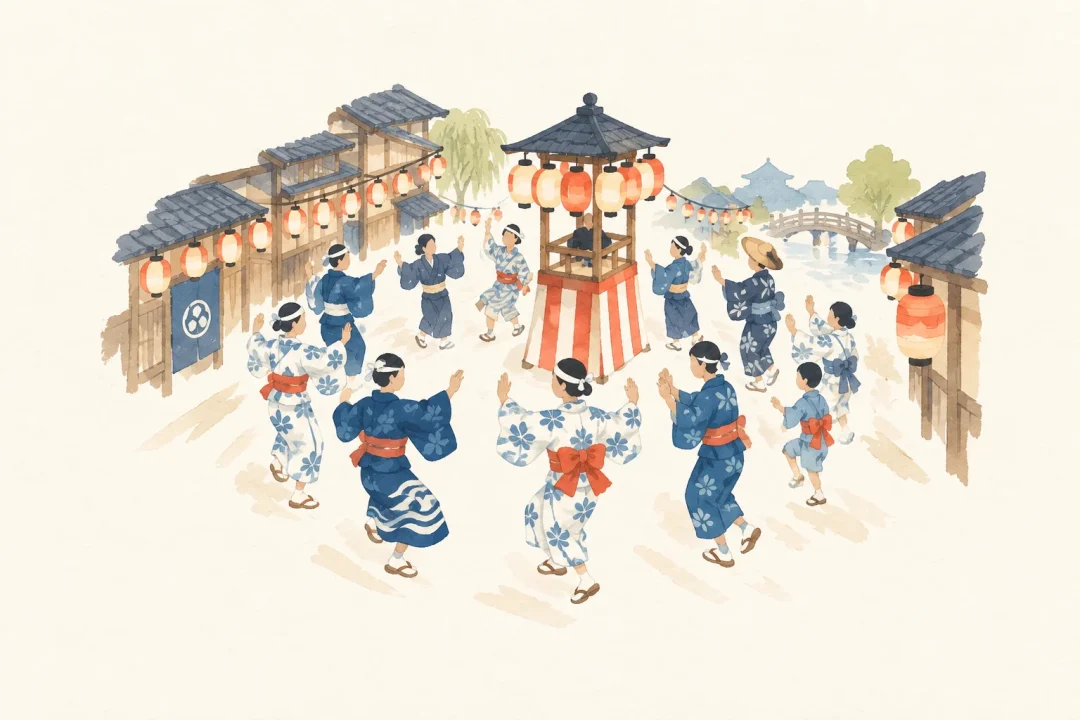
Dancers hold flower hats decorated with artificial flowers and lit with candles, and dance to the beat of drums and songs.
The tradition is carried on by five hamlets divided into the Upper and Lower groups, with local residents involved in everything from making the flower hats to offering the dance.
It is designated an Important Intangible Folk Cultural Property as a folk performing art that demonstrates the tradition of furyu-odori.
Source: 国指定文化財等データベース
Festival highlights
Highlights include the candlelit lanterns beneath flower hats adorned with artificial flowers and the dances performed at night in the shrines.
The flower hats are decorated with artificial chrysanthemums, peonies, morning glories, and other flowers. The chrysanthemums also use the pith from the stems of a plant locally called hashimame.
Dancers holding flower hats perform around the shime-daiko drums and singers, with the Upper and Lower groups performing the songs assigned to each.
Another distinctive scene is when the yori-bo strike their staffs together to signal the start of the dance.
A night in Kuta, where flower-hat lanterns meet the rhythm of drums
What to expect
In preparation for the event, people from the five hamlets gather at houses called hanayado, where they make flower hats and practice the dances and songs.
On the night of the event, participants set out from the hanayado and proceed to Uenomiya Shrine, Okawa Shrine, and Shikobuchi Shrine. At each place, they offer the flower hats at the shrine building, pray, and perform the dance.
At Shikobuchi Shrine, Hanagasa Odori begins after , with participants gathered around the shime-daiko drums and singers.
Seven of the more than ten songs are performed. The Upper and Lower groups take turns each year performing three and four songs, respectively.
Location and access
- Venue and address
Offerings are made at the Kamonomi Shrine, Okawa Shrine, and Shikobuchi Shrine in the Kuta district.
- By car
It is said to take 1 hour and 30 minutes to drive from central Kyoto to Kuta.
As you’ll be traveling through mountainous areas at night, please allow plenty of time for your journey.
Event venue 京都府京都市 上の宮神社
This map uses the venue name. Check the official guide for the event area and entrances.
Dates and season
It is usually held on the night of August 24, and preparations for making the flower hats and practicing begin around early August.
On the night of the festival, participants set out from the hanayado and make offerings as they visit three shrines.
Accommodation and hotels PR
Showing nearby accommodation.
Prices and availability are current at the time of retrieval. For multi-night stays, only the first night’s price is shown. Confirm the final price and directions to the venue with the booking provider. Select your dates again when using the area search link. Search area: within 3 km of Central Kyoto Prefecture / Kyoto City (the search is not centered on the festival venue)
Nearby attractions

京都タワー
京都府京都市下京区にある塔

京都国立博物館
京都市にある国立博物館

京都国立近代美術館
京都市左京区岡崎にある美術館

京都国際マンガミュージアム
日本の京都府京都市中京区にある日本最大の漫画博物館

京都市美術館
京都市左京区岡崎にある美術館

京都府立植物園
京都市左京区にある植物園

京都鉄道博物館
京都府京都市下京区にある鉄道博物館

Fushimi Inari Taisha
京都市伏見区にある神社

元離宮二条城
京都市にある城郭及び元皇室関連施設

Yasaka Shrine
京都市東山区にある神社

円山公園
京都市にある公園

Kitano Tenmangu Shrine
京都市上京区にある神社
Origins and History of Kuta no Hanagasa Odori
The origins of Kuta no Hanagasa Odori are unclear, but more than 130 lyrics appear in Hanagasa Odori Bon and Odori Banzuke Rokujūichiban, said to be records from the Meiji period.
The format of the lyrics and the way they combine tanka poetry suggest a connection to Muromachi kouta, popular in the medieval period.
In the past, boys danced with the flower hats on their heads. Around the transition from the late Taisho period to the early Showa period, the style changed to the present one, in which adults hold the flower hats in their hands.
As a performing art that conveys the character of medieval furyu-odori and kake-odori, it was designated an Important Intangible Folk Cultural Property in 1997 and inscribed on UNESCO’s Intangible Cultural Heritage list in 2022.
Official information
The Agency for Cultural Affairs’ Database of Nationally Designated Cultural Properties provides details and an explanation of the designation of Kuta no Hanagasa Odori.
The Sakyo Ward Office of Kyoto City also introduces it as a traditional event passed down in Kuta.
Source: 京都市左京区役所:森京都 伝統行事 花笠踊(久多)
Kuta no Hanagasa Odori at a Glance
Kuta no Hanagasa Odori is a traditional performing art passed down in Kuta’s five hamlets, where dancers light lanterns decorated with artificial flowers and dance to songs and drums.
The event begins with making flower hats at a hanayado, then proceeds to Uenomiya Shrine, Okawa Shrine, and Shikobuchi Shrine, where the dance is offered.
This Important Intangible Folk Cultural Property preserves traces of medieval furyu-odori and Muromachi kouta. Highlights include the flower hats glowing in the mountain night and the sequence of offerings maintained by the local community.
Japanese Festivals.jp Editorial Team
Celebrating local culture and helping you discover a side of Japan you never knew.
Article updated: 2026/10/19
Submit information or a correction Submit photos of this festival