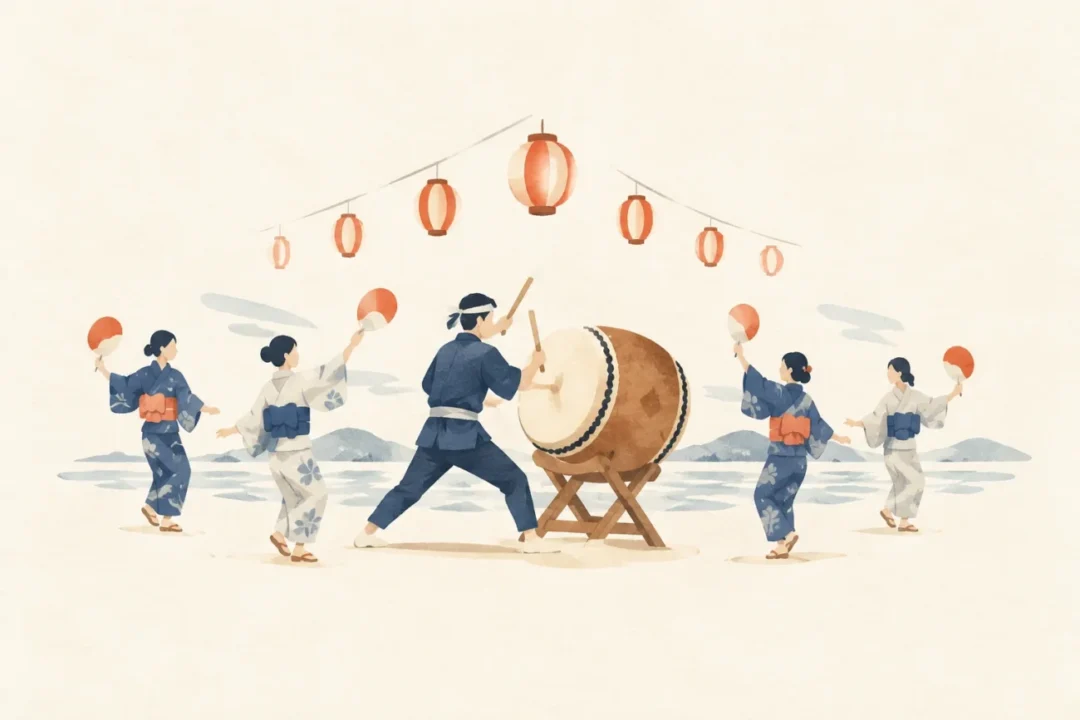
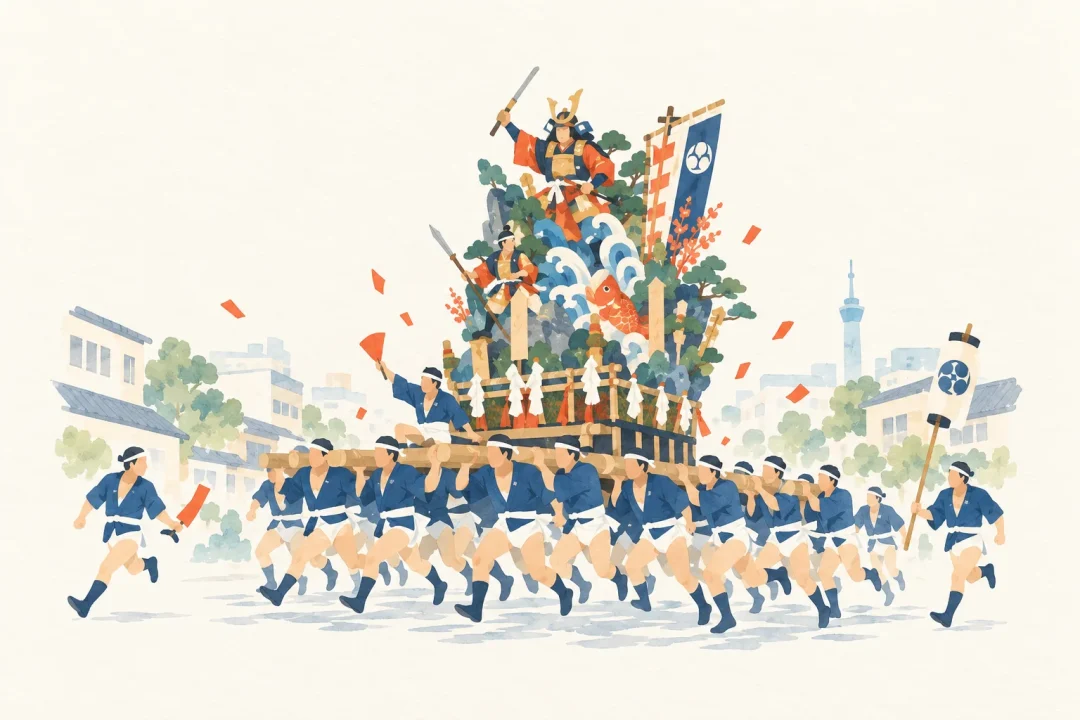
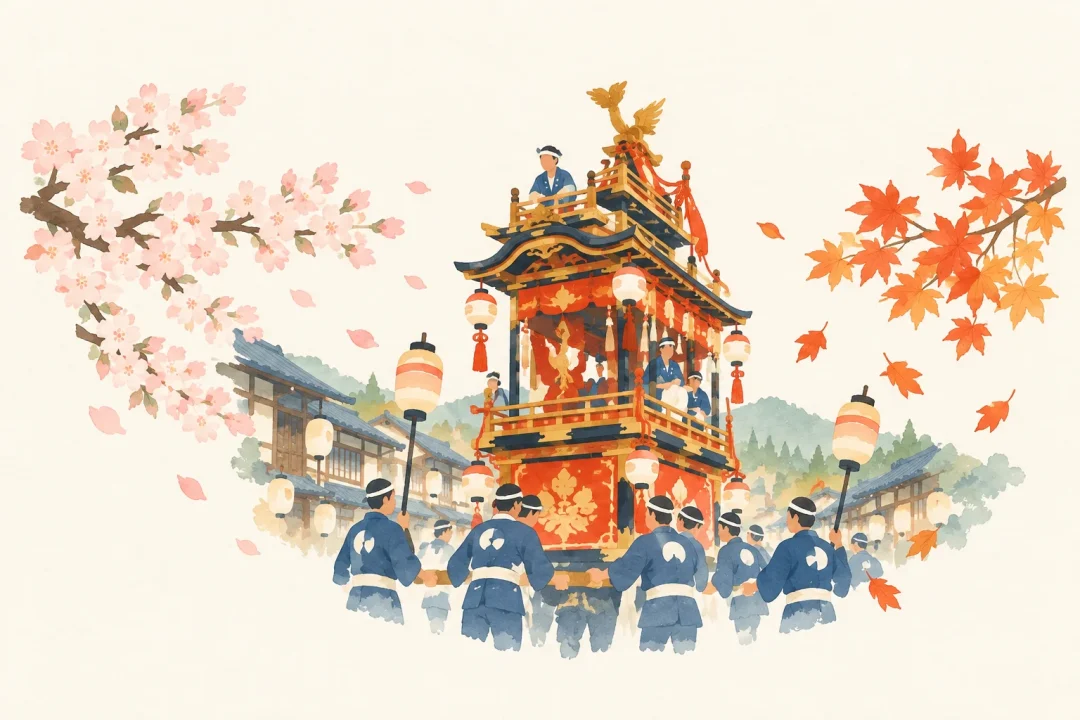
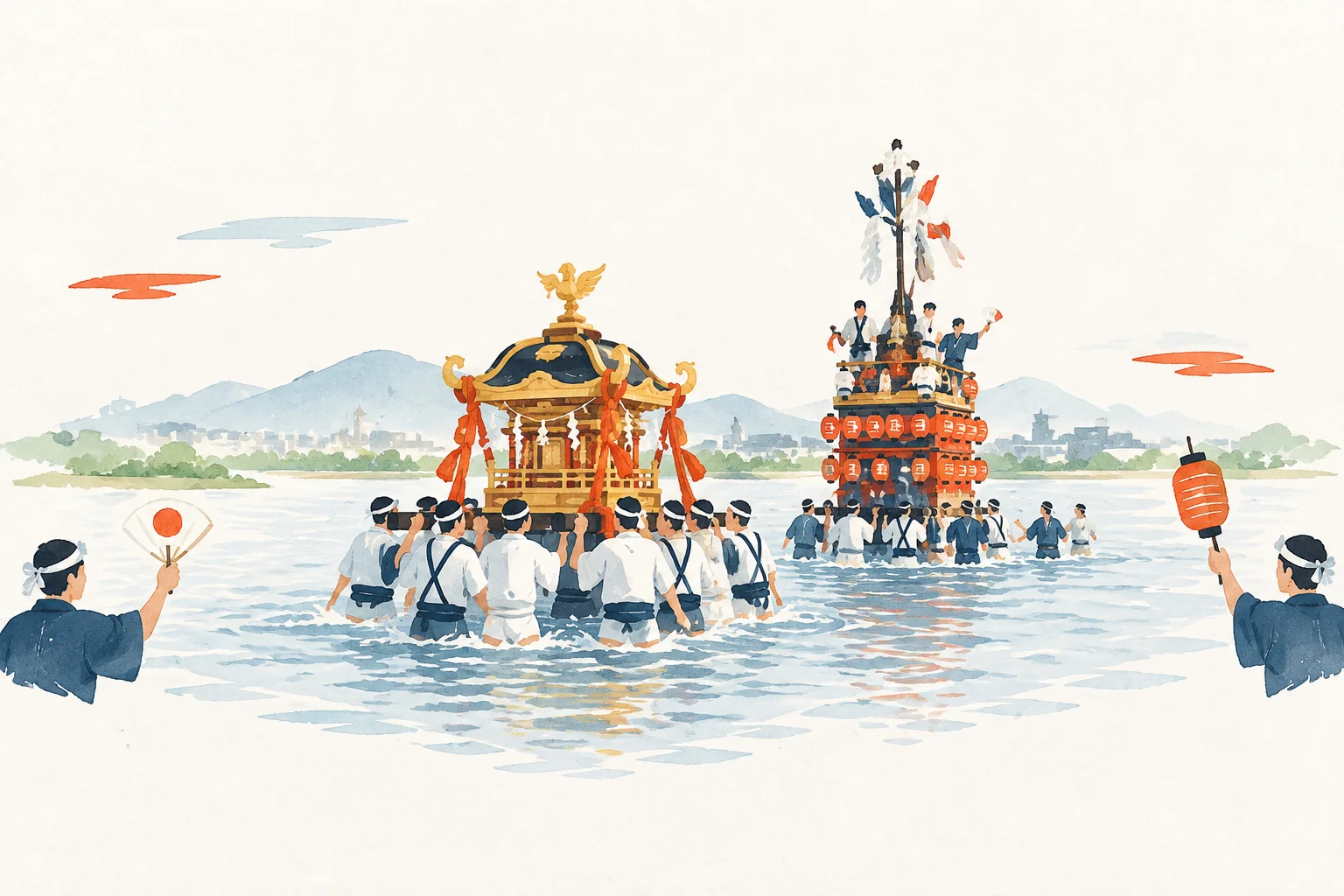
Tagawa’s traditional shrine procession, where mikoshi and dashi cross the Hikosan River
Kawawatari Shinkō Festival
The 2026 edition of Kawawatari Shinkō Festival has ended.
Festival information
EVENT INFORMATION- Dates
- 2026/05/16 〜 2026/05/17Ended
- Season / frequency
- The 3rd Saturday of May and the following Sunday each year / Every year
- Location
- Around Bandagawara on the Hikosan River (between Shinbashi and Bandabashi), Fūji Hachimangū, and the (Butokuden)
- Area
- Fukuoka Prefecture・Tagawa City(From Tokyo: approx. 1 h 50 min–2 h 10 min · flight time only)Prefecture-level estimate to a main station or airport, not the venue. Airport access, check-in and onward travel are extra; remote areas and islands can take much longer.
- Highlights and activities
- Wishes behind the festival
- Participation / viewing
- Open to public participation / spectators welcome
- Last updated
- 2026/10/19
At the Kawawatari Shinkō Festival, and cross the Hikosan River, filling the town of Tagawa with the sound of kane bells and the fervor of the offerings.
Photo credits and terms of use
Photographer: Muyo File:Kawawatari Jinkosai01.jpg / Wikimedia Commons / CC BY-SA 3.0 Own work by the contributorDisplay size only adjusted.May differ from the event currently featured.Photo credits and terms of use
Photographer: Chris Harber File:川渡り神幸祭 風治八幡宮 (4858296111).jpg / Wikimedia Commons / CC BY-SA 2.0 https://www.flickr.com/photos/britishchris/4858296111/Display size only adjusted.May differ from the event currently featured.About Kawawatari Shinkō Festival
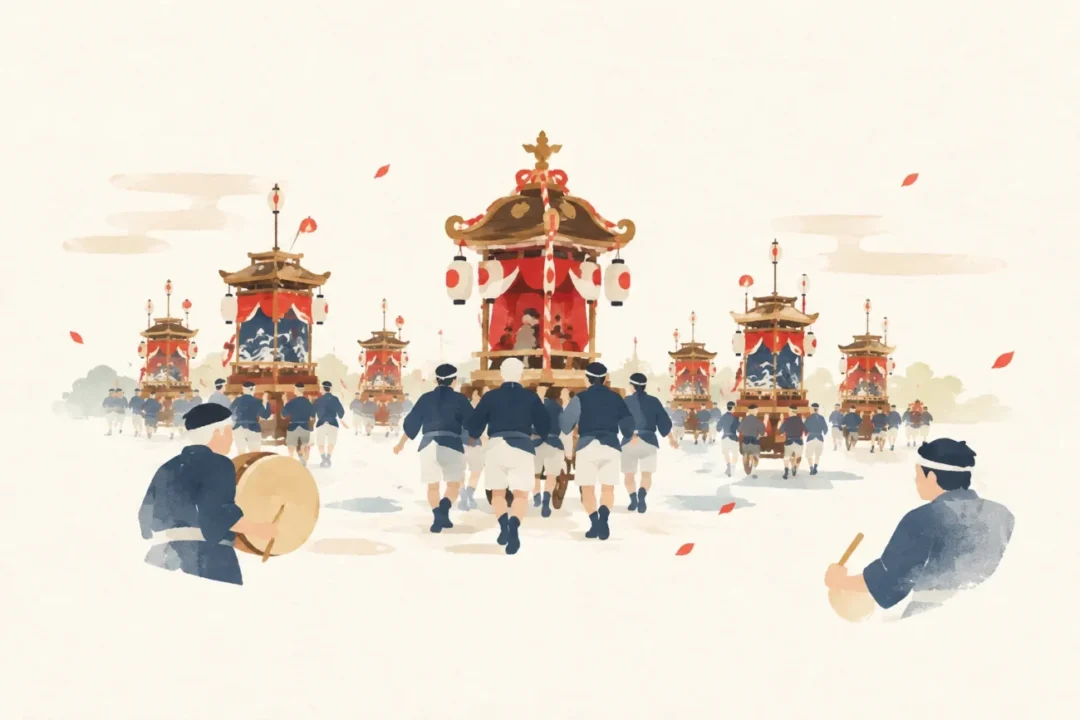
The Kawawatari Shinkō Festival is a shrine procession in which mikoshi from Fūji Hachimangū and Shiratori Shrine in Tagawa City, Fukuoka Prefecture, along with dashi from the shrine parishioner districts, cross the Hikosan River.
2 mikoshi are accompanied by 11 banner dashi. The first day is the procession going down from the shrine, and the second day is the return procession.
The act of crossing the river itself is an offering and is considered a sacred rite.
The five-colored horsehair streamers evoke images of rice ears and express wishes for bountiful harvests and good health.
Source: 川渡り神幸祭 - Wikipedia
Festival highlights
The main highlight is the river-crossing ritual, when the mikoshi and dashi enter the Hikosan River and cross between Shinbashi and Bandabashi.
The brightly colored dashi are said to weigh 2–4 tons each, and several dashi cross the river following the mikoshi.
Along the riverbanks, are dedicated and dashi compete, while the sound of kane bells accompanies the procession.
On Sunday night, illuminated lantern dashi also appear.
Tagawa’s traditional shrine procession, where mikoshi and dashi cross the Hikosan River
What to expect
The festival begins as dashi from each district gather near Fūji Hachimangū, and the mikoshi depart and proceed through the city.
After crossing from the left bank of the Hikosan River to the right bank, the mikoshi arrival ceremony and a lion dance dedication take place at Butokuden in the otabisho.
The following day, the procession crosses the river in the opposite direction from the otabisho, and the mikoshi and dashi return to Fūji Hachimangū.
Both days also feature lion dances, dashi processions, and performances on kane bells.
How to take part
Visitors may watch the festival, but joining the group carrying a mikoshi or dashi is not open to everyone without restrictions; recruitment and an application are required.
A notice titled “Kawawatari Shinkō Festival Mikoshi Bearer Recruitment” was posted for 2026, with an application form provided.
If you wish to participate as a mikoshi bearer, apply using the form on the bearer recruitment page.
For questions about applying, contact the organizer using the inquiry information on its website.
The 2026 recruitment notice explains how to click the QR code or scan it with a device to open the application form.
Location and access
- Venue and address
The festival is held mainly around Bandagawara on the Hikosan River (between Shinbashi and Bandabashi), as well as around Fūji Hachimangū and the otabisho.
The address is Bandagawara on the Hikosan River (between Shinbashi and Bandabashi), Tagawa City, Fukuoka Prefecture.
- Train and bus
About a 5-minute walk from Tagawa-Ita Station on the JR Hitahikosan Line and Heisei Chikuhō Railway.
The Nishitetsu Bus Minami-odori bus stop is also listed.
- By car
Turn right at Higashiōhashi off National Route 201 and continue about 1.5 km to the venue near Shinbashi.
Traffic restrictions are in place on festival days.
- Parking
For 2026, temporary free parking was listed at Tagawa City Hall, the prefectural university, the former site of Daiichi Bowl, the Tagawa Civil Engineering Office, and the former Information Center site. A shuttle bus runs from Tagawa City Hall to the former Information Center site.
Source: 【2026/5/16~5/17開催】田川市「川渡り神幸祭」駐車場・交通規制ガイド | ゆるなご
Address Bandagawara on the Hikosan River (between Shinbashi and Bandabashi), Tagawa City, Fukuoka Prefecture
Dates and season
2026 Festival Information (The listed dates have passed)
The festival is usually held on the 3rd Saturday of May and the following Sunday.
In 2026, the festival was listed as taking place over 2 days, May 16 (Saturday) and the 17th (Sunday). The river-crossing ritual was scheduled for the afternoon of the 16th, followed by the return procession and return to the main shrine on the 17th.
The 2026 schedule lists the river-crossing ritual at 3:30 p.m. on the 16th and 1:30 p.m. on the 17th.
Accommodation and hotels PR
Showing nearby accommodation.
Prices and availability are current at the time of retrieval. For multi-night stays, only the first night’s price is shown. Confirm the final price and directions to the venue with the booking provider. Select your dates again when using the area search link. Search area: within 3 km of Central Fukuoka Prefecture / Tagawa City (the search is not centered on the festival venue)
Tips for your visit
The 2026 festival information stated that road closures and traffic restrictions were scheduled around the venue while festival events were underway.
If traveling by car, use one of the designated temporary free parking lots and check the shuttle bus schedule.
Temporary toilets, waste stations, viewing seats, a first-aid station, and a police post are also listed for the venue.
Nearby attractions
Nearby attractions include Tagawa Coal Memorial Park and the Tagawa City Coal and History Museum.
Both offer insight into Tagawa’s coal-mining history and the region’s past.
If visiting these facilities along with the festival, check their opening status and conditions of use in advance.
Origins and History of Kawawatari Shinkō Festival
The festival is said to have originated during the Eiroku era, when an epidemic spread through Ita Village. The villagers prayed to their tutelary deity at Fūji Hachimangū for the epidemic to end, and, in gratitude for their prayers being answered, dedicated banner dashi.
It is said to have been passed down as a festival ever since, continuing for about 450 years.
In 1970, it was designated Fukuoka Prefecture’s 1st Intangible Folk Cultural Property.
Official information
“Kawawatari Shinkō Festival” is listed as the festival’s official website.
Information about recruiting mikoshi bearers and how to apply is also available on the website of the Fūji Hachimangū Kawawatari Shinkō Festival Mikoshi-Bearers Association.
The 2026 recruitment page for mikoshi bearers provides a link to an application form.
Kawawatari Shinkō Festival at a Glance
The Kawawatari Shinkō Festival is a local shrine procession passed down through generations in which mikoshi and dashi from Tagawa City cross the Hikosan River.
Highlights include 2 mikoshi and 11 banner dashi, lion dances, the sound of kane bells, and lantern dashi.
In 2026, the festival was listed for May 16 and the 17th, with traffic restrictions and temporary parking arrangements around the venue.
Japanese Festivals.jp Editorial Team
Celebrating local culture and helping you discover a side of Japan you never knew.
Article updated: 2026/10/19
Submit information or a correction Submit photos of this festival