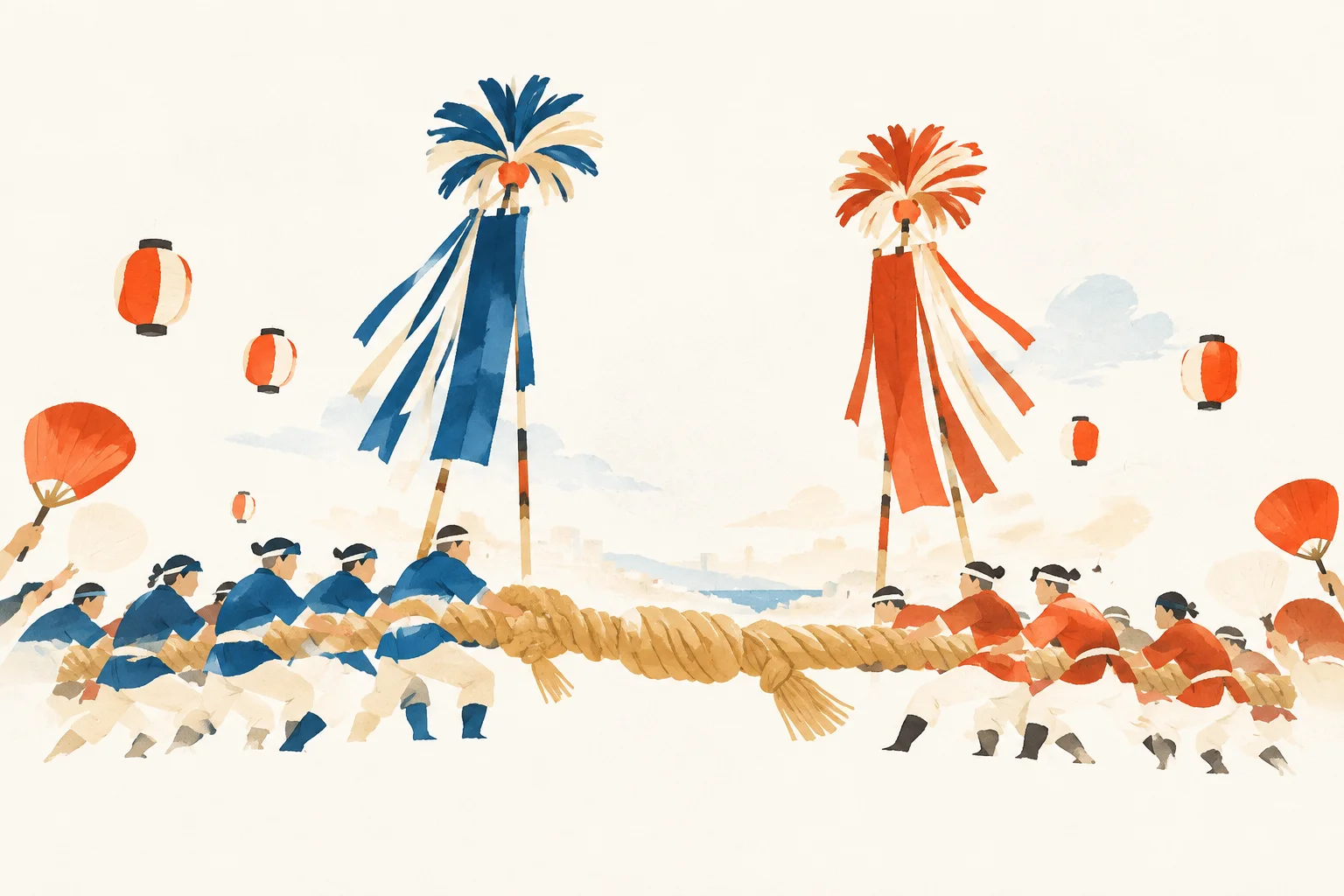
A traditional Naha event where flag bearers perform and the east and west sides join forces with the Great Rope
Naha Great Tug-of-War
Festival information
EVENT INFORMATION- Season / frequency
- Oct / Every year
- Location
- Kokusai Street and the Kumoji Intersection on National Route 58
- Area
- Okinawa Prefecture・Naha City(From Tokyo: approx. 2 h 30 min–3 h · flight time only)Prefecture-level estimate to a main station or airport, not the venue. Airport access, check-in and onward travel are extra; remote areas and islands can take much longer.
- Wishes behind the festival
- Participation / viewing
- Spectators welcome
- Official website / social media
- Official website
- Last updated
- 2026/10/19
Through its flag-bearer procession and the Great Tug-of-War, in which participants split into east and west sides and pull against each other, the Naha Great Tug-of-War offers a chance to experience traditions passed down in Naha. Its 56th edition is scheduled for October 11 (Sunday) in 2026.
About Naha Great Tug-of-War
The Naha Great Tug-of-War is a traditional cultural event representative of Naha City, carrying on the tradition of the Naha Four-Town Tug-of-War from the time of the Ryukyu Kingdom.
The female rope from the west and the male rope from the east are joined, and participants split into east and west sides and pull against each other with the Great Rope.
As an event wishing for the prosperity and peace of the community, as well as harmony in the home, it continues to be passed down by local people.
The 56th edition is scheduled for 2026.
Source: 那覇大綱挽について|那覇大綱挽|一般社団法人 那覇大綱挽保存会
Festival highlights
Highlights include a procession of 14 flag bearers along Kokusai Street and the Great Tug-of-War on National Route 58.
The female and male ropes are joined with a head crossbar, and a total of 280 hand ropes are attached.
According to the preservation association, the rope is 200 meters long, 1 meter 56 centimeters in diameter, and weighs 40 tons. Performances by the flag bearers and participants in traditional attire are also presented before the tug-of-war.
Source: 那覇大綱挽|一般社団法人 那覇大綱挽保存会
A traditional Naha event where flag bearers perform and the east and west sides join forces with the Great Rope
What to expect
On the day, the flag-bearer procession takes place first on Kokusai Street, followed by the Great Tug-of-War at the Kumoji Intersection on National Route 58.
For the tug-of-war, the female and male ropes are joined with a head crossbar, and participants split into east and west sides and pull against each other using hand ropes.
The start is signaled by the gong struck by the head percussionists of the east and west sides, and a siren signals the end.
How to take part
Many people take part as rope pullers in the Great Tug-of-War. The preservation association’s overview lists 15,000 rope pullers.
For local residents, pulling the rope is regarded as a form of communication through which they wish for prosperity, happiness, and unity.
Location and access
- Venue and address
The flag-bearer procession takes place on Kokusai Street, and the Naha Great Tug-of-War takes place at the Kumoji Intersection on National Route 58.
The address is Naha City, Okinawa Prefecture.
Source: 2026年 第56回那覇大綱挽 | 沖縄観光情報WEBサイト おきなわ物語
Address Kokusai Street and the Kumoji Intersection on National Route 58, Naha City, Okinawa Prefecture
Dates and season
The 2026 Naha Great Tug-of-War is scheduled for October 11 (Sunday).
The flag-bearer procession is scheduled from 10:25 a.m. to 12:55 p.m., and the Naha Great Tug-of-War from 1:30 p.m. to 4:10 p.m.
The Naha Great Tug-of-War Festival as a whole runs from October 10 (Saturday) through the 12th (Monday), but this period includes related events.
Source: 第56回那覇大綱挽まつり | NAHANAVI(ナハナビ)
Accommodation and hotels PR
Showing nearby accommodation.
Prices and availability are current at the time of retrieval. For multi-night stays, only the first night’s price is shown. Confirm the final price and directions to the venue with the booking provider. Select your dates again when using the area search link. Search area: within 3 km of Central Okinawa Prefecture / Naha City (the search is not centered on the festival venue)
Nearby attractions

守礼門
日本の沖縄県那覇市首里にある首里城歓会門の外にある牌楼型の門

対馬丸記念館
沖縄県那覇市にある、対馬丸事件についての資料が保存された施設

沖宮
沖縄県那覇市にある神社

沖縄県立博物館・美術館
沖縄県那覇市にある県立文化施設

波上宮
沖縄県那覇市の神社

福州園
沖縄県那覇市久米にある中国式庭園

識名園
沖縄県那覇市にある琉球庭園

那覇市歴史博物館
沖縄県那覇市にある博物館

首里城
沖縄県那覇市にあるグスク

国営沖縄記念公園
沖縄県にある国営公園

海軍司令部壕
沖縄戦において海軍の司令部として使用された防空壕
Origins and History of Naha Great Tug-of-War
The Naha Great Tug-of-War is said to have originated around 1450 CE and developed as a town tug-of-war symbolizing Naha as a trading city.
A set of rules for the tug-of-war was established in 1812, and it continued to be held as a celebratory tug-of-war from the Meiji era onward, but it ceased after 1935.
It was revived in 1971 as part of the 50th-anniversary celebration of Naha's city status, and in 1995 it was registered with Guinness as the “world's largest straw rope.”
Official information
Official information is available on the website of the Naha Great Tug-of-War Preservation Association, a general incorporated association.
Information is provided about the scheduled date, times for the flag-bearer procession and tug-of-war, and venue for the 56th Naha Great Tug-of-War in 2026.
Information about the Naha Great Tug-of-War Festival as a whole can also be found in announcements from the Naha Great Tug-of-War Festival Executive Committee and the Naha City Tourism Division.
Naha Great Tug-of-War at a Glance
The Naha Great Tug-of-War is a large-scale tug-of-war that carries on the tradition of the Naha Four-Town Tug-of-War and is held to pray for prosperity and happiness in the community.
In 2026, the flag-bearer procession along Kokusai Street and the Great Tug-of-War at the Kumoji Intersection on National Route 58 are scheduled for October 11 (Sunday).
The event centers on participants split into east and west sides pulling against each other with the 200-meter-long Great Rope, made by joining the female and male ropes.
Japanese Festivals.jp Editorial Team
Celebrating local culture and helping you discover a side of Japan you never knew.
Article updated: 2026/10/19
Submit information or a correction Submit photos of this festival