The path of the gods and the prayers of the community, etched into the ice of Lake Suwa
The Owatari Ritual
Festival information
EVENT INFORMATION- Season / frequency
- It typically appears during the bitterly cold period from January to February.
- Location
- Lake Suwa, Yatsurugi Shrine
- Area
- Nagano Prefecture・Suwa City(From Tokyo: approx. 1 h 20 min–1 h 50 min · bullet train)Prefecture-level estimate to a main station or airport, not the venue. Airport access, check-in and onward travel are extra; remote areas and islands can take much longer.
- Wishes behind the festival
- Participation / viewing
- Spectators welcome
- Last updated
- 2026/10/19
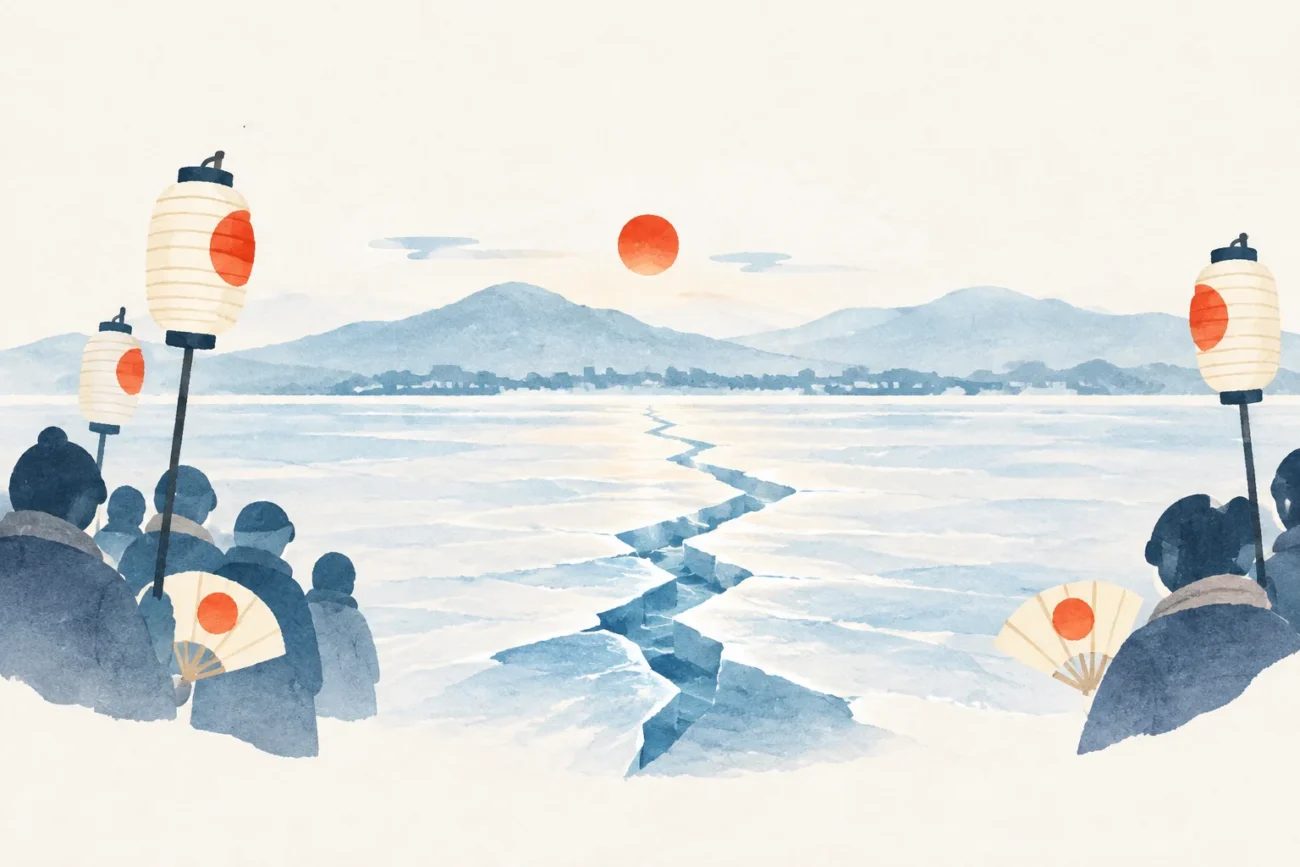
The Owatari Ritual venerates cracks in the ice that appear on Lake Suwa in winter as the path taken by Suwa Myojin. It is an Intangible Folk Cultural Property of Suwa City that links a natural phenomenon with long-standing beliefs.
About The Owatari Ritual
The Owatari Ritual is a rite in which cracks in the ice that appear on Lake Suwa are revered as the path taken by Suwa Myojin, and used to divine the fortunes of the year's crops and social affairs, as well as the climate and rainfall.
Since ancient times, this unique rite has been carried out by Yatsurugi Shrine and the Kowada district, and it is designated an Intangible Folk Cultural Property of Suwa City.
This is a distinctive part of Suwa's culture, where a natural phenomenon is linked to faith in Suwa Myojin.
Festival highlights
The main highlight is the crack in the ice that stretches from the south shore to the north shore when Lake Suwa freezes over completely.
The ice may split and form a ridge-like structure about 30 centimeters to 1 meter 80 centimeters high. At Yatsurugi Shrine, the condition of the ice is observed and examined.
The Omiwatari is also counted among the “Seven Wonders of Suwa.” According to tradition, it marks the path taken by the male deity of the Upper Shrine to visit the female deity of the Lower Shrine.
Source: 御神渡り | 諏訪観光連盟
The path of the gods and the prayers of the community, etched into the ice of Lake Suwa
What to expect
When the Omiwatari appears, around 60 people—including the chief priest, representatives of parishioners, senior officials, and the heads of the various Kowada districts—view the ice cracks said to mark the path taken by Suwa Myojin.
Afterward, the condition of the ice is used to divine crop yields, social fortunes, the climate, rainfall, and other matters, and the results are announced.
Visitors should not step onto the ice involved in the ritual. They can observe the phenomenon from a safe place, such as the lakeshore.
How to take part
The ritual is carried out by people involved, including the chief priest, representatives of parishioners, senior officials, and the heads of the various Kowada districts.
No information has been confirmed about visitors taking part in the ritual itself, but it is possible to observe the Omiwatari from a safe place, such as the lakeshore.
It is dangerous to venture onto the ice. When viewing the ritual, follow the directions of the people involved and all safety guidance.
Location and access
- Venue and address
Around Lake Suwa.
Yatsurugi Shrine, which is involved in the ritual, is at 13-18 Kowada, Suwa City, Nagano Prefecture.
- Train and bus
It is a 10-minute drive from Kamisuwa Station on the JR Chuo Main Line.
- By car
It is a 10-minute drive from Kamisuwa Station.
Roads around Lake Suwa are routinely congested.
- Parking
Information about parking in the area is available, but parking on the road or in ways that inconvenience nearby residents is prohibited.
Address 13-18 Kowada, Suwa City, Nagano Prefecture (Yatsurugi Shrine)
Dates and season
- Season
It typically appears during the bitterly cold period from January to February.
Accommodation and hotels PR
Showing nearby accommodation.
Prices and availability are current at the time of retrieval. For multi-night stays, only the first night’s price is shown. Confirm the final price and directions to the venue with the booking provider. Select your dates again when using the area search link. Search area: within 3 km of Central Nagano Prefecture / Suwa City (the search is not centered on the festival venue)
Tips for your visit
The ice on Lake Suwa varies in thickness and strength, and may be thin in places where hot springs or natural gas emerge.
Avoid going onto the ice or climbing onto ice washed up along the shore to take photos, as this can lead to falling into the water or slipping.
Roads may also be congested, so do not park on the road or in ways that inconvenience nearby residents. View the phenomenon from a safe place.
Nearby attractions

サンリツ服部美術館
長野県諏訪市にある美術館

諏訪大社
長野県諏訪地域にある4つの神社の総称
Origins and History of The Owatari Ritual
Since ancient times, the Owatari Ritual has been a unique rite carried out by Yatsurugi Shrine and the Kowada district.
The Omiwatari has been described in Heian-period waka poetry and passed down as one of the Seven Wonders of Suwa.
It was designated an Intangible Folk Cultural Property of Suwa City in Showa 53. In recent years, mild winters have led to more instances of “Akenoumi,” when the lake does not freeze over completely.
Official information
The Nagano Prefecture Suwa Regional Development Bureau provides information under the title “Omiwatari on Lake Suwa,” including how the Omiwatari forms, details of the ritual, safety precautions, and nearby live cameras.
An overview of its designation as an Intangible Folk Cultural Property of Suwa City is also available in the Shinshu Cultural Properties Information database.
The Owatari Ritual at a Glance
The Owatari Ritual is a traditional rite in which cracks in the ice that appear on Lake Suwa in winter are revered as the path taken by Suwa Myojin, and used to divine the fortunes of the coming year.
The ritual has been passed down by Yatsurugi Shrine and the Kowada district and is designated an Intangible Folk Cultural Property of Suwa City.
When viewing the phenomenon, do not go onto the ice. Observe the Omiwatari from a safe place, such as the lakeshore.
Japanese Festivals.jp Editorial Team
Celebrating local culture and helping you discover a side of Japan you never knew.
Article updated: 2026/10/19
Submit information or a correction Submit photos of this festival