Kunisaki’s autumn festivals, reflected in its inherited ritual groups and doburoku
Kunisaki Tōya observances
Festival information
EVENT INFORMATION- Season / frequency
- Nagamatsu: every year, November 13–November 20 / Kutsukake: every year, September 25–October 19 / Every year
- Location
- Wakamiya Hachiman Shrine, Shirahige Tahara Shrine
- Area
- Oita Prefecture・Kitsuki City(From Tokyo: approx. 1 h 35 min–1 h 55 min · flight time only)Prefecture-level estimate to a main station or airport, not the venue. Airport access, check-in and onward travel are extra; remote areas and islands can take much longer.
- Highlights and activities
- Wishes behind the festival
- Last updated
- 2026/10/19
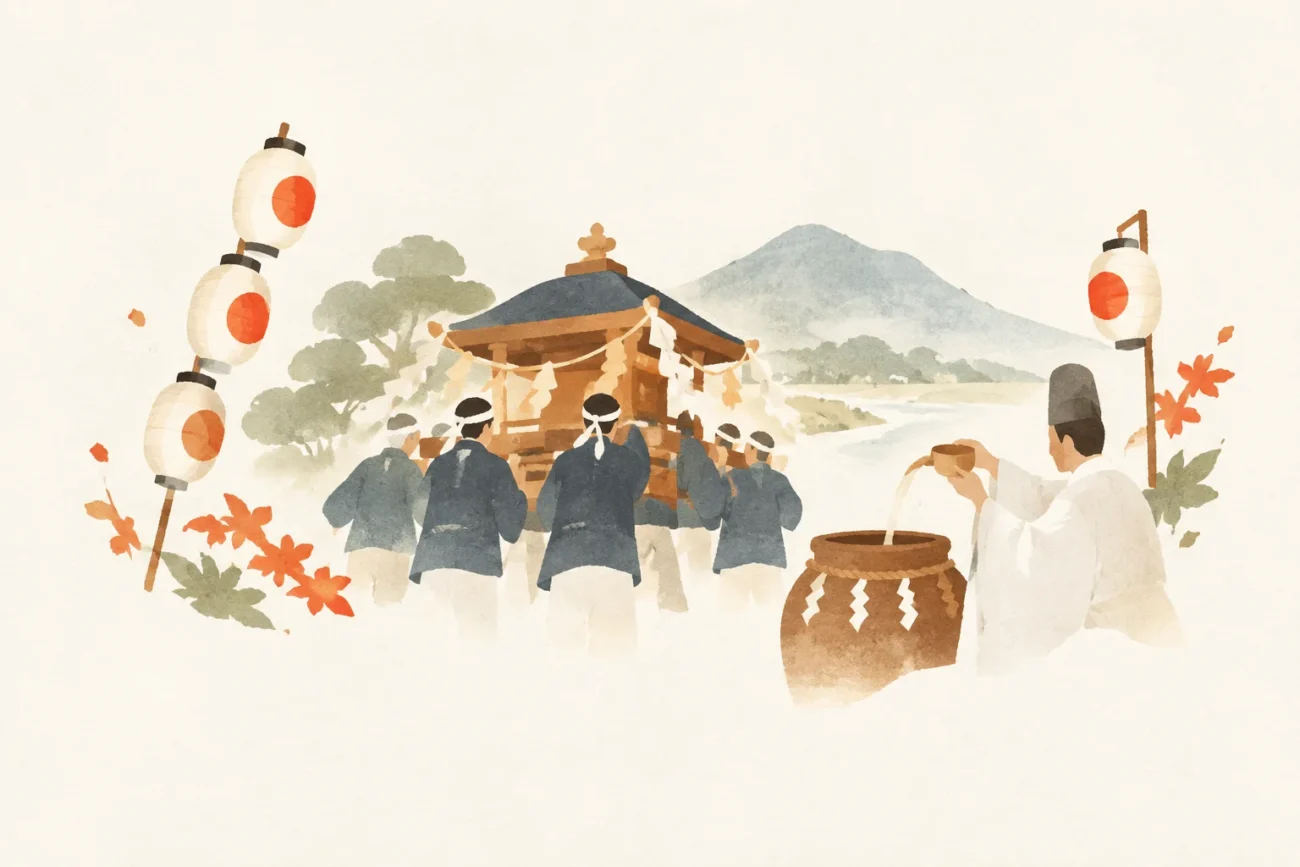
The Kunisaki Tōya observances in Nagamatsu and Kutsukake, Ota, Kitsuki City, where local ritual groups pass down their roles. The autumn festival at Wakamiya Hachiman Shrine and the doburoku-related at Shirahige Tahara Shrine preserve the old beliefs and way of life of the Kunisaki Peninsula.
About Kunisaki Tōya observances
The Kunisaki Tōya observances are festivals passed down at Wakamiya Hachiman Shrine in Nagamatsu and Shirahige Tahara Shrine in Kutsukake, both in Ota, Kitsuki City.
The events are carried out by local ritual organizations called Jigan-za, with designated households or groups taking turns serving as Hōrimoto (祝元).
At Nagamatsu, a series of autumn festivals takes place, while at Kutsukake, faith-based practices rooted in the community continue, centered on doburoku brewing and the .
Source: 国指定文化財等データベース
Festival highlights
A highlight is how local ritual organizations share responsibilities while carrying out events over several days.
At Nagamatsu, activities between Ohake Tate and Ohakeage included purification with seawater, choosing the Hōrimoto, handing over seed rice for the sacred rice field, Tōgōage, when offerings are presented, and Ohimachi gatherings.
At Kutsukake, the festival includes the start of doburoku brewing, purification rites at the river, drawing seawater, the reisai, and Hakeage. Doburoku is served to at the reisai.
Kunisaki’s autumn festivals, reflected in its inherited ritual groups and doburoku
What to expect
During the festival, a member of the Jigan group serves as the Hōrimoto, taking charge of preparations and carrying out the shinji according to a set schedule.
At Nagamatsu, traditions include Tōgōage, when sake and new-harvest glutinous rice are offered before the kami, the Ohimachi gathering held by the Jigan-za, and the final naorai meal.
At Kutsukake, doburoku is brewed, and after purification rites and drawing seawater, the reisai takes place. Doburoku offered to the kami is then served to ujiko.
How to take part
The Jigan group and Hōrimoto, who take charge of the festival, are drawn from designated local households and groups.
It is reported that doburoku was served to worshippers at the reisai of Shirahige Tahara Shrine.
No information is provided on whether general visitors can take on roles in running the festival.
Source: どぶろく祭り|おおいた遺産|大分を彩る120の美しき遺産
Location and access
- Venue and address
Wakamiya Hachiman Shrine (Nagamatsu, Ota, Kitsuki City) / Shirahige Tahara Shrine (Kutsukake, Ota, Kitsuki City)
- Train and bus
25 minutes by car from JR Kitsuki Station (Shirahige Tahara Shrine)
- By car
20 minutes from Kitsuki IC on the Oita Airport Road (Shirahige Tahara Shrine)
- Parking
Shirahige Tahara Shrine, 100 spaces, free
Source: PDF資料 / 白鬚田原神社どぶろく祭り(大分県/杵築市)|開催期間・アクセス|るるぶ&more.
Address Nagamatsu and Kutsukake, Ota, Kitsuki City, Oita Prefecture
Dates and season
- Season
Nagamatsu: every year, November 13–November 20 / Kutsukake: every year, September 25–October 19
- Frequency
Every year
Accommodation and hotels PR
Showing nearby accommodation.
Prices and availability are current at the time of retrieval. For multi-night stays, only the first night’s price is shown. Confirm the final price and directions to the venue with the booking provider. Select your dates again when using the area search link. Search area: within 3 km of Central Oita Prefecture / Kitsuki City (the search is not centered on the festival venue)
Tips for your visit
Doburoku is served at events at Shirahige Tahara Shrine, so if you visit by car, take care not to drink and drive.
Brewing and serving sake are part of the festival, but general visitors do not take on festival roles.
Schedules and events differ between the two areas, so check the details before visiting to avoid confusing Nagamatsu with Kutsukake.
Origins and History of Kunisaki Tōya observances
The Kunisaki Tōya observances preserve the ujiko-centered ritual organizations that have been passed down on the Kunisaki Peninsula since the medieval period, along with the practices associated with those organizations.
On December 20, 1984, they were selected as an intangible folk cultural property for which measures such as documentation should be undertaken.
The description at the time of selection also records that the traditional seat system has been maintained at Nagamatsu, while at Kutsukake, in Meiji 41, the organization responsible for conducting the festival changed from Jigan to the Jigan group.
Official information
The Kunisaki Tōya observances are listed in the Agency for Cultural Affairs’ Database of Nationally Designated Cultural Properties as an intangible folk cultural property for which measures such as documentation should be undertaken.
The listed preservation groups are the Wakamiya Hachiman Shrine Jinmoto-za Preservation Society and the Shirahige Tahara Shrine Doburoku Festival Preservation Society.
The database description is based on the information available when the item was selected.
Kunisaki Tōya observances at a Glance
The Kunisaki Tōya observances are festivals passed down through the Jigan-za at Nagamatsu and Kutsukake in Ota, Kitsuki City.
At Nagamatsu, the autumn festivals run from Ohake Tate to Ohakeage; at Kutsukake, doburoku brewing and the reisai are central.
The ujiko organization with roots in the medieval period, the rotation of Hōrimoto, and shinji in which sake and new rice are offered all bring the region’s faith and way of life to life.
Japanese Festivals.jp Editorial Team
Celebrating local culture and helping you discover a side of Japan you never knew.
Article updated: 2026/10/19
Submit information or a correction Submit photos of this festival