A mountain deity’s annual divination that reads the coming year’s harvest and natural conditions from azuki rice buried in the ground
Yama-no-Kami Annual Divination
Festival information
EVENT INFORMATION- Season / frequency
- In the predawn hours on the first Saru day of lunar calendar: November / Every year
- Location
- In the mountains near Enmeiji Temple, Ōiri, Obata, Shinshiro
- Area
- Aichi Prefecture・Shinshiro City(From Tokyo: approx. 1 h 40 min–2 h · bullet train)Prefecture-level estimate to a main station or airport, not the venue. Airport access, check-in and onward travel are extra; remote areas and islands can take much longer.
- Highlights and activities
- Wishes behind the festival
- Participation / viewing
- Not open to public participation / no spectators allowed
- Last updated
- 2026/11/11
Yama-no-Kami Annual Divination, passed down in Obata, Shinshiro, is a ritual that uses the condition of azuki rice buried in the ground for a year to divine the coming year’s crops and natural conditions.
About Yama-no-Kami Annual Divination
Yama-no-Kami Annual Divination is a ritual in the Obata district known locally as “Otameshi.”
In the predawn hours on the first Saru day of lunar calendar: November each year, the representatives leave Morotsuchi Shrine and head into the mountains where the mountain deity and Atago Shrine are enshrined.
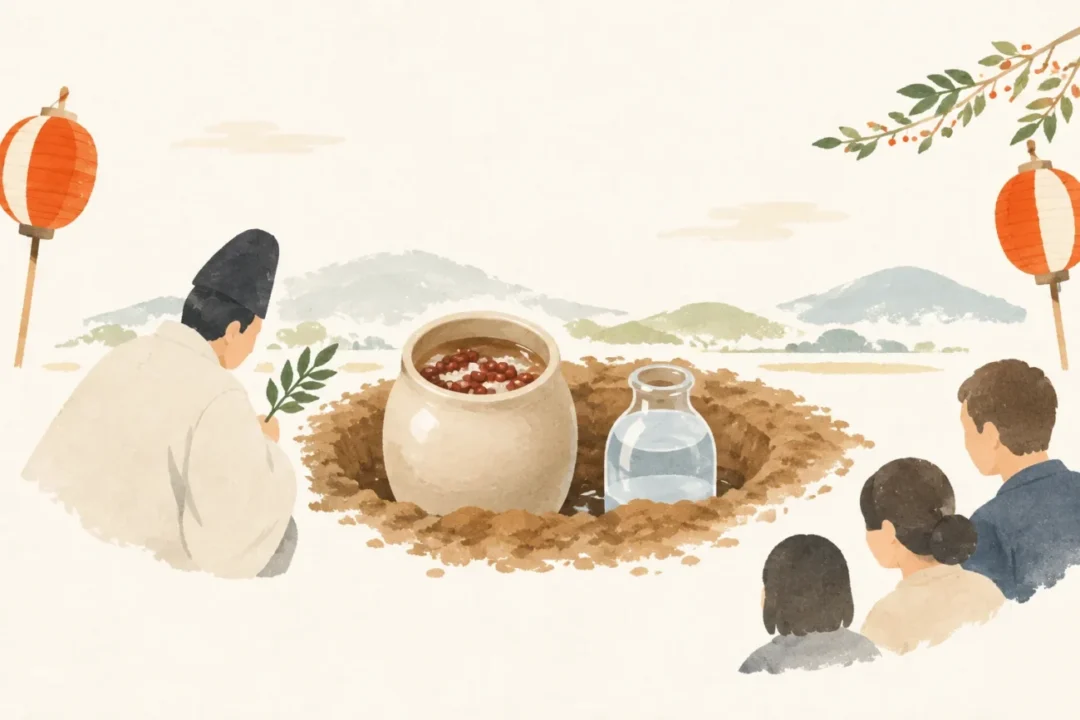
They dig up a jar buried in the ground the previous year and use the condition of the azuki rice and water inside to divine the coming year’s crops, harvest volume, flooding or drought, and unusual events.
It is designated an Intangible Folk Cultural Property of Shinshiro City.
Festival highlights
A highlight is digging up the jar buried a year earlier and carefully examining its contents.
The degree to which the rice and azuki beans retain their original shape is used to divine whether the crop will be good, average, or poor; the amount remaining indicates whether the harvest will be large or small.
The amount of water in the jar is used to read signs of flooding or drought, while foreign objects such as leaves, insects, and soil crumbs are examined for signs of unusual events.
After the examination, the azuki rice is poured into a stream, and fresh azuki rice is placed in the jar.
A mountain deity’s annual divination that reads the coming year’s harvest and natural conditions from azuki rice buried in the ground
What to expect
The ritual begins at Morotsuchi Shrine, and the ujiko representatives enter the mountains where the mountain deity and Atago Shrine are enshrined.
An altar covered with bamboo slats is set up in front of the shrine, and , sacred sake, and azuki rice are offered.
The jar buried the previous year is then dug up and its contents examined. After interpreting their condition, they are poured into a nearby stream.
Finally, fresh azuki rice is placed in the jar, which is buried in the ground again.
How to take part
Entry to the ritual site is forbidden to anyone other than the ujiko representatives, and public viewing is not available.
Women are not permitted in the sacred area dedicated to the mountain deity.
There is no public viewing, and only the ujiko representatives may enter the ritual site.
Location and access
- Venue and address
Ōiri, Obata, Shinshiro (near Enmeiji Temple, in the mountains behind the temple)
- Train and bus
About 2 km from Mikawa-Tōgō Station on the JR Iida Line to the Obata district
- By car
Information indicates a journey of about 1 hour 20 minutes from Toyohashi Station by the Iida Line
Address Ōiri, Obata, Shinshiro
Dates and season
- Season
In the predawn hours on the first Saru day of lunar calendar: November
- Frequency
Every year
Accommodation and hotels PR
Showing nearby accommodation.
Prices and availability are current at the time of retrieval. For multi-night stays, only the first night’s price is shown. Confirm the final price and directions to the venue with the booking provider. Select your dates again when using the area search link. Search area: within 3 km of Central Aichi Prefecture / Shinshiro City (the search is not centered on the festival venue)
Tips for your visit
The ritual site is not open to the public, and only the ujiko representatives may enter the sacred area.
Women are not permitted in the sacred area, and photography is generally not allowed.
You cannot enter the ritual site for the purpose of viewing the ceremony, so visitors should respect local customs.
Nearby attractions

長篠城
愛知県新城市にあった城
写真:First version: Aboshi at Japanese Wikipedia Second version: Mocchy at Japanese Wikipedia / CC BY-SA 3.0
Photo source ·Origins and History of Yama-no-Kami Annual Divination
Yama-no-Kami Annual Divination is a ritual that has been passed down in the Obata district for generations.
Locally, it has traditionally been called “Otameshi,” rather than by its formal name.
It was designated an Intangible Folk Cultural Property of Shinshiro City in Showa 33 (1958)April 1, and the custom of prohibiting women from entering the sacred area used for the divination is still observed today.
Official information
The contact office is the History and Culture Division of the Shinshiro City Board of Education.
The telephone number is 0536-23-7610, and the fax number is 0536-23-8388.
Yama-no-Kami Annual Divination at a Glance
Yama-no-Kami Annual Divination is a ritual held in the predawn hours on the first Saru day of lunar calendar: November in the Obata district, where it is known as “Otameshi.”
The ujiko representatives dig up a jar buried the previous year and divine the coming year’s crops, harvest, and weather from the shape and amount of the azuki rice, the water, and the presence or absence of foreign objects.
Finally, fresh azuki rice is placed in the jar.
The ritual site is not open to the public, and women are not permitted in the sacred area.
Sources and references
Japanese Festivals.jp Editorial Team
Celebrating local culture and helping you discover a side of Japan you never knew.
Article updated: 2026/11/11