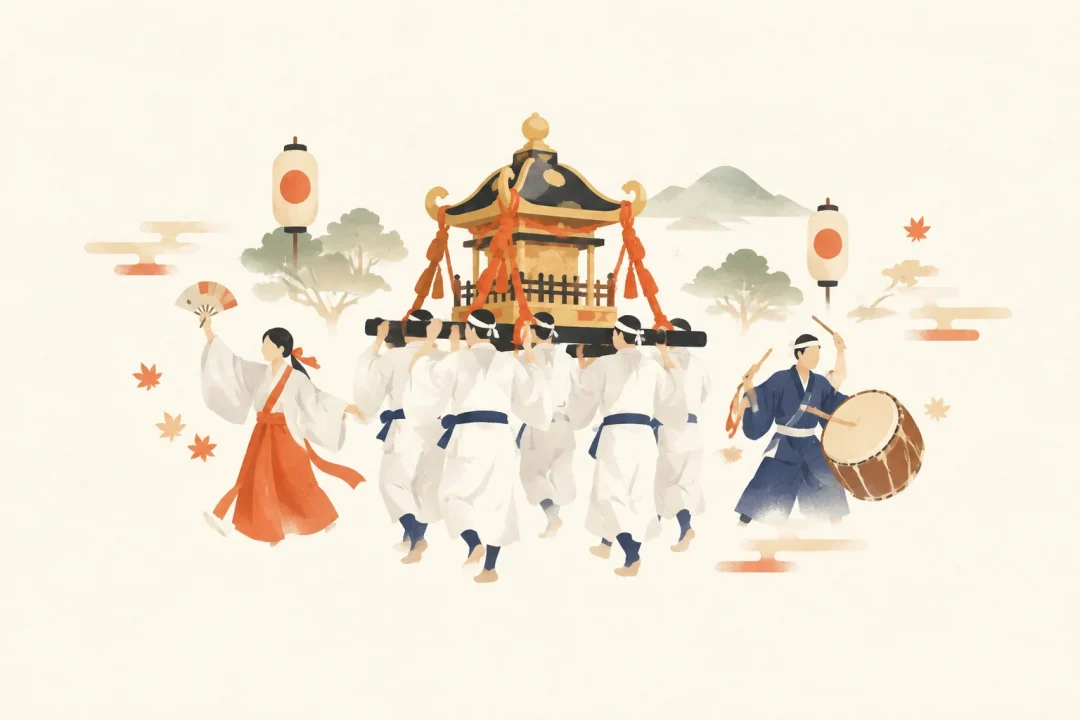
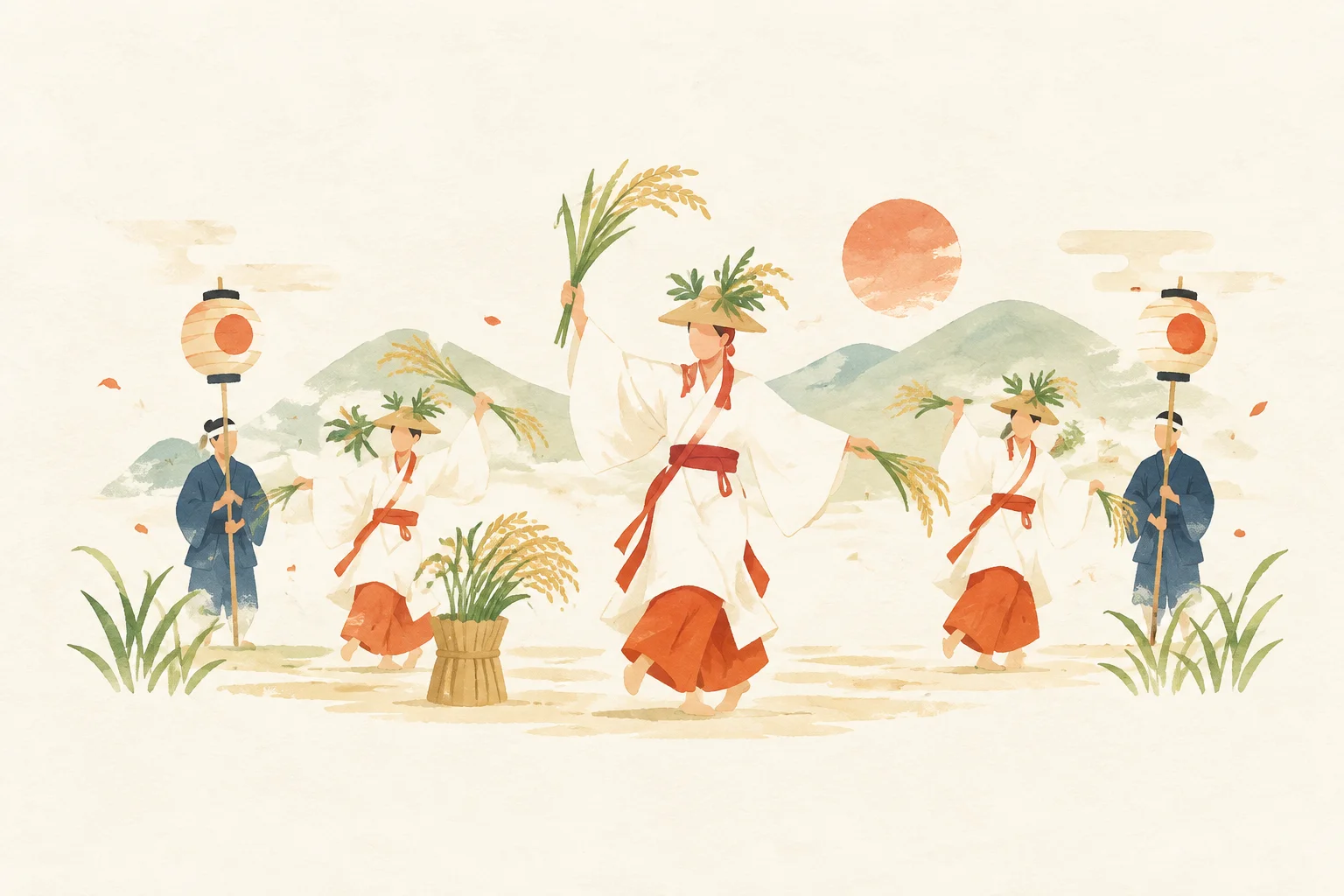
A prayer for an abundant harvest in Suginohara, depicting the four seasons of rice cultivation through song and dance
Suginohara no Ota-mai
Festival information
EVENT INFORMATION- Season / frequency
- February Lunar New Year / Every other year
- Area
- Wakayama Prefecture・Aridagawa Town(From Tokyo: approx. 3 h 30 min–4 h · bullet train + connecting train)Prefecture-level estimate to a main station or airport, not the venue. Airport access, check-in and onward travel are extra; remote areas and islands can take much longer.
- Highlights and activities
- Wishes behind the festival
- Last updated
- 2026/10/19
Suginohara no Ota-mai is a traditional ta-asobi performance from Aridagawa Town, Wakayama Prefecture, in which the stages of rice cultivation are acted out through song and dance to pray for an abundant harvest.
About Suginohara no Ota-mai
Suginohara no Ota-mai is a ta-asobi event passed down in a mountain village upstream along the Arida River in Wakayama Prefecture.
It portrays the process of rice cultivation over the year through songs, dances, and acted-out movements, praying for that year’s abundant harvest.
Designated an Important Intangible Folk Cultural Property, it carries the region’s farming culture and performing arts into the present day.
Source: 杉野原の御田舞 | わかやまの文化財
Festival highlights
Highlights include the procession to Kawazu Myōjin and the offering of “Haru-kuwa,” in which performers swing hoes to the beat of the .
At Amida-do Hall, “Hadaka-nae-oshi,” in which participants stomp vigorously around a brazier, is followed by the appearance of the father-in-law, the son-in-law, the harvester, and others.
Scenes from rice cultivation unfold one after another, including shihōkuwa (four-direction plowing), calling the ox, sowing seeds, rice planting, harvesting, and hulling rice.
A prayer for an abundant harvest in Suginohara, depicting the four seasons of rice cultivation through song and dance
What to expect
During the event, the performers form a procession led by a representative of the district, followed in order by the taiko player, the father-in-law, the son-in-law, the harvester, the ox, the rice-planting children, and others.
After paying respects at Kawazu Myōjin and offering Haru-kuwa, the participants proceed to Amida-do Hall, where they perform Hadaka-nae-oshi and Ota-mai.
In Ota-mai, performers act out plowing the fields, sowing seeds, planting rice, and harvesting, accompanied by exchanges of dialogue and songs.
Location and access
- Address
Aridagawa Town
Host municipality 和歌山県有田川町
This map shows the surrounding area, not the exact venue location.
Dates and season
- Season
February Lunar New Year
- Frequency
Every other year
Accommodation and hotels PR
Showing nearby accommodation.
Prices and availability are current at the time of retrieval. For multi-night stays, only the first night’s price is shown. Confirm the final price and directions to the venue with the booking provider. Select your dates again when using the area search link. Search area: within 3 km of Central Wakayama Prefecture / Aridagawa Town (the search is not centered on the festival venue)
Origins and History of Suginohara no Ota-mai
Suginohara no Ota-mai is a ta-asobi performance said to have been passed down since the Muromachi period.
It preserves a -like style of performance centered on roles for a father-in-law and son-in-law, once widely found in the foothills along the Arida River, which rises on Mount Koya.
Records state that Amida Hall was built in the early 16th century. In the past, the event was also accompanied by Doto-shiki, a village-entry ceremony for three-year-old children.
Source: 第5回 杉野原の御田舞(おんだのまい) 〜舅(しゅうと)と聟(むこ)〜 - LIVING和歌山 / 国指定文化財等データベース
Official information
You can check the designation details and description of Suginohara no Ota-mai in the Database of Nationally Designated Cultural Properties and Other Items (Agency for Cultural Affairs).
The event location and venue are also listed in the Wakayama Prefectural Board of Education’s Intangible Folk Cultural Properties Calendar.
Source: 和歌山県無形民俗文化財カレンダー | 和歌山県教育委員会
Suginohara no Ota-mai at a Glance
Suginohara no Ota-mai is a traditional performing art that depicts the year in rice cultivation through songs, dances, and actors’ movements, praying for the community’s peace and a bountiful harvest.
A procession to Kawazu Myojin, Harukuwa, Hadaka-nae-oshi at Amida Hall, and performances such as rice planting and hulling form a sequence of events.
開催は例年2月の旧正月で、隔年とされています。
Japanese Festivals.jp Editorial Team
Celebrating local culture and helping you discover a side of Japan you never knew.
Article updated: 2026/10/19
Submit information or a correction Submit photos of this festival