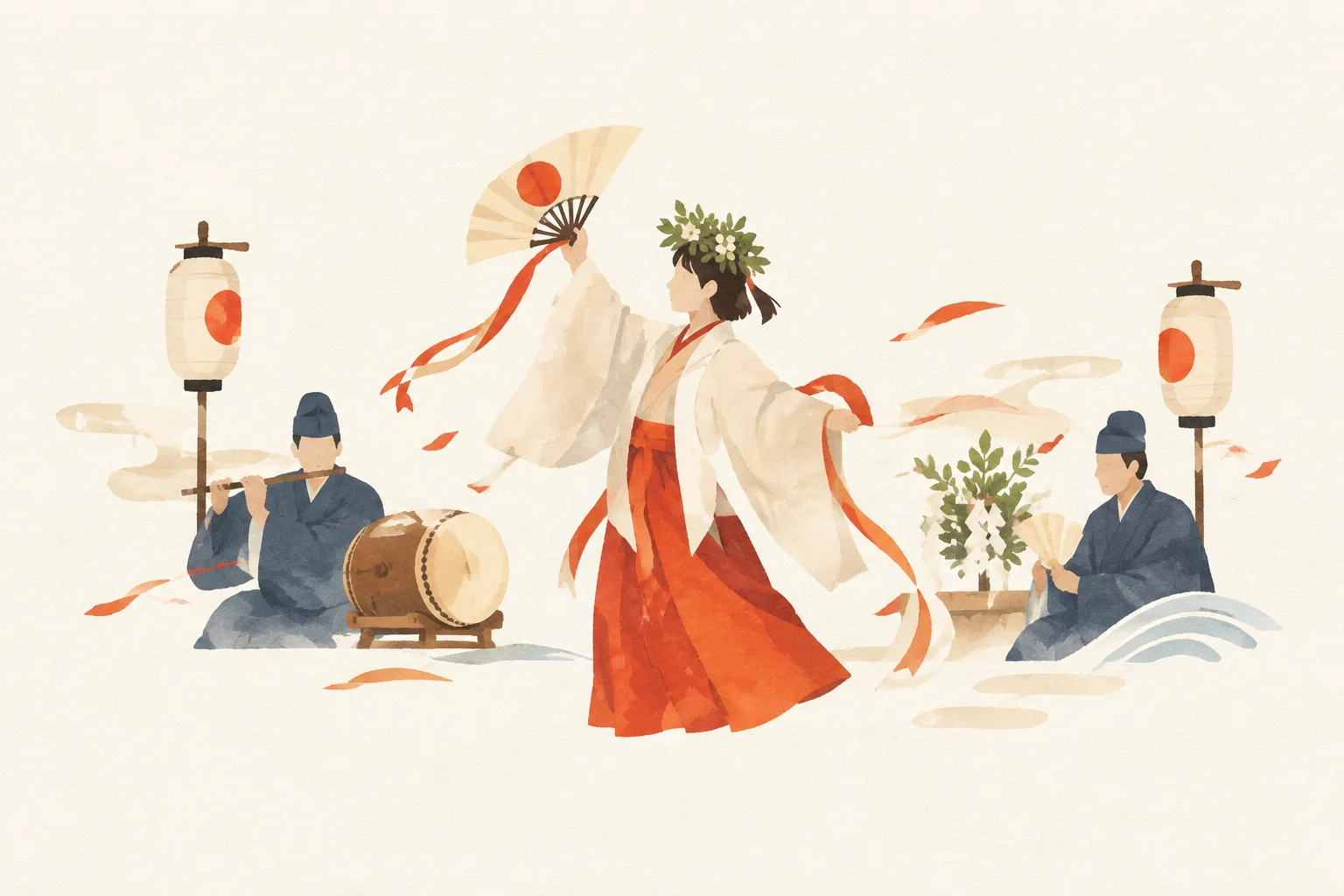
A dance of prayer from the Rikuchu coast, where miko and kagura performers weave their sounds together
Miko-mai of the Rikuchu Coastal Region
Festival information
EVENT INFORMATION- Season / frequency
- At shrine festivals and other occasions
- Area
- Iwate Prefecture(From Tokyo: approx. 2 h 10 min–2 h 40 min · bullet train)Prefecture-level estimate to a main station or airport, not the venue. Airport access, check-in and onward travel are extra; remote areas and islands can take much longer.
- Highlights and activities
- Wishes behind the festival
- Last updated
- 2026/10/19
A folk performing art passed down in the Rikuchu coastal region, where miko dances, music, and oracle exchanges come together.
About Miko-mai of the Rikuchu Coastal Region
Miko-mai of the Rikuchu coastal region is a folk performing art involving shrine maiden dances and prayers, passed down along the coast of Iwate Prefecture.
Miko have been closely connected with local religious life through practices such as entertaining the Oshir-sama, spring prayers, boiling-water oracles at shrine festivals, and prayers for the sick.
Miko-mai is also performed when someone completes their training under a master and receives a secret teaching called odaiji.
Source: Database of Nationally Designated Cultural Properties, etc.
Festival highlights
A highlight is this distinctive performing art, in which miko and kagura performers dance to music and sing in call-and-response.
The kagura performers provide musical accompaniment on drums, flutes, and hand gongs. During oracle scenes, they exchange questions and answers with the drummer, known as the dōtori.
Performances include dances such as the “Bamboo Grass Dance” and the “Water Deity Dance,” and the footwork also incorporates movements resembling henbai.
A dance of prayer from the Rikuchu coast, where miko and kagura performers weave their sounds together
What to expect
Miko-mai is performed during boiling-water oracles at shrine festivals and on occasions such as when a performer completes their training and receives a secret teaching called odaiji.
Kagura performers are invited for the dance, accompanying the miko with drums, flutes, and hand gongs.
During the oracle, the miko and kagura performers sing in call-and-response, and the miko also exchange questions and answers with the dōtori.
Location and access
Host prefecture Iwate Prefecture
This map shows the surrounding area, not the exact venue location.
Dates and season
- Season
At shrine festivals and other occasions
Origins and History of Miko-mai of the Rikuchu Coastal Region
In the Rikuchu coastal region, miko have been part of local religious life through prayers, festivals, prayers for the sick, purification rites after funerals, and other practices.
Although detailed information about its origins or when it developed has not been confirmed, miko-mai is regarded as an important folk performing art that illustrates the formation or emergence of a performing art.
In 1993, it was selected as an Intangible Folk Cultural Property for which measures such as creating a record should be undertaken.
Official information
Database of Nationally Designated Cultural Properties, etc.
Miko-mai of the Rikuchu Coastal Region at a Glance
Miko-mai of the Rikuchu coastal region is a distinctive folk performing art from the coast of Iwate Prefecture, performed jointly by miko and kagura performers.
Traditions include musical accompaniment on drums, flutes, and hand gongs; call-and-response singing; question-and-answer exchanges accompanying oracles; and dances such as the “Bamboo Grass Dance” and the “Water Deity Dance.”
The number of practitioners has declined, and only a handful of people can still perform miko-mai, making it a precious tradition preserved in the region.
Japanese Festivals.jp Editorial Team
Celebrating local culture and helping you discover a side of Japan you never knew.
Article updated: 2026/10/19
Submit information or a correction Submit photos of this festival