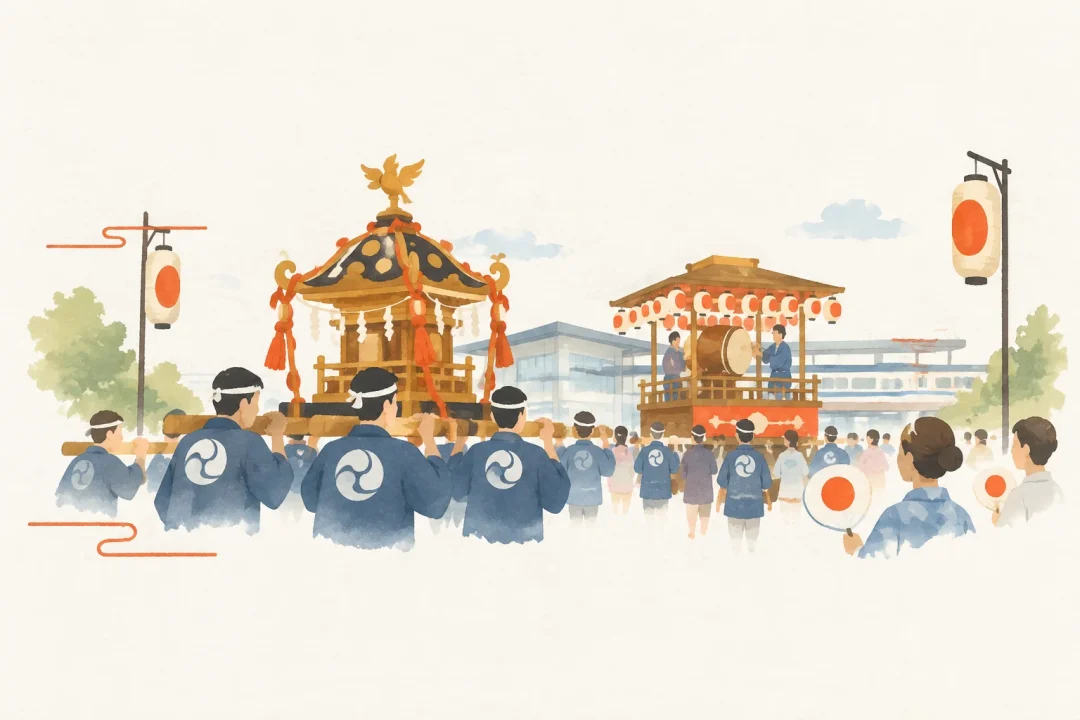
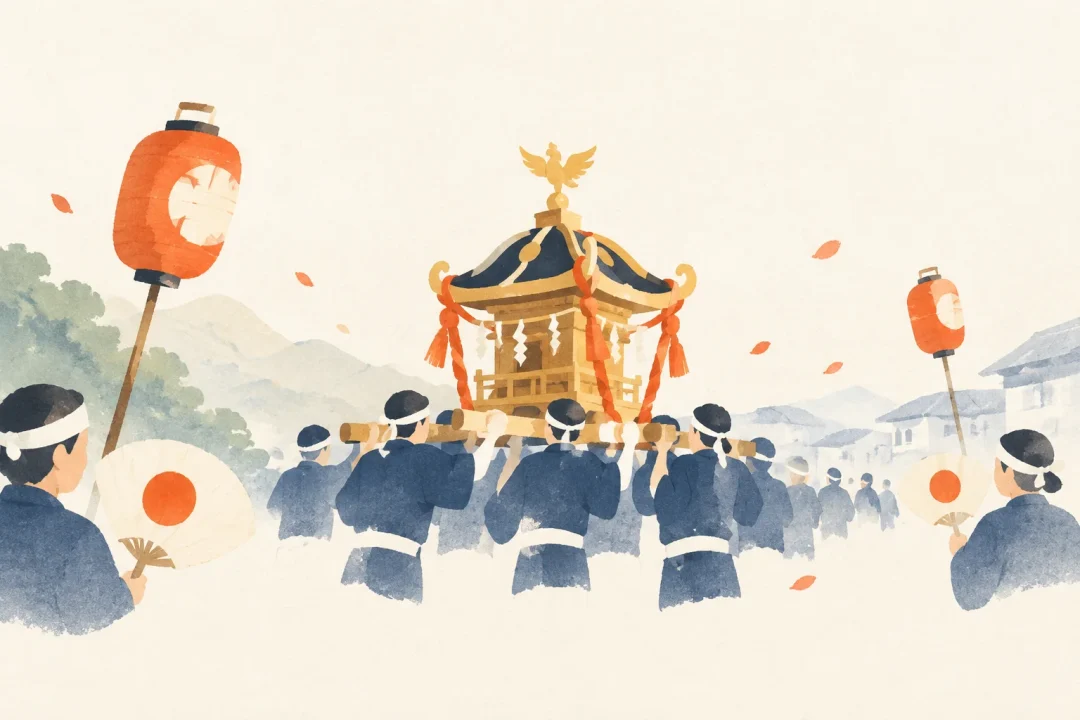
A Shinto ritual centered on a serving of mosō piled high with eight go of rice, giving thanks for the harvest and praying for good health
Ooi Matsuri

Festival information
EVENT INFORMATION- Season / frequency
- The second Sunday of every December / Every year
- Location
- Shimoizumi Community Center
- Area
- Ibaraki Prefecture・Sakuragawa City(From Tokyo: approx. 1 h 10 min–1 h 30 min · limited express)Prefecture-level estimate to a main station or airport, not the venue. Airport access, check-in and onward travel are extra; remote areas and islands can take much longer.
- Features
- Highlights and activities
- Wishes behind the festival
- Last updated
- 2026/10/19
This in the Shimoizumi and Hongō districts of Sakuragawa City centers on mosō—eight go of rice piled high—and gives thanks for a good harvest and expresses wishes for good health.
About Ooi Matsuri
Ooi Matsuri is a Shinto ritual passed down in the Shimoizumi and Hongō districts of Sakuragawa City, Ibaraki Prefecture.
Parishioners of Kashima Shrine gather at the household responsible for hosting that year and sit around a bowl heaped high with eight go of rice, called “mosō.”
The event gives thanks for the harvest and prays for people’s health. In the Shimoizumi district, it is held at Shimoizumi Community Center.
Members of the public do not take part inside; they watch from outside.
Source: 大飯祭り | 桜川市公式ホームページ
Festival highlights
A highlight is the distinctive ritual meal: people eat “mosō,” eight go of rice piled high in a bowl, with grilled saury, simmered dishes, namasu, miso soup, pickles, and other foods.
In the Hongō district, the “Imahamā,” carrying a fish box, appears; in the Shimoizumi district, “Kashima-sama” serves another helping of rice in a ritual called “Onaoshi.”
The gesture of covering someone with rice, along with distinctive attire and objects such as straw sandals, a winnowing basket, and a sedge hat, gives this local festival its distinctive character.
Source: 大飯祭り - Wikipedia
A Shinto ritual centered on a serving of mosō piled high with eight go of rice, giving thanks for the harvest and praying for good health
What to expect
The festival proceeds with the priest of Kashima Shrine bringing the shrine’s spirit to the tōya household, after which people begin eating the rice.
Participants eat mosō with side dishes, followed by different characters and ritual actions in each district.
In the Hongō district, there is a scene where someone pretends to offer fish and young people cover the tōya host with rice. At the end, another serving of rice is offered as “Onaoshi.”
The event as a whole starts around 11 a.m. and lasts about 1 hour.
How to take part
General visitors cannot take part in the festival rites or communal meal.
This is a religious rite led by parishioners of Kashima Shrine. General visitors watch from outside the area.
This is an occasion to observe the local festival quietly without aiming to eat at the venue or take part in the customary actions, and without disrupting the festivities.
Please follow on-site guidance on the day regarding whether viewing is permitted and where to stand.
Location and access
- Venue and address
Shimoizumi Community Center (374-3 Shimoizumi, Sakuragawa City).
- Train and bus
It is 15 minutes by taxi from Iwase Station on the JR Mito Line.
- By car
It is a 5-minute drive from the Sakuragawa-Chikusei IC on the Kita-Kanto Expressway via Route 50, and a 50-minute drive from the Tsuchiura-Kita IC on the Joban Expressway via Routes 125, Prefectural Route 14, and Prefectural Route 41.
- Parking
There is no parking.
Address 374-3 Shimoizumi, Sakuragawa City, Ibaraki Prefecture
Dates and season
Ooi Festival is held on the 2nd Sunday of December every year.
It starts at around 11 a.m. and ends after about 1 hour.
If you plan to observe, please also check the venue guidance once the date has been confirmed.
Accommodation and hotels PR
Showing nearby accommodation.
Prices and availability are current at the time of retrieval. For multi-night stays, only the first night’s price is shown. Confirm the final price and directions to the venue with the booking provider. Select your dates again when using the area search link. Search area: within 3 km of Central Ibaraki Prefecture / Sakuragawa City (the search is not centered on the festival venue)
Tips for your visit
Members of the public cannot participate in the festival; they can only observe from outside.
There is no parking at the venue, so if you plan to come by car, please consider in advance how you will get around the area.
As the event centers on a Shinto ritual and a shared meal, please take care not to disrupt proceedings by taking photos at close range or talking.
Follow local instructions about where to observe and any guidance on the day.
Nearby attractions

真壁城
茨城県桜川市にあった城

礒部稲村神社
茨城県桜川市にある神社
Origins and History of Ooi Matsuri
Ooi Matsuri is said to have originated in the “Kashima-dachi” ritual, in which rice was heaped high in bowls and shared as a celebratory meal when soldiers were sent off to serve as frontier guards.
In the past, the Shimoizumi district held its event on December 13, while the Hongō district held it on the 14th. On the 15th, the two districts held “Uketoriwatashi” in front of Kashima Shrine.
It is now held on the second Sunday of December.
The tōya is responsible for preparations, conducting the event, and cleanup; the role is said to come around roughly once every 60 years.
Official information
The Sakuragawa City official website provides information on the location, how to observe the event, when it is held, and how to get there under “Ooi Matsuri.”
It also states that the public cannot participate and that the event is observed from outside.
The venue is Shimoizumi Community Center, and the festival is held on the second Sunday of every December.
The official information also confirms that visitors can take a taxi from Iwase Station on the JR Mito Line, gives directions by car, and notes that there is no parking.
Ooi Matsuri at a Glance
Ooi Matsuri is a Shinto ritual passed down in Sakuragawa City’s Shimoizumi and Hongō districts, where people gather around a heaping serving of rice called mosō.
The festival gives thanks for a good harvest and prays for good health, with distinctive roles such as Kashima-sama and Imahamā appearing in each district.
Members of the public cannot participate in the festival and observe from outside.
It is held every second Sunday of December, starting around 11 a.m. and lasting about 1 hour. There is no parking at Shimoizumi Community Center.
Japanese Festivals.jp Editorial Team
Celebrating local culture and helping you discover a side of Japan you never knew.
Article updated: 2026/10/19
Submit information or a correction Submit photos of this festival