A ritual in Mukōtanoura that divines fortunes by shooting at a target and wards off evil spirits
O-Yumi Shinji
Festival information
EVENT INFORMATION- Season / frequency
- Every year on February 11 / Every year
- Location
- Kameyama Hachiman Shrine
- Area
- Hiroshima Prefecture・Mihara City(From Tokyo: approx. 3 h 50 min–4 h 20 min · bullet train)Prefecture-level estimate to a main station or airport, not the venue. Airport access, check-in and onward travel are extra; remote areas and islands can take much longer.
- Wishes behind the festival
- Last updated
- 2026/11/21
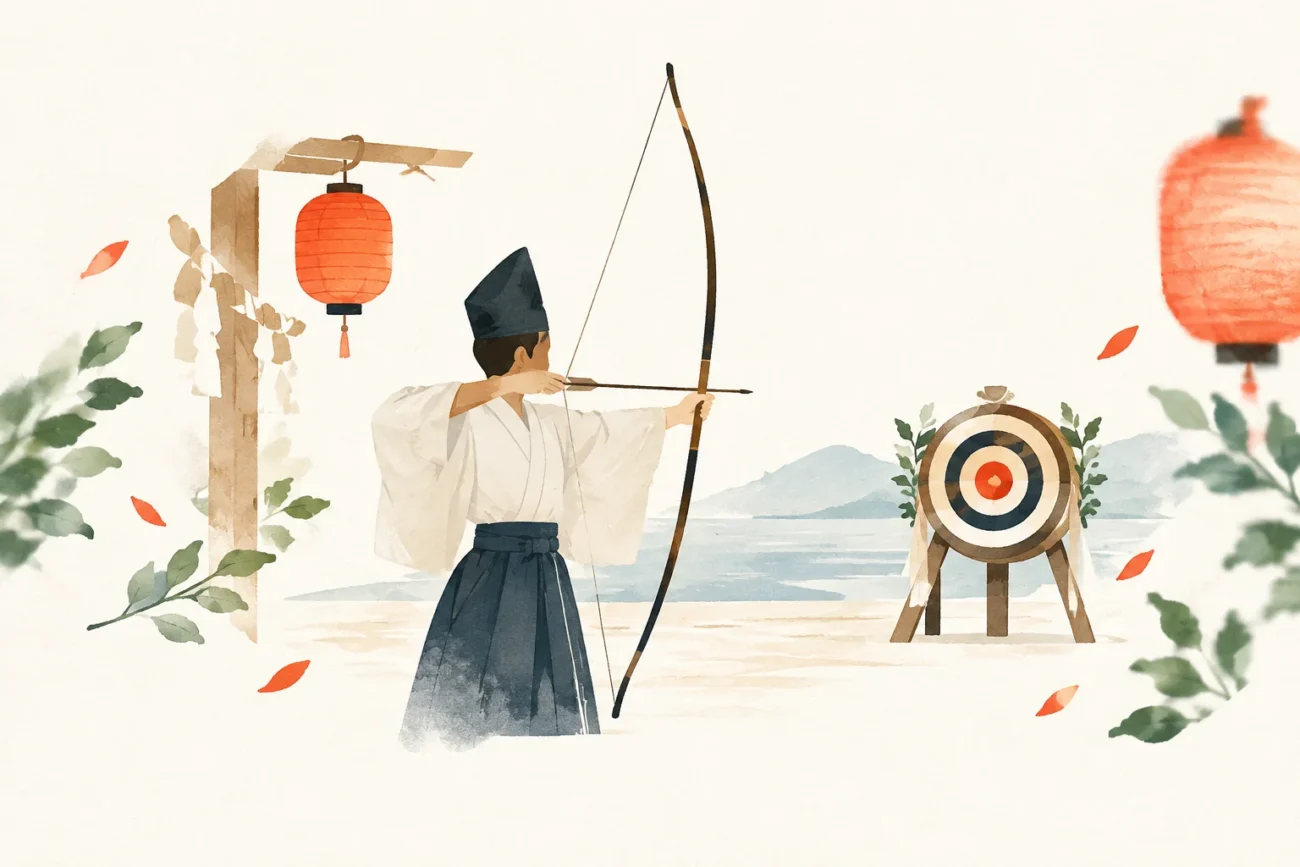
The O-Yumi , passed down at Kameyama Hachiman Shrine in Mukōtanoura, Sagiura-cho, Mihara City, is an event in which an arrow is shot at a target to divine the fortunes of the new year, ward off evil spirits, and pray for peace throughout the year.
About O-Yumi Shinji
The O-Yumi Shinji is a ritual held every year on February 11 at Kameyama Hachiman Shrine in Mukōtanoura, Sagiura-cho, Mihara City.
An arrow is shot at a target to divine the fortunes of the new year, ward off evil spirits, and pray for peace throughout the year.
This local event is organized by the Mukōda district; currently, the First through Fifth Promotion Districts take turns serving as tōya (also called tōya).
Festival highlights
One highlight is how the clear act of shooting an arrow at a target carries the meaning of divining the fortunes of the year.
The shot is made to ward off evil spirits and pray for peace throughout the year.
Since groups and promotion districts in the Mukōda district take turns serving as tōya (also called tōya), this ritual is also passed down through the community’s shared roles.
A ritual in Mukōtanoura that divines fortunes by shooting at a target and wards off evil spirits
What to expect
During the ritual, an arrow is shot at a target to divine the fortunes of the new year.
It also carries the wish to shoot away evil spirits and pray for peace throughout the year.
For the event’s organization, groups in the Mukōda district take turns serving as tōya (also called tōya). Currently, the First through Fifth Promotion Districts take on this role.
Location and access
- Venue and address
Kameyama Hachiman Shrine, Mukōtanoura, Sagiura-cho, Mihara City
Address Mukōtanoura, Sagiura-cho, Mihara City, Hiroshima Prefecture
Dates and season
- Season
Every year on February 11
- Frequency
Every year
Accommodation and hotels PR
Showing nearby accommodation.
Prices and availability are current at the time of retrieval. For multi-night stays, only the first night’s price is shown. Confirm the final price and directions to the venue with the booking provider. Select your dates again when using the area search link. Search area: within 3 km of Central Hiroshima Prefecture / Mihara City (the search is not centered on the festival venue)
Nearby attractions

広島県立中央森林公園
広島県三原市にある森林公園
Origins and History of O-Yumi Shinji
The O-Yumi Shinji is a folk performing art designated as an Intangible Folk Cultural Property of Mihara City.
According to the city’s information, it was designated as an Intangible Folk Cultural Property of the city on May 19, 2008.
No verifiable information is available about its origins, when it was established, or how it changed before its designation.
Official information
The Mihara City website’s cultural property guide provides information on the name, area, organizers, designation, date, venue, and content of the O-Yumi Shinji.
O-Yumi Shinji at a Glance
The O-Yumi Shinji is a ritual held every year on February 11 at Kameyama Hachiman Shrine in Mukōtanoura, Sagiura-cho, Mihara City.
An arrow is shot at a target to divine the fortunes of the new year, ward off evil spirits, and pray for peace throughout the year.
It is designated as an Intangible Folk Cultural Property of Mihara City, and groups and promotion districts in the Mukōda district take turns serving as tōya (also called tōya).
Sources and references
Japanese Festivals.jp Editorial Team
Celebrating local culture and helping you discover a side of Japan you never knew.
Article updated: 2026/11/21