The autumn festival in Kui, preserving the old Miyaza tradition and the ritual handling of a large sea bream
Oto at Kui Inao Shrine
Festival information
EVENT INFORMATION- Season / frequency
- A Sunday close to October 19 each year / Every year
- Location
- Kui Inao Shrine
- Area
- Hiroshima Prefecture・Mihara City(From Tokyo: approx. 3 h 50 min–4 h 20 min · bullet train)Prefecture-level estimate to a main station or airport, not the venue. Airport access, check-in and onward travel are extra; remote areas and islands can take much longer.
- Features
- Participation / viewing
- Spectators welcome
- Participation fee
- Free
- Last updated
- 2026/10/19
Oto at Kui Inao Shrine is an autumn festival that preserves the medieval Miyaza tradition passed down in Kui Town, Mihara City. You can watch parishioners divide into seats to perform the rites and ritually prepare a large sea bream in the traditional manner.
About Oto at Kui Inao Shrine
Oto at Kui Inao Shrine is a parishioner-centered ritual held as part of the shrine’s autumn festival.
“Oto” refers both to the event itself and to the parishioners’ organization responsible for the rites.
Oto representatives divided between the East Seat and West Seat conduct the rites according to traditional practice, preserving the medieval Miyaza system to this day.
It has been selected by the national government as an Intangible Folk Cultural Property for which measures such as documentation should be undertaken.
Source: 久井稲生神社の御当 - 三原市ホームページ / 久井稲生神社の御当 | 広島県 | 日本の文化遺産を探す|国宝・重要文化財データベース
Festival highlights
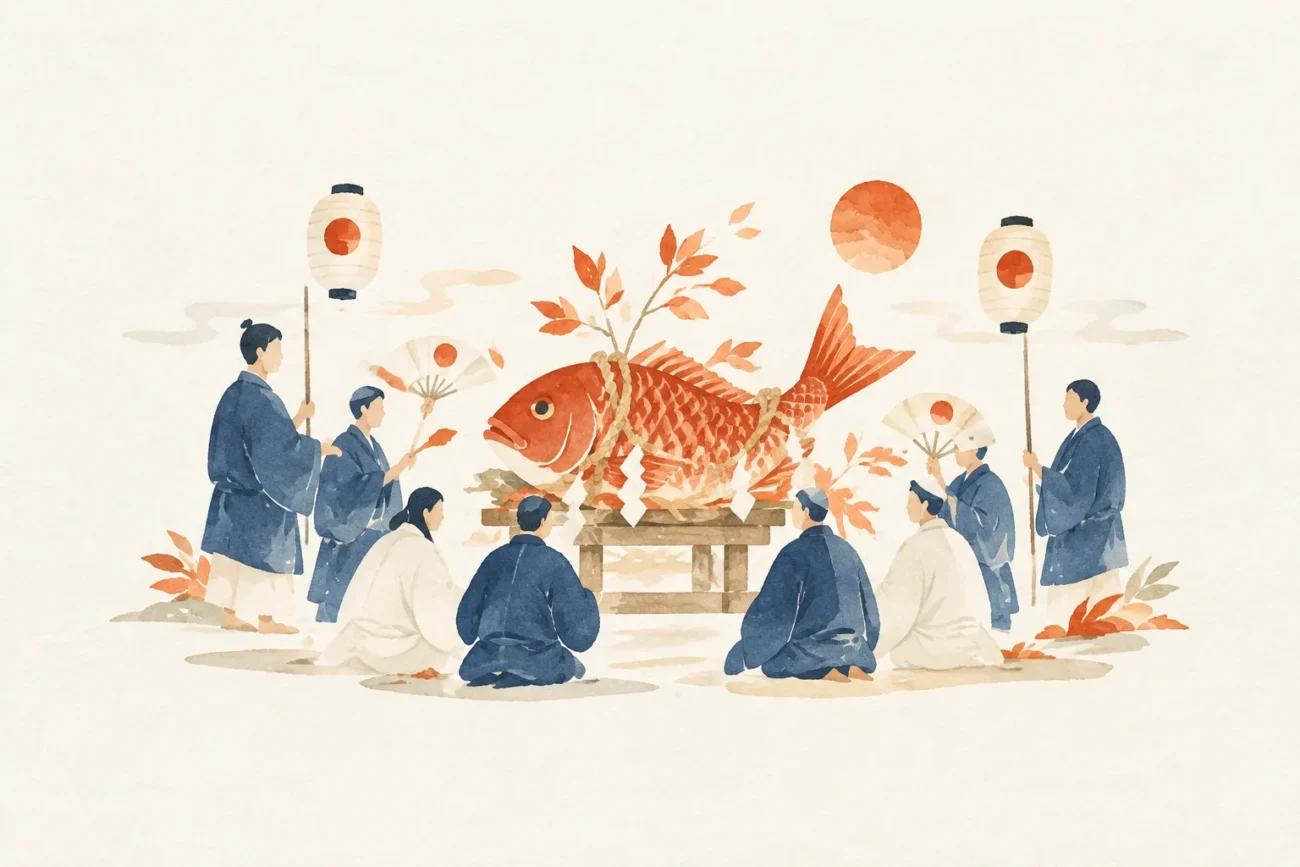
A major highlight is the ritual preparation of a large sea bream offered before the deity, using only a knife and metal chopsticks.
In the East Seat, it is arranged into forms known as “Turtle’s Insertion of the Head” and “Crane’s Feather-Shedding Drop”; in the West Seat, it is prepared as sashimi.
The orderly arrangement of trays on seats covered with straw mats, and the different ways the East Seat and West Seat are conducted, offer a tangible sense of the structure of the old Miyaza.
The autumn festival in Kui, preserving the old Miyaza tradition and the ritual handling of a large sea bream
What to expect
After the morning ceremony, “Miko no To,” the seat for shrine family members and shrine attendants, is held in the hall.
The Oto representatives then take their places in the East Seat and West Seat, and the presiding representative offers sake and a large sea bream, among other things, before the deity.
After the sea bream is prepared, sake, daikon radish namasu, and sea bream dishes are served, followed by a meal with each seat group.
How to take part
The festival is led by the representatives, who are divided between the East Seat and West Seat.
Visitors may watch from the , but cannot take a seat in the East or West Seat.
The ritual preparation of the large sea bream and the arrangement of the seats can be viewed from outside the designated seating area.
Location and access
- Venue and address
Kui Inao Shrine (1-1 Egi, Kui Town, Mihara City, Hiroshima Prefecture)
- Train and bus
Take a Geibi Bus bound for Kozan from JR Mihara Station for about 30 minutes, get off at the “Kui Kokuhō Hospital-mae” bus stop, then walk about 5 minutes.
- By car
About 15 minutes from the Mihara-Kui IC on the Sanyo Expressway.
- Parking
About 100 free parking spaces are available.
Address 1-1 Egi, Kui Town, Mihara City, Hiroshima Prefecture
Dates and season
- Season
A Sunday close to October 19 each year
- Frequency
Every year
Accommodation and hotels PR
Showing nearby accommodation.
Prices and availability are current at the time of retrieval. For multi-night stays, only the first night’s price is shown. Confirm the final price and directions to the venue with the booking provider. Select your dates again when using the area search link. Search area: within 3 km of Central Hiroshima Prefecture / Mihara City (the search is not centered on the festival venue)
Tips for your visit
Visitors are asked to watch the festival from the shrine grounds and not to enter the East Seat or West Seat reserved for the Oto representatives.
Details of the festival may change from year to year, so if you plan to attend, it is advisable to check in advance with the Culture Division of the Mihara City Board of Education.
Please watch quietly from the viewing area so as not to disrupt the rites, including the ritual handling of the large sea bream.
Nearby attractions
In Kui Town, you can also visit Kui no Iwakai, designated a national natural monument, alongside Oto at Kui Inao Shrine.
It is a distinctive landscape where huge rocks ranging from 1 meter to 7 meters in diameter extend across an area of about 22 hectares.
In the direction of central Mihara, you can also visit the site of Mihara Castle and Buttsuji Temple, making it possible to plan an itinerary exploring the history and nature around Kui Town.
Source: 久井支所のご案内 - 三原市ホームページ

広島県立中央森林公園
広島県三原市にある森林公園
Origins and History of Oto at Kui Inao Shrine
Oto has been passed down in a form that closely follows the proceedings recorded in the “Inari Oto no Oboe” of Keicho 3 (1598).
The system in which Oto representatives divide into seats to perform the rites derives from the Miyaza tradition that developed in the medieval period.
While many Miyaza have disappeared, Kui’s tradition was recognized for preserving its structure and ritual practices, and in Showa 56 (1981)December 24 it was selected as an Intangible Folk Cultural Property for which measures such as documentation should be undertaken.
Official information
Information from the host municipality is available on the Mihara City website under “Oto at Kui Inao Shrine.”
For inquiries, contact the Cultural Properties Section, Culture Division, Mihara City Board of Education.
If you are planning to watch the festival, you can ask the Culture Division to confirm the date and viewing arrangements for the day.
Oto at Kui Inao Shrine at a Glance
Oto is the central event of the autumn festival held in Egi, Kui Town, at Kui Inao Shrine.
The Oto, the parishioners’ organization, divides into the East Seat and West Seat to perform traditional rites and hold a meal using sweet sake and a large sea bream.
This folk event preserves a medieval Miyaza tradition in a form close to that recorded in 1598, and can be viewed from the shrine grounds.
Japanese Festivals.jp Editorial Team
Celebrating local culture and helping you discover a side of Japan you never knew.
Article updated: 2026/10/19
Submit information or a correction Submit photos of this festival