A sacred performing art of southern Hokkaido, passed down through priestly dances and music
Matsumae Kagura

Festival information
EVENT INFORMATION- Dates
- 松前公演:2026/04/29Ended函館公演:2026/10/10Ended小樽公演:2026/10/24Scheduled
- Season / frequency
- Held in conjunction with annual festivals, New Year festivals, and Funadama festivals at local shrines. A public performance is held every year in Matsumae on April 29. / Held in conjunction with annual festivals and New Year festivals at local shrines, with a public performance taking place every year in Matsumae.
- Location
- Venues in Each Area
- Area
- Hokkaido・Hakodate City, Otaru City, Hokuto City, Matsumae Town, Fukushima Town, Shiriuchi Town, Kikonai Town, Nanae Town, Shikabe Town, Mori Town, Yakumo Town, Oshamambe Town, Imakane Town, Setana Town, Shimamaki Village, Suttsu Town, Kuromatsunai Town, Rankoshi Town, Kimobetsu Town, Kyogoku Town, Kutchan Town, Kyowa Town, Iwanai Town, Tomari Village, Kamoenai Village, Niki Town, Obira Town(From Tokyo: approx. 1 h 30 min–2 h · flight time only)Prefecture-level estimate to a main station or airport, not the venue. Airport access, check-in and onward travel are extra; remote areas and islands can take much longer.
- Features
- Highlights and activities
- Wishes behind the festival
- Participation / viewing
- Spectators welcome
- Participation fee
- 2026 Matsumae Town public performance: Free admission
- Age restrictions
- 2026 Otaru City workshop: Grades 1 through 6 of elementary school. Junior high school students may inquire if interested
- Required number of participants
- 2026 Otaru City workshop: Capacity of 20 participants
- Last updated
- 2026/10/21
Matsumae is a sacred ritual performing art passed down in southern Hokkaido, featuring torimono dances, miko dances, and performed to the sounds of and ryūteki flute. You can enjoy dances passed down in each community at shrine festivals and public performances throughout the region.
About Matsumae Kagura
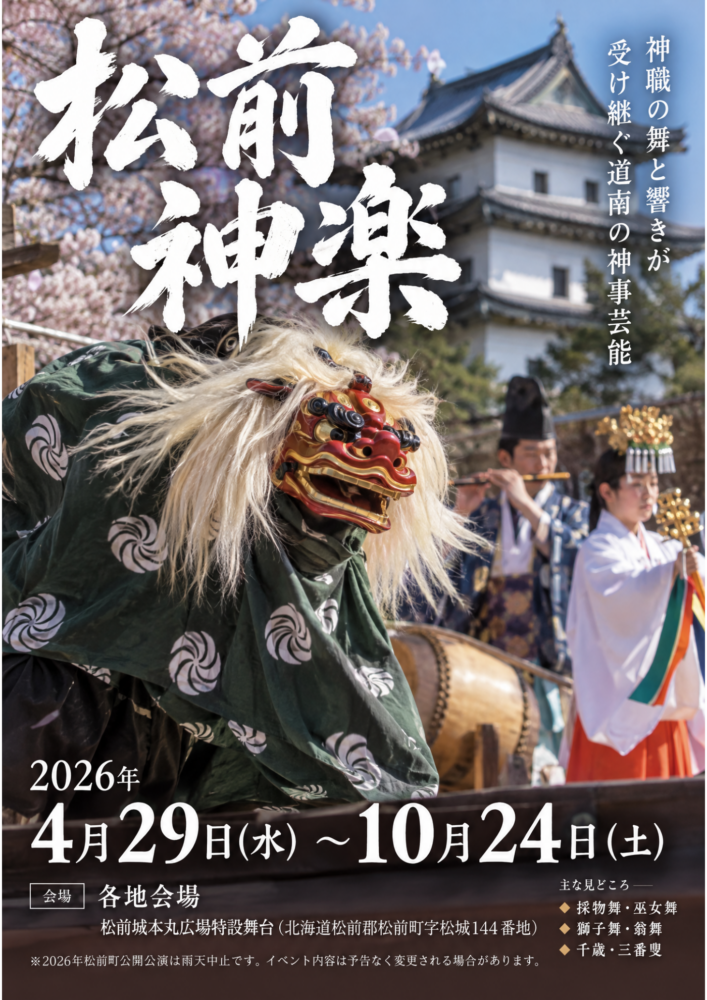
Matsumae Kagura is a form of kagura passed down by , mainly in southern Hokkaido. It preserves a diverse repertoire, including dances with ritual objects, miko dances, boiling-water rituals, and lion dances.
It is dedicated at annual festivals, New Year festivals, Funadama festivals, and other events at local shrines, and has long been connected with regional festivals.
It was designated a National Important Intangible Folk Cultural Property in 2018.
The tradition is now passed down across a wide area of Hokkaido, including the Oshima, Hiyama, and Shiribeshi regions.
Source: 国指定文化財等データベース
Festival highlights
The highlight is a variety of sacred ritual performing arts presented in a dance space measuring one ken square, accompanied by the sounds of taiko, ryūteki flute, and tebiragane hand cymbals.
Alongside torimono dances and miko dances, shishimai and the masked Okina dance have also been passed down.
A distinctive feature of kagura performed by shinshoku is the inclusion of “Chitose,” “Okina,” and “Sanbasō,” dances with few known examples of transmission.
Another appealing feature is the ongoing efforts in each community to preserve the tradition with respect for its heritage.
A sacred performing art of southern Hokkaido, passed down through priestly dances and music
What to expect
Matsumae Kagura is performed at shrine worship halls and performance venues, combining rituals and dance.
At the 2026 performance in Matsumae, Matsumae Kagura is scheduled to begin at noon, following a gate-purification ritual and performances of local arts.
A performance lasting about 30 minutes is scheduled in Hakodate, while Otaru will host a joint performance by the preservation societies of Otaru, Matsumae, Hakodate, and Fukushima.
There is also a tradition of lion dances visiting homes throughout the district as part of a New Year gate-purification ritual.
Source: 「松前神楽上演」開催のお知らせ – 箱館奉行所
How to take part
In 2026, a hands-on workshop for children on “Matsumae Kagura” was held in Otaru City.
It was for children in grades 1 through 6 of elementary school. Junior high school students could inquire if interested, and advance registration was required.
This information did not specify general eligibility to participate as a performer of kagura in the public performance.
The 2026 workshop in Otaru City was for children in the eligible grades and required advance registration.
It was stated that participants could attend only the sessions they were available for, out of the 5 sessions.
Capacity was 20 participants, and participation was free.
Applications were accepted via a dedicated form or by contacting the Lifelong Learning Division of the Otaru City Board of Education.
Source: 松前神楽 | 小樽市
Location and access
- Venue and address
Special stage at the main enclosure plaza of Matsumae Castle (144 Aza Matsushiro, Matsumae, Matsumae District, Hokkaido)
- Train and bus
No information provided on the nearest station or bus stop, or walking time
- By car
No information provided on routes or the interchange to use
- Parking
No information provided on the name or terms of use
Source: 【終了】「郷土芸能大公開・松前神楽公開公演」の開催について(2026/4/29)|まつまえの文化財
Event venue 北海道函館市、小樽市、北斗市、松前町、福島町、知内町、木古内町、七飯町、鹿部町、森町、八雲町、長万部町、今金町、せたな町、島牧村、寿都町、黒松内町、蘭越町、喜茂別町、京極町、倶知安町、共和町、岩内町、泊村、神恵内村、仁木町、小平町 各地会場
This map uses the venue name. Check the official guide for the event area and entrances.
Dates and season
- Matsumae Performance
2026/04/29
- Hakodate Performance
2026/10/10
- Otaru Performance
2026/10/24
The 2026 public performance in Matsumae Town was scheduled for April 29 (Wednesday), from 10:30 a.m. to 2 p.m.
Matsumae Kagura was scheduled for 12 p.m. to 2 p.m., and the Matsumae Kagura Matsumae Block Joint Preservation Society was to perform on stage.
It was scheduled to follow the gate-purification ritual, the Yakko-furi procession, and the opening ceremony, among other events, with a mochi toss planned for after the performance.
Tips for your visit
The 2026 public performance in Matsumae Town was scheduled to be canceled in case of rain.
If the event is canceled, the cancellation will be announced on Matsumae Town’s information page.
Event details may change without notice, so check the event status and the day’s schedule before heading to the outdoor special stage at the main enclosure plaza of Matsumae Castle.
Nearby attractions
The public performance in Matsumae takes place on a special stage in the main enclosure of Matsumae Castle and is presented as an event where visitors can enjoy the castle, cherry blossoms, and history together.
The Otaru joint performance takes place in the Marine Hall at Otaru Civic Center.
The Hakodate performance is held in the Great Hall at Hakodate Magistrate's Office, alongside regular admission and visits.
In each case, visitors can plan nearby sightseeing based on the stated connection between the festival venue and related facilities.
Origins and History of Matsumae Kagura
The origins of Matsumae Kagura are unclear, and its development can be traced through multiple traditions and records.
A record indicates that kagura was performed in Matsumae domain territory in 1625. In 1674, Chin-kama Yutate Kagura was performed at Fukuyama Castle as an official domain event.
Records from 1681 show that a ritual beginning with prayers and dances had taken shape.
Although it lost the patronage of the domain after the Meiji era began, ties with parishioners grew stronger, and the tradition spread to various areas.
Source: 松前神楽 | まつまえの文化財
Official information
The Agency for Cultural Affairs' Database of Nationally Designated Cultural Properties lists Matsumae Kagura as an Important Intangible Folk Cultural Property.
The preservation organization is the Matsumae Kagura Hokkaido Federation Preservation Society.
Performance information is available from the respective announcements by Matsumae Town, Hakodate Magistrate's Office, Otaru Tourism Association, and others.
Public performances in 2026 are scheduled in Matsumae, a performance in Hakodate, and a joint performance in Otaru.
Source: 令和八年度松前神楽北海道連合保存会合同公演in小樽マリンホール | 小樽観光協会公式サイト「おたるぽーたる」:北海道小樽へようこそ!
Matsumae Kagura at a Glance
Matsumae Kagura is an Important Intangible Folk Cultural Property passed down by Shinto priests, mainly in southern Hokkaido.
Performances include dances with ritual objects, miko dances, a boiling-water ritual, lion dances, and the Okina dance, accompanied by taiko drums, ryuteki flute, and tebiragane hand cymbals.
Public performances are scheduled in 2026 in Matsumae, Hakodate, and Otaru, each with different venues, fees, and entry procedures.
An opportunity to enjoy a diverse range of sacred performing arts while respecting the traditions of each region.
Japanese Festivals.jp Editorial Team
Celebrating local culture and helping you discover a side of Japan you never knew.
Article updated: 2026/10/21
Submit information or a correction Submit photos of this festival