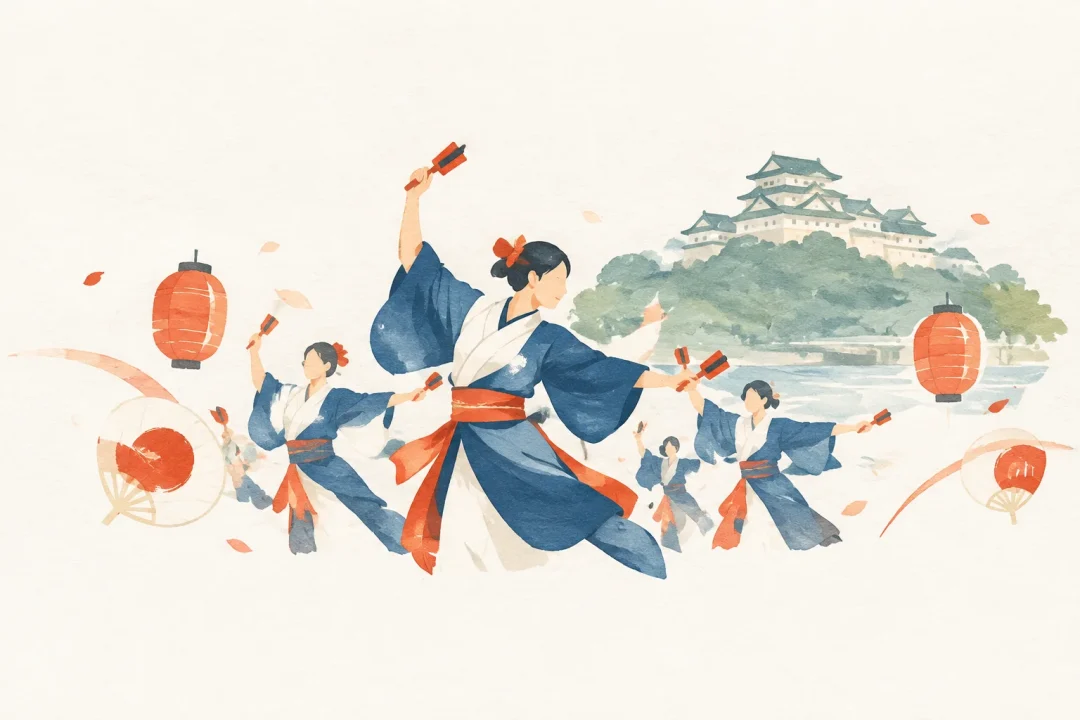
Gobo’s Buddhist-invocation-style dance, passed down with a large gourd at the front, drums, and singing
Gibyo Odori

Festival information
EVENT INFORMATION- Season / frequency
- Eve festival on October 4 and main festival on October 5
- Location
- In front of Betchin Hall and at the in Hamanose, Misato-cho
- Area
- Wakayama Prefecture・Gobo City(From Tokyo: approx. 3 h 30 min–4 h · bullet train + connecting train)Prefecture-level estimate to a main station or airport, not the venue. Airport access, check-in and onward travel are extra; remote areas and islands can take much longer.
- Highlights and activities
- Last updated
- 2026/10/19
Gibyo Odori, handed down in Gobo City, is a Buddhist-invocation-style furyu dance performed as an offering using large gourds, drums, hand drums, and gongs. At Kotake Hachiman Shrine’s festival, dancers form lines or circles to the singing.
About Gibyo Odori
Gibyo Odori is a Buddhist-invocation-style furyu dance passed down in Sono, Gobo City, Wakayama Prefecture.
The dance is performed as an offering at Kotake Hachiman Shrine’s festival and has been passed down by local people.
This distinctive performance uses large and small gourds, drums, hand drums, and gongs, with dancers performing in 2 lines or a circle to the singing.
Source: 国指定文化財等データベース
Festival highlights
Highlights include a natural, large, unusual gourd measuring 3 shaku in length, carried at the front, and the dancers wearing flower hats.
People carrying drums, hand drums, gongs, and small gourds dance slowly to the singing, forming 2 facing lines or a circle.
Enjoy the distinctive expression of Gibyo Odori, which blends solemnity with humor.
Source: 戯瓢踊 | わかやまの文化財
Gobo’s Buddhist-invocation-style dance, passed down with a large gourd at the front, drums, and singing
What to expect
The event begins with the reading of the “Shionjo,” a letter of commendation bestowed by Tokugawa Harusada, the ninth lord of the Kishu domain. The dance then begins.
Led by a large, unusual gourd, dancers carrying drums, hand drums, gongs, and small gourds form lines or circles as they sing.
Performances take place in front of Betchin Hall and at the otabisho in Hamanose, Misato-cho.
How to take part
The Gyo Hyotan Odori was once performed mainly by people aged 50 or older among the of the Gobō group. It is said that these restrictions were lifted around 1955, after which local residents began participating more widely.
For the current application period and participation requirements for dancers, check the information provided for each festival year.
Source: 戯瓢踊(けほんおどり)とは? 意味や使い方 - コトバンク
Location and access
- Venue and address
In front of Betchin Hall and at the otabisho in Hamanose, Misato-cho (Gobo City, Wakayama Prefecture).
Event venue 和歌山県御坊市 別院堂前および美里町浜之瀬の御旅所
This map uses the venue name. Check the official guide for the event area and entrances.
Dates and season
The Gyo Hyotan Odori is held in October and is dedicated at Kotake Hachiman Shrine’s festival.
Cultural heritage information says it is performed as an offering on October 5, while another account says it is performed during the eve festival on October 4 and the main festival on October 5.
Accommodation and hotels PR
Showing nearby accommodation.
Prices and availability are current at the time of retrieval. For multi-night stays, only the first night’s price is shown. Confirm the final price and directions to the venue with the booking provider. Select your dates again when using the area search link. Search area: within 3 km of Central Wakayama Prefecture / Gobo City (the search is not centered on the festival venue)
Origins and History of Gibyo Odori
The origins of Gibyo Odori are unclear, but it is thought to belong to a tradition of furyu dances based on the bowl-tapping performances popular in the capital, and to have reached Gobo in the early Edo period.
One name for the dance is said to derive from the sound of tapping a bowl, and the performers sing a bowl-tapping song attributed to Kuya.
During the Edo period, a form in which a letter of commendation associated with the Tokugawa family was read aloud before the dance was also passed down.
Official information
Information about the dance as a cultural property can be found in Wakayama Prefecture’s cultural property listings and the Agency for Cultural Affairs’ Database of Nationally Designated Cultural Properties.
The Gibyo Odori Preservation Society is listed as the preservation organization, and the dance is introduced as an intangible folk cultural property designated by the prefecture and selected nationally.
Gibyo Odori at a Glance
Gibyo Odori is a Buddhist-invocation-style furyu dance handed down in Gobo City and performed as an offering at Kotake Hachiman Shrine’s festival.
A distinctive feature is the line or circle formed by dancers carrying drums, hand drums, gongs, and small gourds, led by a large, unusual gourd, as they sing.
Though aspects of its origins remain unclear, it is a local folk performing art thought to date back to the early Edo period.
Japanese Festivals.jp Editorial Team
Celebrating local culture and helping you discover a side of Japan you never knew.
Article updated: 2026/10/19
Submit information or a correction Submit photos of this festival