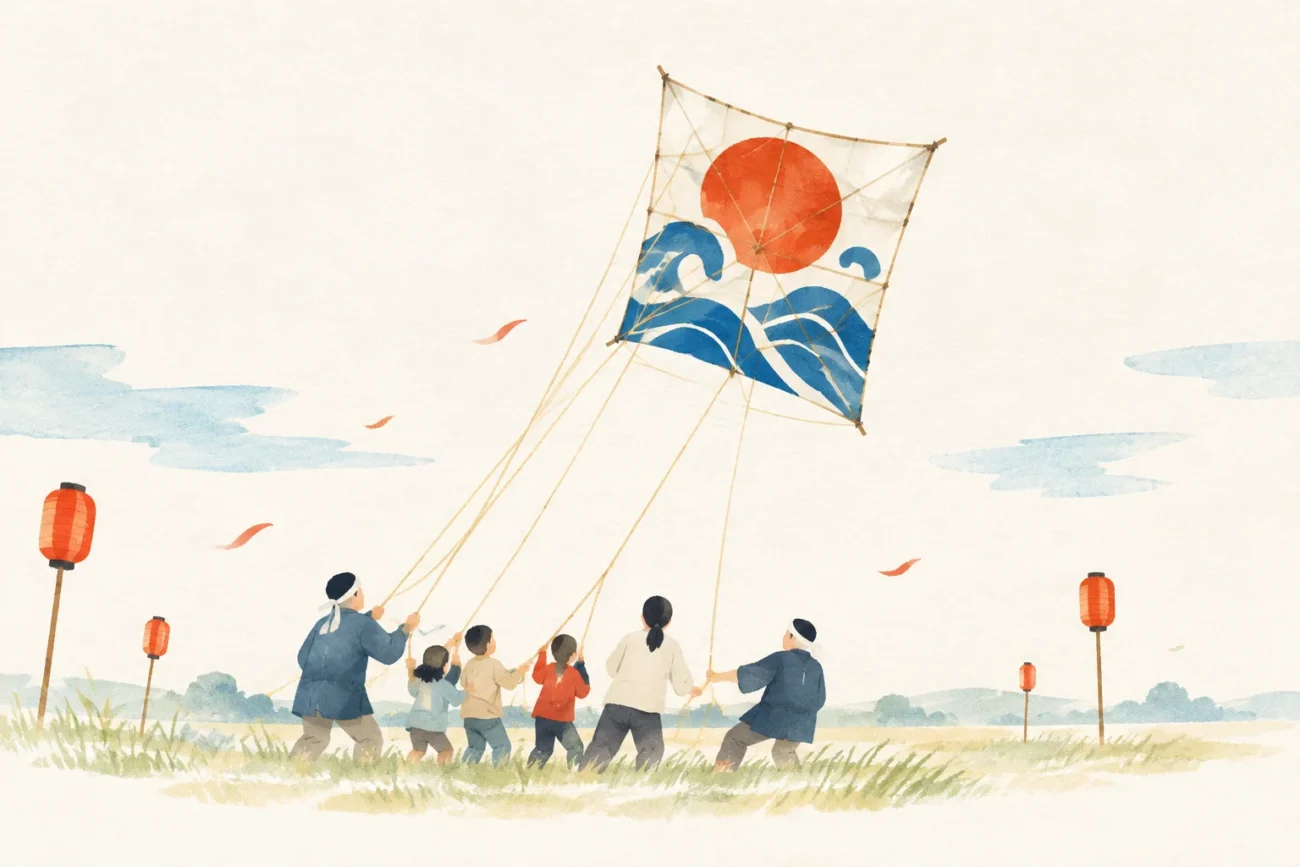
A giant celebratory kite from Hōshubana, soaring skyward through the efforts of the local community
Kasukabe Giant Kite Festival
The 2026 edition of Kasukabe Giant Kite Festival has ended.
Festival information
EVENT INFORMATION- Dates
- 第1期:2026/05/03Ended第2期:2026/05/05Ended
- Season / frequency
- Usually May 3 and 5 / Every year
- Location
- Edogawa Riverbank, Nishihōshubana (downstream of Hōshubana Bridge)
- Area
- Saitama Prefecture・Kasukabe City(From Tokyo: approx. 30 min–1 h · train)Prefecture-level estimate to a main station or airport, not the venue. Airport access, check-in and onward travel are extra; remote areas and islands can take much longer.
- Wishes behind the festival
- Participation / viewing
- Spectators welcome
- Participation fee
- In 2026, parking costs ¥1,000 per vehicle.
- Age restrictions
- There is an application program for children celebrating their first Boys’ Day.
- Required number of participants
- More than 100 people take part in pulling the lines to fly the giant kites.
- Last updated
- 2026/10/19
This festival in Nishihōshubana, Kasukabe City, brings local people together to fly giant kites made from washi paper and bamboo. It began as a way to divine whether the silkworm harvest would be plentiful, and is now enjoyed as an event praying for children to grow up healthy.
About Kasukabe Giant Kite Festival
The Hōshubana Giant Kite Festival is a giant-kite event passed down through generations at the Edogawa Riverbank in Nishihōshubana, Kasukabe City.
It began as a way to divine whether the silkworm harvest would be plentiful, and is now held to pray for the health and happy growth of children celebrating their first Boys’ Day.
It is a community-rooted event where local people work together to fly giant kites made from washi paper and bamboo.
Source: 春日部大凧あげ祭り/春日部市公式ホームページ
Festival highlights
The main highlight is watching a giant kite measuring 15 meters tall, 11 meters wide, and weighing 800 kilograms soar into the sky.
The Kamiwaka-gumi and Shimowaka-gumi each fly their own giant kite, with more than 100 people working together to pull the lines.
Smaller kites, including komachi kites, are flown alongside the giant kites, so you can enjoy a variety of kites across the entire riverbank.
A giant celebratory kite from Hōshubana, soaring skyward through the efforts of the local community
What to expect
At the festival, the giant kites are assembled and their bridle lines are attached on the riverbank. The completed kites are then lowered from their supports and flown.
On the first day, a prayer is held for the health of children celebrating their first Boys’ Day, and a piece of paper bearing each child’s name is attached to a giant kite before it is flown.
Members of the Shōwa Giant Kite Culture Preservation Society spend about 3 months making the giant kites from washi paper and bamboo.
Source: 春日部大凧あげ祭り|特別版 埼玉祭
How to take part
The giant kites are flown by local groups, and general visitors can watch at the venue.
Children celebrating their first Boys’ Day can apply to take part in a ceremony that includes a prayer for their health and receiving a handmade kite bearing their name.
The event for children celebrating their first Boys’ Day is open for applications every year, and details on how to apply are usually posted around December.
If you would like to take part, please check the application process and eligibility requirements announced when registration opens.
You can watch the giant kites fly at the venue without taking part.
Source: これまでの情報 - 春日部市メール
Location and access
- Venue and address
Edogawa Riverbank, Nishihōshubana (downstream of Hōshubana Bridge)
- Train and bus
About 15 minutes by temporary direct bus from the north exit of Minami-Sakurai Station on the Tobu Urban Park Line.
About 35 minutes by Asahi Bus from the east exit of Kasukabe Station. Get off at “Odako Park Iriguchi.”
About 30 minutes by Asahi Bus from the east exit of Tobu Dobutsu Koen Station. Get off at “Odako Park-mae.”
- By car
About 1 hour from Tokyo via National Route 4.
About 25 minutes from Iwatsuki Interchange, about 25 minutes from Kashiwa Interchange, and about 20 minutes from Satte Interchange.
- Parking
Paid parking is available in 2026 and costs ¥1,000 per vehicle.
Crowds are expected on the day, so visitors are advised to use public transportation.
Address Edogawa Riverbank, Nishihōshubana, Kasukabe City, Saitama Prefecture (downstream of Hōshubana Bridge)
Dates and season
- Period 1
2026/05/03
- Period 2
2026/05/05
2026 event information (the listed dates have passed)
The event was announced for May 3 and 5. If both days were canceled due to rain, it was scheduled to be postponed to May 6.
The program included making and flying large kites, flying small kites, and a creative kite-flying competition.
Accommodation and hotels PR
Showing nearby accommodation.
Prices and availability are current at the time of retrieval. For multi-night stays, only the first night’s price is shown. Confirm the final price and directions to the venue with the booking provider. Select your dates again when using the area search link. Search area: within 3 km of Central Saitama Prefecture / Kasukabe City (the search is not centered on the festival venue)
Tips for your visit
As you watch the giant kites fly from the riverbank, please be mindful of activity around you and of crowding at the venue.
Traffic increases on the festival date, and congestion is expected if you travel by car.
To be safe, allow plenty of time and use public transportation whenever possible.
Nearby attractions

八幡公園
埼玉県春日部市にある公園

牛島公園
埼玉県春日部市にある公園
Origins and History of Kasukabe Giant Kite Festival
The festival dates back to 1841, the 12th year of the Tenpō era in the late Edo period.
It is said that a story about a monk who stayed at Shōryūji Temple in Nishihōshubana led people to play on the word “agaru,” meaning both “to rise” (as a kite does) and “to rise” (as the price of cocoons does), and to use kites to divine whether the silkworm harvest would be plentiful.
It later became an event celebrating the birth of boys on the Tango no Sekku holiday, and the kites grew larger and began to be flown collectively.
Official information
The “Kasukabe Giant Kite Festival” information on the official Kasukabe City website covers the festival’s origins, how the kites are made, the venue, transportation, and the first Boys’ Day celebration.
For inquiries, contact the Tourism Promotion 담당 in Kasukabe City’s Commerce, Industry and Tourism Division.
Kasukabe Giant Kite Festival at a Glance
The Hōshubana Giant Kite Festival began as a way to divine whether the silkworm harvest would be plentiful, and has been passed down as an event praying for children to grow up healthy.
One of the main highlights is seeing local people work together to fly a giant kite made from washi paper and bamboo.
At the Edogawa Riverbank in Nishihōshubana, you can enjoy both traditional kite-making techniques and the dramatic spectacle of the kites taking flight.
Japanese Festivals.jp Editorial Team
Celebrating local culture and helping you discover a side of Japan you never knew.
Article updated: 2026/10/19
Submit information or a correction Submit photos of this festival