Hirata’s contest of decorations, where everyday objects depict history and stories
Hirata Ichi-shiki Kazari
Festival information
EVENT INFORMATION- Season / frequency
- For 3 days starting July 20 every year / Every year
- Location
- The summer festival of Hirata Tenmangu Shrine and exhibition venues run by neighborhoods and groups
- Area
- Shimane Prefecture・Izumo City(From Tokyo: approx. 1 h 20 min–1 h 40 min · flight time only)Prefecture-level estimate to a main station or airport, not the venue. Airport access, check-in and onward travel are extra; remote areas and islands can take much longer.
- Wishes behind the festival
- Last updated
- 2026/11/11
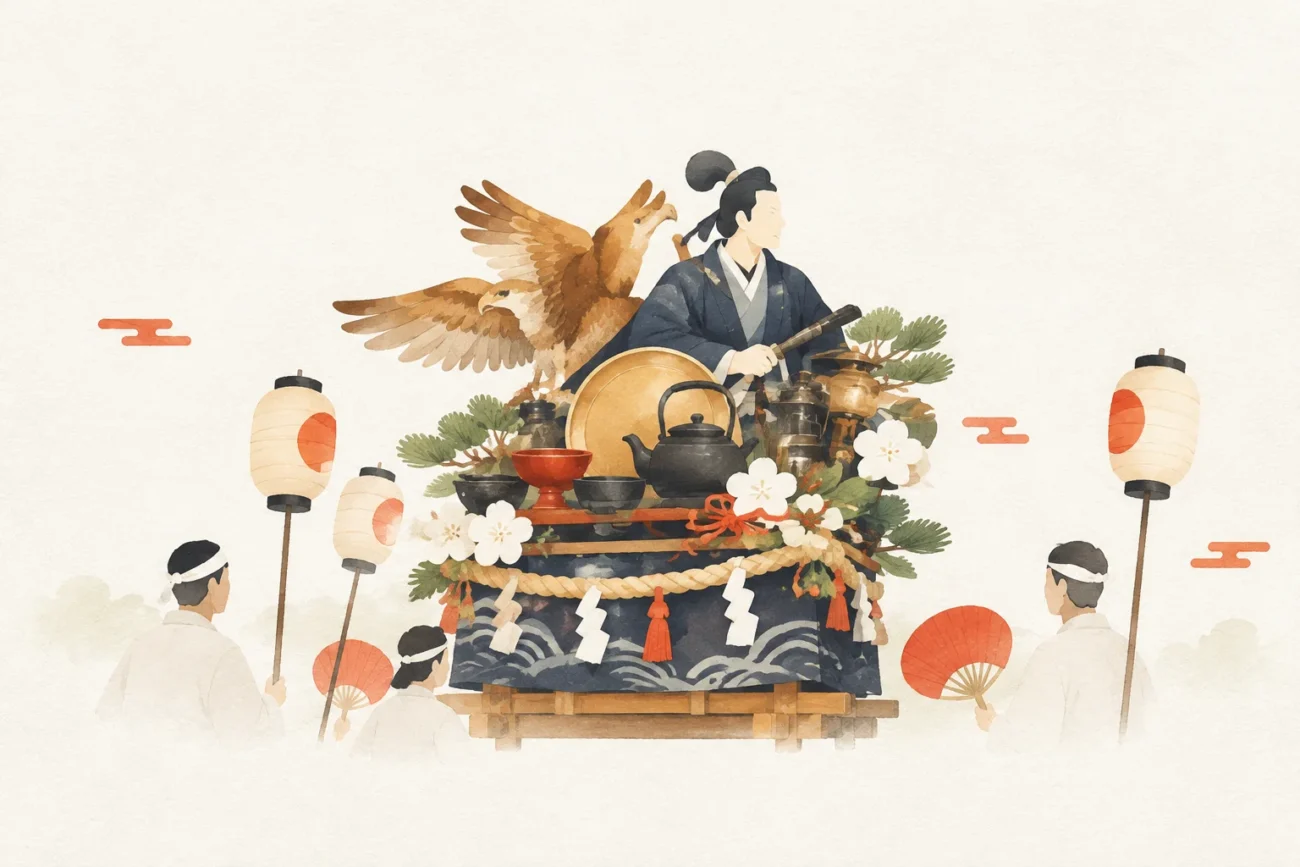
Hirata Ichi-shiki Kazari is a folk art from the Hirata area that combines everyday objects such as tea utensils and metalware to depict historical figures and animals. At the summer festival of Hirata Tenmangu Shrine, each neighborhood and group displays its own creatively designed decorations.
Photo credits and terms of use
Photographer: Cheng-en Cheng File:Station sign and mascot at Unshū-Hirata Station.jpg / Wikimedia Commons / CC BY-SA 2.0 https://www.flickr.com/photos/rail02000/16377372582/Display size only adjusted.May differ from the event currently featured.About Hirata Ichi-shiki Kazari
Hirata Ichi-shiki Kazari is a folk art that uses a complete set of items of a single type of familiar household goods—such as pottery, metalware, tea utensils, or Buddhist implements—to depict historical figures, scenes, animals, and more.
At the summer festival of Hirata Tenmangu Shrine, works are displayed at exhibition venues run by neighborhoods and groups for 3 days starting July 20 every year.
Closely tied to the festival, Ichi-shiki Kazari arose from a desire to comfort the gods and has been passed down as an important feature of the Hirata Tenmangu Festival.
Festival highlights
One highlight is the imaginative use of everyday objects to create three-dimensional representations of people, scenes, and animals.
Neighborhoods and groups compete to create elaborate decorations by freely combining objects of the same kind, such as pottery, metalware, tea utensils, and Buddhist implements.
One early dedication is said to have featured a tea millstone made to look like a rice bale, with a standing statue of Daikokuten placed on top.
Hirata’s contest of decorations, where everyday objects depict history and stories
What to expect
During the summer festival, neighborhoods and groups display Ichi-shiki Kazari at their exhibition venues.
The works rearrange items of a single type of everyday goods to depict historical figures, scenes, animals, and more. These may include pottery, metalware, tea utensils, or Buddhist implements.
Works can also be seen outside the festival period at the Hirata Ichi-shiki Kazari Permanent Exhibition Hall and the VIVA shopping center. The Cotton Road Exchange Center holds hands-on sessions by reservation.
Location and access
- Venue
The summer festival of Hirata Tenmangu Shrine and exhibition venues run by neighborhoods and groups
Event venue 島根県出雲市 平田天満宮の夏祭り
This map uses the venue name. Check the official guide for the event area and entrances.
Dates and season
- Season
For 3 days starting July 20 every year
- Frequency
Every year
Accommodation and hotels PR
Showing nearby accommodation.
Prices and availability are current at the time of retrieval. For multi-night stays, only the first night’s price is shown. Confirm the final price and directions to the venue with the booking provider. Select your dates again when using the area search link. Search area: within 3 km of Central Shimane Prefecture / Izumo City (the search is not centered on the festival venue)
Nearby attractions
The nearby Cotton Road is introduced as a tourist spot, with streetscapes that recall a town that prospered through the cotton trade from the Edo period onward.
Hands-on sessions are held at the Cotton Road Exchange Center, which is associated with Hirata Ichi-shiki Kazari, but you need to book in advance to take part.
Izumo Taisha Shrine is also listed as a nearby tourist spot.

出雲大社
島根県出雲市にある神社

出雲大社宝物殿
島根県出雲市にある出雲大社の展示施設

出雲文化伝承館
島根県の博物館・美術館のスポットです。

出雲科学館
島根県出雲市にある科学館

宍道湖自然館ゴビウス
島根県出雲市にある水族館

島根県立古代出雲歴史博物館
島根県出雲市にある博物館
Origins and History of Hirata Ichi-shiki Kazari
The origins of Hirata Ichi-shiki Kazari are said to date back to Kansei 5 (1793).
After an epidemic spread in Hōreki 2 (1752), a sacred procession was held at Hirata Tenmangu Shrine. The tradition is said to have begun when Jubee Kikyoya, a picture-framer who lived in Teramachi, celebrated the fulfillment of his prayer by dedicating a lion to welcome the and a decoration made from a complete set of tea utensils.
It was designated an Intangible Folk Cultural Property of Hirata City in Heisei 1 (1989)March and is now treated as an Intangible Folk Cultural Property of Izumo City.
Official information
平田一式飾り 公式サイト:Hirata Ichi-shiki Kazari Official Website
Hirata Ichi-shiki Kazari at a Glance
Hirata Ichi-shiki Kazari is a folk art that uses a single type of everyday item—such as pottery, metalware, tea utensils, or Buddhist implements—to depict people, scenes, and animals.
At the summer festival of Hirata Tenmangu Shrine, works are displayed at each neighborhood’s and group’s exhibition venues for 3 days starting July 20 every year.
This tradition, passed down in the Hirata area, dates back to a dedication in Kansei 5 (1793) and was designated an Intangible Folk Cultural Property of Hirata City in Heisei 1 (1989).
Sources and references
Japanese Festivals.jp Editorial Team
Celebrating local culture and helping you discover a side of Japan you never knew.
Article updated: 2026/11/11