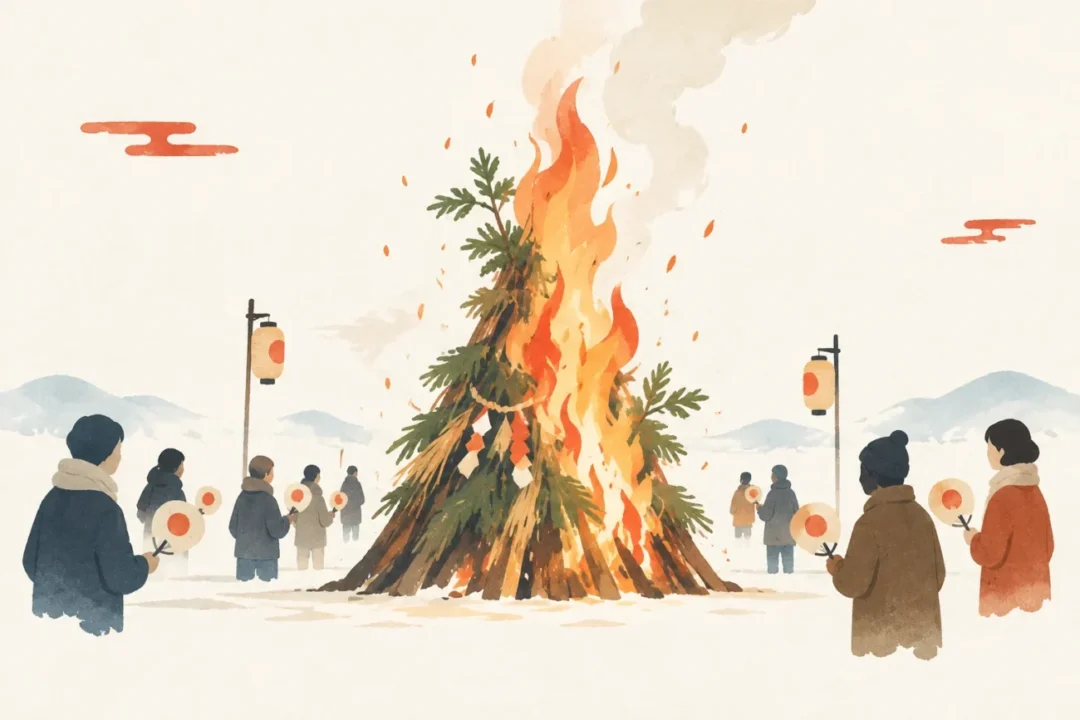
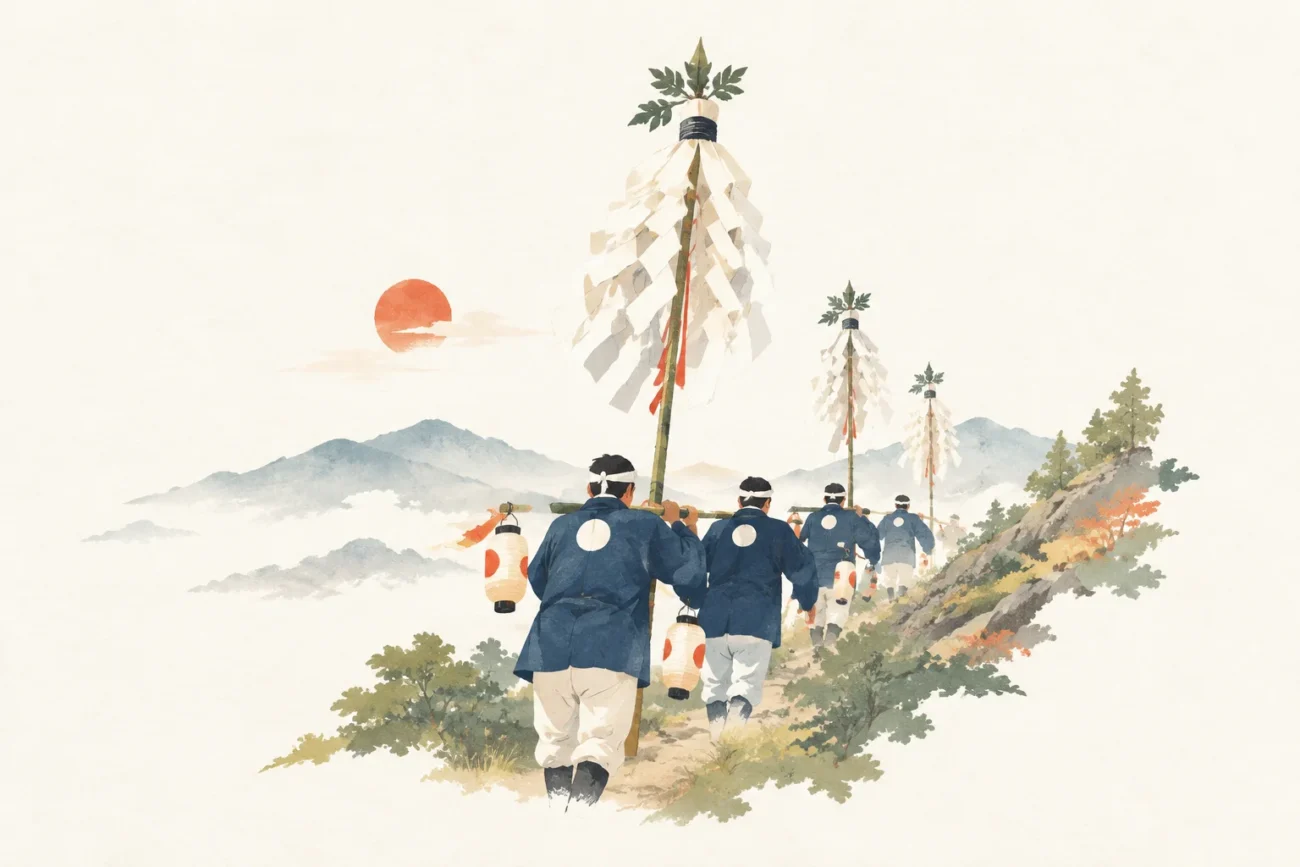
An Atsushio offering ritual: raising gohei representing the Three Mountains of Dewa and entrusting them to a tree on the mountain
Atsushio Bonten Festival
Festival information
EVENT INFORMATION- Location
- Iwao Shrine in Atsushio
- Area
- Fukushima Prefecture・Kitakata City(From Tokyo: approx. 1 h 20 min–1 h 40 min · bullet train)Prefecture-level estimate to a main station or airport, not the venue. Airport access, check-in and onward travel are extra; remote areas and islands can take much longer.
- Highlights and activities
- Last updated
- 2026/11/13
This , in which a bonten is offered on the mountaintop, has been passed down at Iwao Shrine in Atsushio, Kitakata City. representing the Three Mountains of Dewa are raised on a bamboo pole, which members of the preservation association are said to have carried up the mountain behind the shrine.
About Atsushio Bonten Festival
The Atsushio Bonten Festival has been held at Iwao Shrine in Atsushio, Kitakata City.
Its origins are unknown, but it is said to have been performed as far back as the Edo period.
This shinji involves offering a “bonten,” made by attaching gohei representing Yamagata's Three Mountains of Dewa to the tip of a bamboo pole. It serves as a yorishiro to invite the deities of the Three Mountains of Dewa, with people's wishes entrusted to them.
Festival highlights
The highlight is the bonten: a bamboo pole about 8 meters long with large, medium, and small gohei attached to its tip.
Members of the preservation association are said to have carried the bonten up the mountain behind the shrine and tied it to the tallest tree there.
It is said that this form of offering—carrying it to the mountaintop and tying it to a tree—has no other known example in the prefecture.
An Atsushio offering ritual: raising gohei representing the Three Mountains of Dewa and entrusting them to a tree on the mountain
What to expect
The festival begins with making large, medium, and small gohei representing Yamagata's Three Mountains of Dewa on the grounds of Iwao Shrine.
The gohei are attached to the end of a bamboo pole about 8 meters long, which is called a bonten.
Members of the preservation association are said to have then carried the bonten up the mountain behind the shrine and tied it to the tallest tree on the summit.
Location and access
- Venue and address
Iwao Shrine in Atsushio (Kitakata City)
Event venue 福島県喜多方市 熱塩の磐椅神社
This map uses the venue name. Check the official guide for the event area and entrances.
Accommodation and hotels PR
Showing nearby accommodation.
Prices and availability are current at the time of retrieval. For multi-night stays, only the first night’s price is shown. Confirm the final price and directions to the venue with the booking provider. Select your dates again when using the area search link. Search area: within 3 km of Central Fukushima Prefecture / Kitakata City (the search is not centered on the festival venue)
Nearby attractions

喜多方蔵の里
福島県喜多方市にある資料館
写真:contri from Yonezawa-Shi, Yamagata, Japan / CC BY-SA 2.0
Photo source ·Origins and History of Atsushio Bonten Festival
The origins of the Atsushio Bonten Festival are unknown, but it is said to have been performed as far back as the Edo period.
The 2018 Kitakata City Board of Education meeting minutes record the approval of a proposal to designate the festival an intangible folk cultural property.
The minutes explain that having an organization committed to continuing the tradition was also one of the requirements for designation.
Official information
The Kitakata City Board of Education meeting minutes (Heisei 30March) include an explanation concerning the cultural-property designation of the Atsushio Bonten Festival.
Atsushio Bonten Festival at a Glance
The Atsushio Bonten Festival is an offering ritual passed down at Iwao Shrine.
A bonten is made by attaching gohei representing the Three Mountains of Dewa to a bamboo pole; members of the preservation association are said to have carried it up the mountain behind the shrine and tied it to a tree on the summit.
Although its origins are unknown, it is said to have been performed as far back as the Edo period, and it is designated an intangible folk cultural property of Kitakata City.
Sources and references
Japanese Festivals.jp Editorial Team
Celebrating local culture and helping you discover a side of Japan you never knew.
Article updated: 2026/11/13