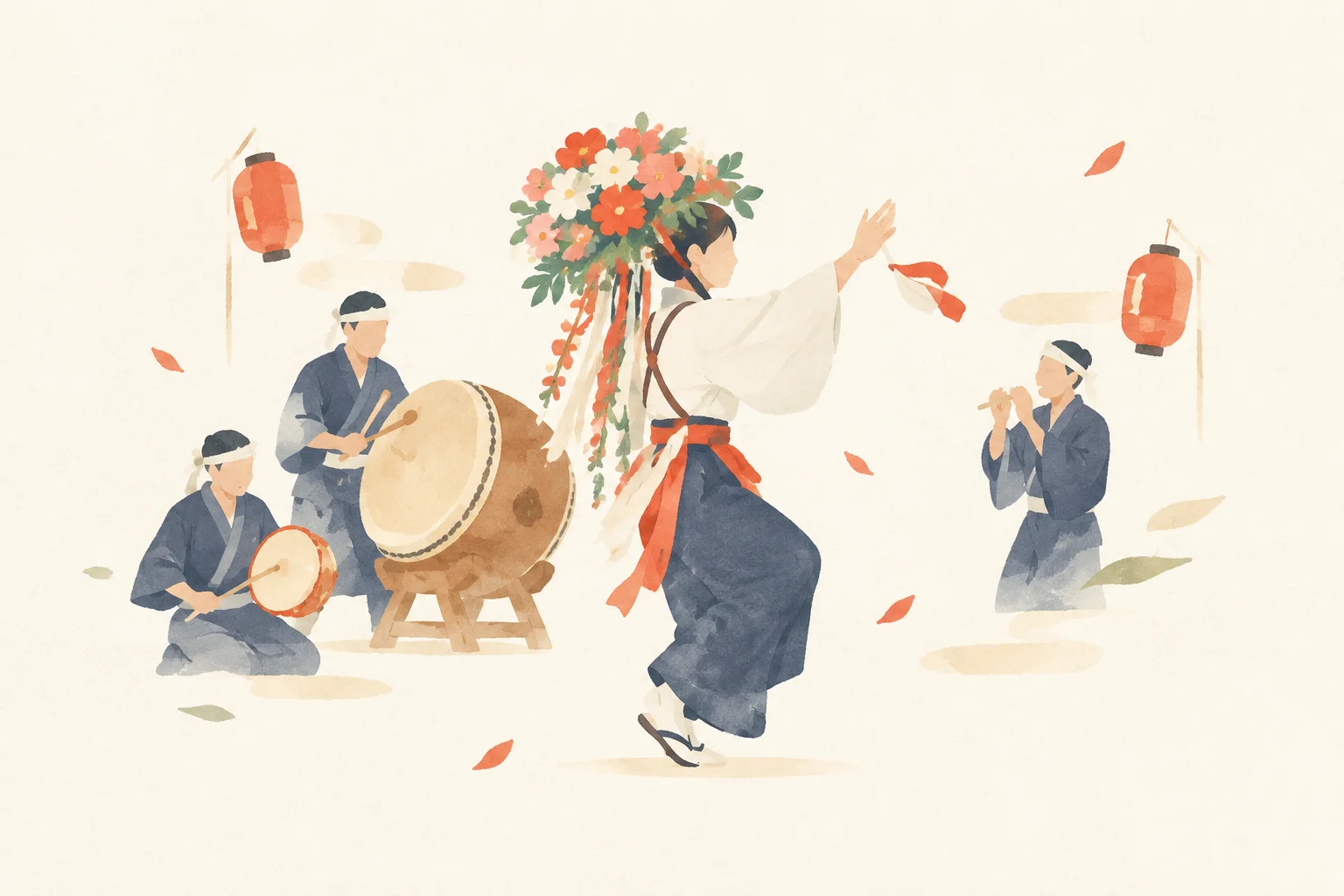
Iga’s traditional dance from Yamabata, adorned with kakko drums and floral decorations
Shinto Ritual Dance at Katsute Shrine
The 2026 edition of Dance at Katsute Shrine has ended.
Festival information
EVENT INFORMATION- Dates
- 2026/10/11Ended
- Season / frequency
- Every year, the 2nd Sunday in October / Every year
- Location
- Katsute Shrine
- Area
- Mie Prefecture・Iga City(From Tokyo: approx. 2 h 30 min–3 h · bullet train + connecting train)Prefecture-level estimate to a main station or airport, not the venue. Airport access, check-in and onward travel are extra; remote areas and islands can take much longer.
- Highlights and activities
- Wishes behind the festival
- Participation / viewing
- Spectators welcome
- Last updated
- 2026/10/19
Dancers wearing flower decorations perform alongside kakko drums, a large drum, and singing in the Shinto ritual dance handed down at Katsute Shrine in Yamabata, Iga.
About Shinto Ritual Dance at Katsute Shrine
The Shinto ritual dance at Katsute Shrine is a locally handed-down kanko dance dedicated on the day of the autumn festival at Katsute Shrine in Yamabata, Iga, Mie.
It features many roles, including naka-odori dancers who dance with oke-do drums strapped to their chests, uta- singers, and gaku-uchi musicians who play the large drum.
It is designated an Important Intangible Folk Cultural Property of Japan and is also inscribed on UNESCO’s Intangible Cultural Heritage list as one of the Furyu-odori dances.
Source: 国指定文化財等データベース / 勝手神社の神事踊 | イベント | 観光三重(かんこうみえ)
Festival highlights
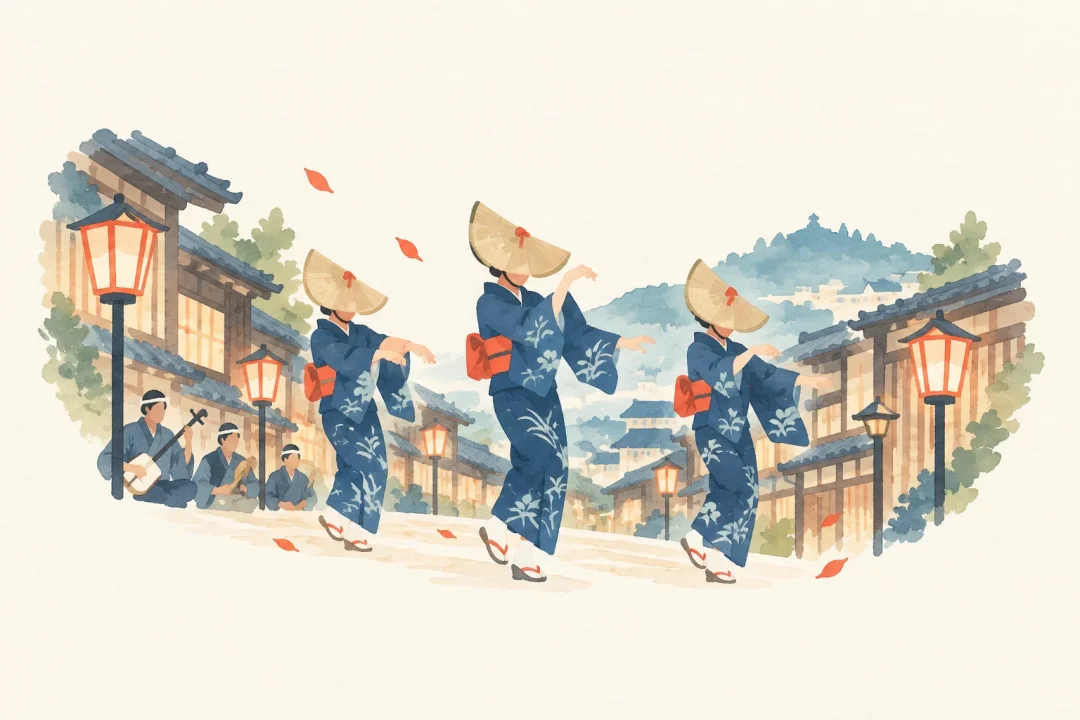
A highlight is the naka-odori, in which dancers wear the colorful, flower-draped decoration called “Ochizui” on their backs and dance while beating the kakko drum strapped to their chests.
Sections with singing alternate with sections danced to the rhythm of the large drum, creating a rich interplay of complex melodies and rhythms.
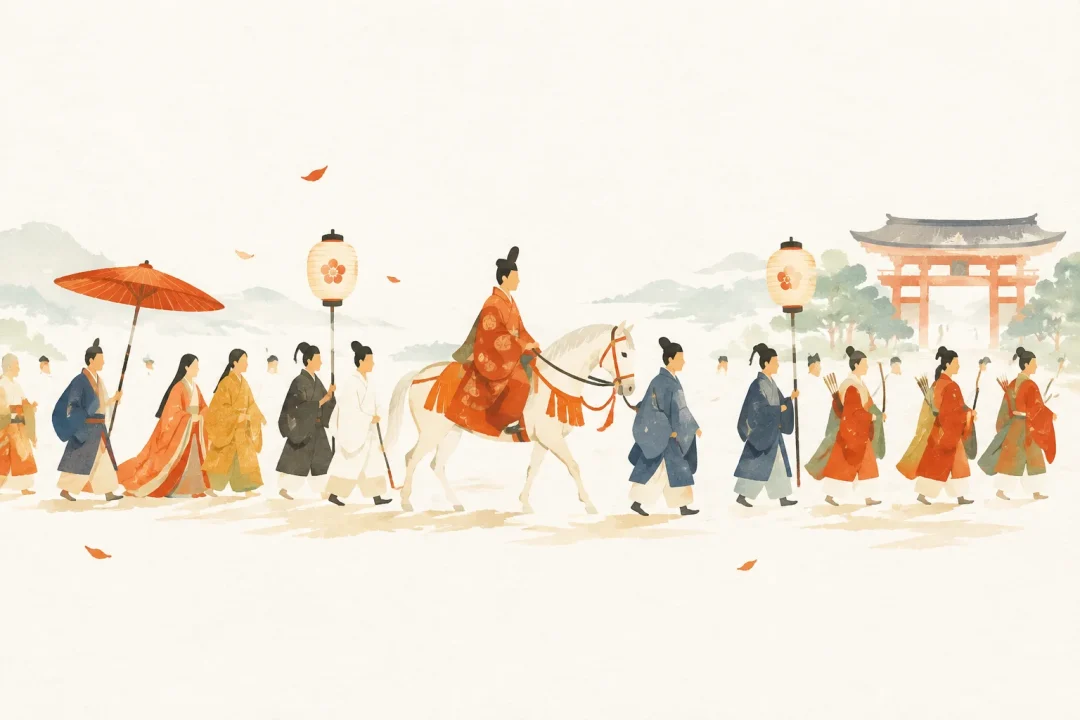
During the procession from the , there are moments when a monkey, a red horse, and a black horse lead the parade.
Iga’s traditional dance from Yamabata, adorned with kakko drums and floral decorations
What to expect
Five performances are dedicated as part of the Shinto ritual dance: Shiki-iri, Omiyamairi, Kamiyaku-odori, Hidari-mai no Shiki-iri, and Tsushima-odori.
Each role handles a different sound or movement: the naka-odori dancers perform while beating kakko drums, the uta-dashi singers sing, and the gaku-uchi musicians play the large drum.
Delicate gestures can also be seen, such as the tachi-utai dancers performing with fans and the gaku-uchi musicians twirling their drumsticks.
How to take part
Visitors can watch the event.
Location and access
- Venue and address
Katsute Shrine (482 Yamabata, Iga, Mie)
- Train and bus
It is about 15 minutes by car from Shindo Station on the JR Kansai Main Line.
- By car
It is about 10 minutes from the Mibuno IC on the Meihan National Highway.
Address 482 Yamabata, Iga, Mie 519-1421
Dates and season
2026 event information (the listed dates have passed)
In 2026, the event was held on October 11 (Sun.), with the shinji odori scheduled to begin at 2 p.m.
In a typical year, it is dedicated on the 2nd Sunday of October.
Accommodation and hotels PR
Showing nearby accommodation.
Prices and availability are current at the time of retrieval. For multi-night stays, only the first night’s price is shown. Confirm the final price and directions to the venue with the booking provider. Select your dates again when using the area search link. Search area: within 3 km of Central Mie Prefecture / Iga City (the search is not centered on the festival venue)
Tips for your visit
Before the Shinto ritual dance, a procession called the “Owatari” travels from the otabisho to Katsute Shrine, covering a route of about 1 km.
A kagoma and a monkey may approach spectators along the route, so watch from a spot that does not obstruct the procession.
The program may change or be canceled due to weather or other circumstances, so it’s a good idea to check the situation on the day before setting out.
Source: 勝手神社の神事踊 | 特集 | 伊賀ポータル
Nearby attractions
Places listed near the venue include the Mibuno Castle Ruins, Kasuga Shrine, the Nishizawa Japanese iris colony, and Narizuka Kofun.
The straight-line distances from Katsute Shrine are 2.0 km to the Mibuno Castle Ruins, 2.3 km to Kasuga Shrine, and 2.5 km to the Nishizawa Japanese iris colony.
If you plan to visit other places along with the festival, check each facility’s opening status and conditions of use individually.

上野城
三重県伊賀市に存在した城
写真:The original uploader was T@ka at Japanese Wikipedia . / CC BY-SA 3.0
Photo source ·
伊賀流忍者博物館
三重県伊賀市にある忍者の博物館

敢國神社
三重県伊賀市一之宮にある神社

芭蕉翁記念館
三重県伊賀市の上野公園にある記念館
Origins and History of Shinto Ritual Dance at Katsute Shrine
The Shinto ritual dance at Katsute Shrine is described as similar to the Furyu-odori dances that were popular from around the middle of the Edo period.
It was designated an Intangible Folk Cultural Property of Mie Prefecture in 1963 and an Intangible Folk Cultural Property Requiring Measures Such as Documentation by the national government in 1971, before becoming an Important Intangible Folk Cultural Property of Japan in 2018.
In 2022, it was approved for inscription on UNESCO’s Intangible Cultural Heritage list as one of the “Furyu-odori” dances.
Official information
The 2026 event information is available on the Kanko Mie event page.
The page provides venue information for Katsute Shrine, event times, travel information, and contact details.
An information page from the Iga City Tourism Association is also listed as the official URL.
Shinto Ritual Dance at Katsute Shrine at a Glance
The Shinto ritual dance at Katsute Shrine is a kanko dance handed down in Yamabata, Iga, where kakko drums, a large drum, singing, and vivid Ochizui decorations come together in a traditional performing art.
In 2026, the dance will be dedicated at Katsute Shrine from October 11 at 2 p.m.
The procession featuring a monkey, a red horse, and a black horse is another highlight, and visitors can see up close a dance associated with both Japan’s Important Intangible Folk Cultural Property designation and UNESCO’s Intangible Cultural Heritage listing.
Japanese Festivals.jp Editorial Team
Celebrating local culture and helping you discover a side of Japan you never knew.
Article updated: 2026/10/19
Submit information or a correction Submit photos of this festival