Entrusting gratitude for the harvest to a straw snake: Kōjin worship in Izumo and Hōki
Kōjin Festival of Izumo and Hōki
Festival information
EVENT INFORMATION- Season / frequency
- Usually held around November through December each year / Every year
- Area
- Tottori Prefecture・伯耆地方,出雲 region(From Tokyo: approx. 1 h 15 min–1 h 30 min · flight time only)Prefecture-level estimate to a main station or airport, not the venue. Airport access, check-in and onward travel are extra; remote areas and islands can take much longer.
- Highlights and activities
- Wishes behind the festival
- Last updated
- 2026/11/12
The Kōjin Festival of Izumo and Hōki is a folk event spanning Shimane and Tottori prefectures, in which giant straw snakes and bundles of ritual paper streamers are offered to Kōjin in gratitude for the harvest. Names and practices vary by area.
About Kōjin Festival of Izumo and Hōki
The Kōjin Festival of Izumo and Hōki is an event to thank Kōjin for that year’s harvest.
In Izumo, it is called “Kōjin Matsuri,” while in Hōki it is called “Mōshiage,” among other names. The event has been passed down across parts of Shimane and Tottori prefectures.
It is held mainly after the harvest, around November through December.
Festival highlights
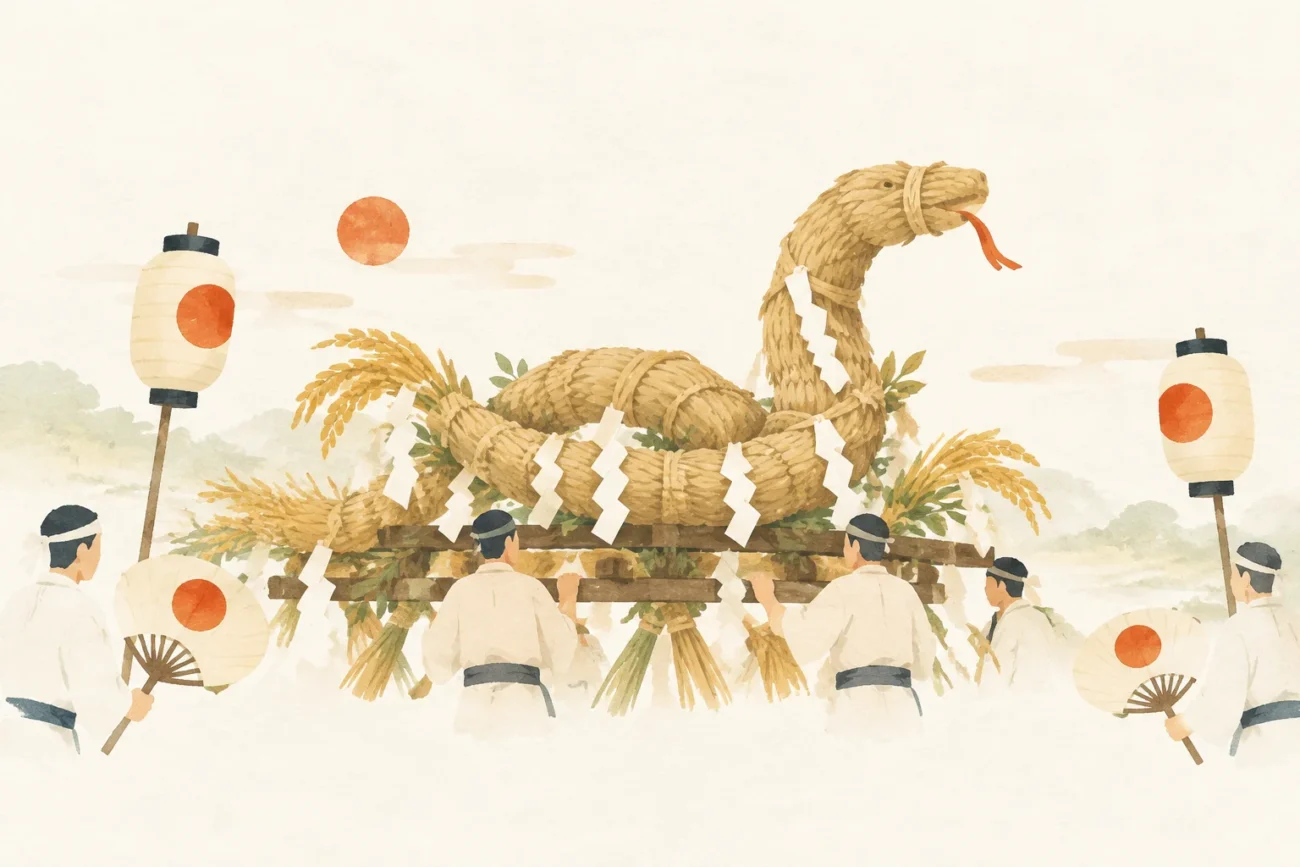
A hallmark of this event is the making of a giant straw snake and a large number of bundles of ritual paper streamers.
The straw snake is often wrapped around a tree dedicated to Kōjin or offered on a stone or other object, with bundles of ritual paper streamers inserted around it or into the straw snake.
In some areas, people also use the event to predict the next year’s harvest or hide the straw snake.
Entrusting gratitude for the harvest to a straw snake: Kōjin worship in Izumo and Hōki
What to expect
The event begins with the making of a giant straw snake and a large number of bundles of ritual paper streamers.
Afterward, the straw snake is wrapped around a tree dedicated to Kōjin or offered on a stone or other object, with bundles of ritual paper streamers inserted around it or into the straw snake.
In some areas, people also predict the next year’s harvest or hide the straw snake.
Location and access
- Address
Hōki region, Izumo region
Host municipality 鳥取県伯耆地方,出雲 region
This map shows the surrounding area, not the exact venue location.
Dates and season
- Season
Usually held around November through December each year
- Frequency
Every year
Tips for your visit
This is a widespread folk event spanning Shimane and Tottori prefectures, with practices that vary by area.
If you plan to visit, please check with the relevant municipal board of education or another appropriate office for details about whether the event is being held.
Origins and History of Kōjin Festival of Izumo and Hōki
The Kōjin Festival of Izumo and Hōki is an event that carries on Kōjin worship associated with gratitude for the harvest.
It was designated an intangible folk cultural property on March 11, 2009 and is classified as an intangible folk cultural property for which measures such as documentation should be undertaken.
In Heisei 26, the Agency for Cultural Affairs produced videos titled “Kōjin Festival of Izumo” and “Kōjin Festival of Hōki” in March.
Official information
The Agency for Cultural Affairs’ Cultural Heritage Online lists the Kōjin Festival of Izumo and Hōki as an intangible folk cultural property.
The designation date is March 11, 2009, and no preservation group has been identified.
Kōjin Festival of Izumo and Hōki at a Glance
The Kōjin Festival of Izumo and Hōki is a folk event spanning Shimane and Tottori prefectures, in which Kōjin is worshipped in gratitude for the harvest.
It is characterized by the making of a giant straw snake and bundles of ritual paper streamers, which are offered on trees or stones.
Known as Kōjin Matsuri in Izumo and Mōshiage in Hōki, among other names, it is held mainly from November through December.
Japanese Festivals.jp Editorial Team
Celebrating local culture and helping you discover a side of Japan you never knew.
Article updated: 2026/11/12