What’s the difference between mikoshi, dashi, and yatai? A guide to the names to know before watching a festival
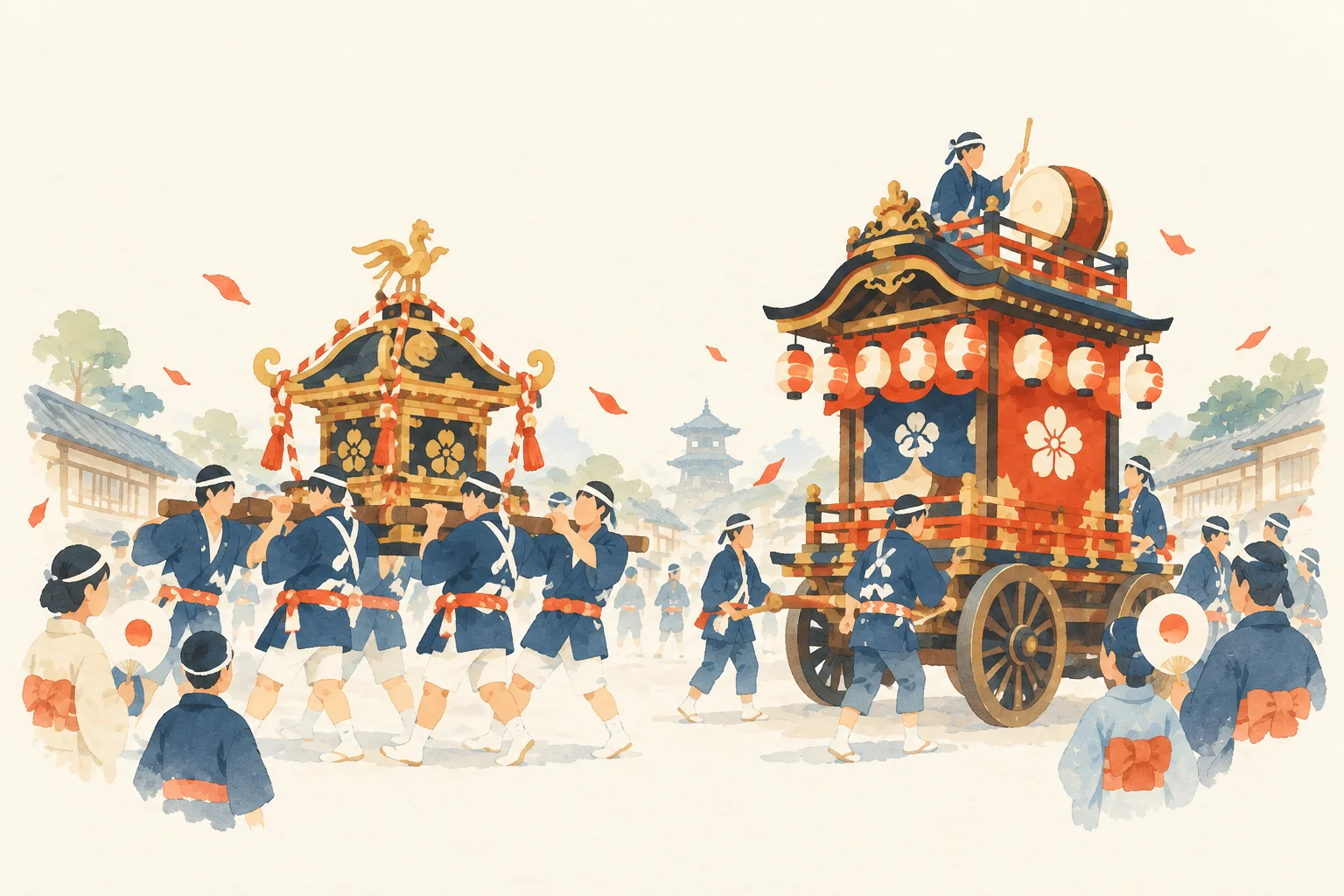
“,” “,” and “”—words often seen in festival guides. They may look similar in that they are large, decorated structures moving through town, but they do not necessarily mean the same thing. Knowing a few names makes it easier to find the festival you want to see in search results, and helps you notice the decorations and people’s movements when you’re there. We recommend first learning the broad differences, then checking the terms used by that particular festival.
Think of a mikoshi as something that welcomes the deities
To understand a mikoshi, focus on its role rather than how it is carried. At Yasaka Shrine’s Gion Festival, the deities enshrined in each mikoshi are introduced. A mikoshi is more than a beautiful conveyance with a roof and metal fittings; it is part of a Shinto rite in which the deities are welcomed and taken through the town. (Yasaka Shrine, “Introduction to Mikoshi and Hoko Floats, and Procession Map”)
If you classify mikoshi only by whether people carry them on their shoulders, you’ll encounter exceptions. Since the way they move and their scale differ from festival to festival, don’t decide what to call one based only on whether it has wheels. If the official guide mentions “,” “Shinkō-sai,” or “Kankō-sai,” it helps to read about where the rite goes from and to as well.
Dashi offer a way to appreciate design, festival music, and teamwork
At the Kawagoe Festival, dashi carrying dolls travel through town, and the highlight is hikKawase, a musical face-off between the festival ensembles. As a spectator, there are many things to look at: the overall shape, dolls, curtains, musicians, and people pulling the float. What’s interesting is that, beyond comparing them with mikoshi, you can enjoy the unique design of each float. (Kawagoe Festival Official Website, “Overview and History”)
Even among things described as types of “dashi,” local terms such as hoko, yama, and are used in different regions. Once you’ve learned the broad categories, using the name specific to your destination makes it easier to understand venue guides and local explanations.
At festivals, “yatai” doesn’t always mean a food stall
The yatai featured at the Takayama Festival are not food stalls. The term refers to ornate festival floats, admired for their mechanical dolls and decorations. Adding terms such as “Takayama Festival yatai hiki-soroe” or “festival yatai” to your search can help keep results separate from food-related information. (Hida Takayama Travel Guide, “How to Enjoy the Takayama Festival”)
| A term you found in a guide | What to check next |
|---|---|
| Mikoshi | The enshrined deities, the route of the procession, and the times of the rites |
| Dashi, hoko, and yama | The local name, participating neighborhoods, decorations, and festival music |
| Festival yatai | Is it a festival structure or a food stall? |
| Yamakasa | Whether it is a kazari yamakasa or a kaki yamakasa |
If you’re unsure about a term, check the official website’s glossary
The official Hakata Gion Yamakasa website explains terms such as kaku, nagare, omote, and miokuri. Rather than looking up unfamiliar words only in a general dictionary, reading the festival’s own official explanations helps connect them to what you’ll see there. (Hakata Gion Yamakasa, “Yamakasa Glossary”)
You don’t have to memorize everything from the start. For the festival you plan to see, learn the name of one type of structure and one main event. Even that can turn the memory of “something big passing by” into the more specific pleasure of remembering “the doll on that town’s dashi was impressive.”
Official information consulted
- Yasaka Shrine, “Introduction to Mikoshi and Hoko Floats, and Procession Map”
- Kawagoe Festival Official Website, “Overview and History”
- Hakata Gion Yamakasa, “Yamakasa Glossary”
- Hida Takayama Travel Guide, “How to Enjoy the Takayama Festival”
This article is based on publicly available information from official sources, local governments, tourism associations, and others. Information checked: 2026/10/01. Please check the official information for the year you plan to visit for dates, venues, traffic restrictions, and participation requirements.
